

TL;DR
- When to move to co-managed IT: adopt it when coverage, compliance, or security gaps outpace internal capacity.
- Co-managed IT preserves internal control while adding senior engineering, 24/7 monitoring, and enterprise-grade backup.
- Look for measurable signals: audit failures, rising incidents, inconsistent backups, vendor overload, or RFP security requirements.
- Use a short validation audit (patch rate, backup success, mean time to detect) and a transition checklist before onboarding an MSP.

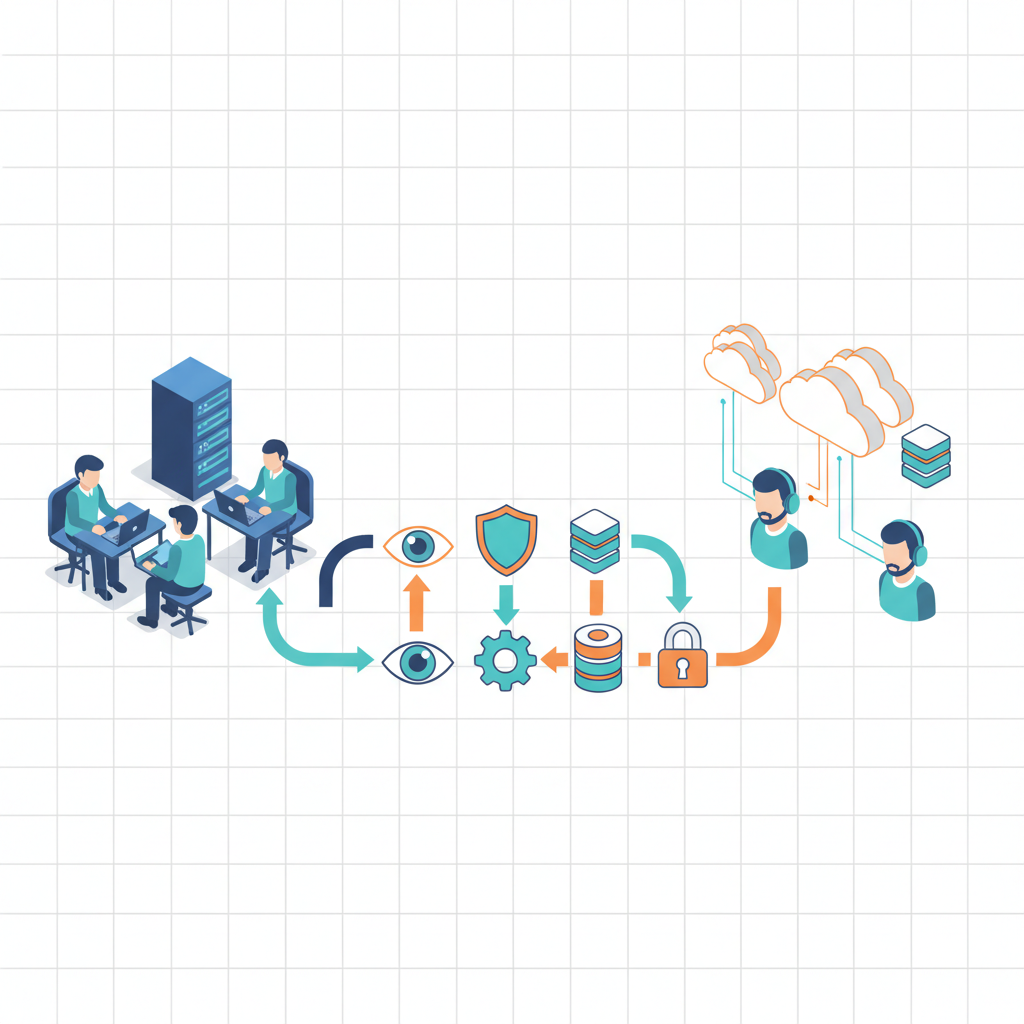
Quick summary — who should consider co‑managed IT (TL;DR for executives)
If you run a regulated New Jersey or New York company and you ask "when to move to co-managed IT," the short answer is: when internal IT lacks either capacity or specific compliance and security expertise required by your sector. Co-managed IT blends your in-house team with external senior engineers and 24/7 monitoring so you keep operational control while outsourcing gaps. For example, a mid-sized medical practice that must meet HIPAA audit trails but lacks a full-time security engineer should consider co-managed IT to hold compliance evidence under your control while outsourcing monitoring and incident response.
For regulated NJ & NY businesses, co‑managed IT reduces audit risk while keeping key compliance controls under your organization's control.
What is co‑managed IT? (definition and how it differs from fully outsourced or in‑house)
Co‑managed IT is a hybrid support model where your in-house IT staff and an external managed service provider (MSP) share responsibilities. Unlike fully outsourced IT, you retain control of strategy, proprietary systems, or specialized workflows. Unlike purely in‑house teams, you gain access to senior engineers, enterprise tools, and 24/7 monitoring. A quotable definition: "Co‑managed IT combines your internal IT ownership with external senior-engineer support and continuous monitoring." For more on this, see Co-managed vs in-house it nj.
Concrete example: your internal team continues to own ticket triage and business-specific apps, while the MSP runs advanced security tooling (EDR, SIEM), performs threat hunting, and manages backups. This maps directly to a regulated business IT strategy: you centralize policy and evidence internally while the MSP supplies scale and specialist capabilities.
When NOT to move to co‑managed IT
Co‑managed IT isn't right for every organization. Don't pursue it when: (1) You already have a complete senior security and operations team with spare capacity; (2) Your systems are few, static, and low-risk with no regulatory obligations; (3) Your budget cannot cover predictable managed services or you need an immediate single‑vendor liability shift (in which case full outsourcing may be better); (4) You require custom in-house proprietary development that external access would meaningfully disrupt. If any of these apply, keep focusing on strengthening internal capabilities or consider a full MSP engagement instead.
10 operational and risk signals that indicate it's time to move to co‑managed IT
This list groups practical co-managed it signs you can measure. Each signal below includes a concrete threshold or artifact to validate the problem and a short example relevant to regulated business it strategy in NJ & NY. For more on this, see Co-managed it nj ny.
Signal 1 — 24/7 coverage gaps and escalating on-call costs
If incidents occur outside business hours and your team pays overtime or rotating on-call consultants frequently, that's a clear sign. Validate with: number of after-hours incidents per quarter > 5, average on-call hourly rate > internal budgeted rate by 30%, or mean time to acknowledge (MTTA) > 60 minutes after hours. Example: a county healthcare provider in NJ faced ambulance-route scheduling downtime twice in a month; co‑managed monitoring reduced night MTTA to under 15 minutes in comparable cases.
Signal 2 — inability to meet regulatory audit evidence and compliance timelines
If you miss audit deadlines for NY DFS 23 NYCRR 500, HIPAA, PCI, or state breach reporting, it's time to act. Concrete artifacts: incomplete audit logs, missing access reviews, or backup retention gaps. For example, a small NY financial services firm could not produce SIEM logs for a quarterly audit — co‑managed IT fills that gap while leaving control of policy and attestations with internal teams.
Signal 3 — rising security incidents or lack of senior security engineering
A rising incident count, repeated phishing compromises, or no staff with security engineering experience indicate need. Measure: incident rate month-over-month > 20% increase, or no staff with CISSP/experience in endpoint/Network detection. Co‑managed work brings senior engineers and threat hunting without replacing your team.
Signal 4 — inconsistent patching and backup reliability
Look for patch compliance under 90% on critical assets or backup success below 95% over 30 days. Concrete thresholds: critical patch coverage >90% within 30 days, backup verification success >99% for business-critical VMs. Example: a Jersey City clinic discovered backups failed for a billing VM; a co‑managed approach enforces scheduled patching and daily backup verification.
Signal 5 — cost spikes from emergency break/fix vs predictable SLAs
If emergency tickets dominate spend and yearly IT costs are unpredictable, track the percentage of spend on break/fix (target <30% of total IT spend). When break/fix exceeds that, a co‑managed SLA model can convert volatile spending into predictable monthly costs.
Signal 6 — need for advanced tools (EDR, SIEM) without internal expertise
Advanced security tooling requires tuning and senior oversight. If you have tools but lack a tuning and response plan, measure tool health: SIEM rule coverage, false positive rate, and EDR agent deployment at 100% with quarterly tuning. Co‑managed models supply tools plus senior‑engineer-led tuning and hunting.
Signal 7 — staff turnover and knowledge continuity risks
High turnover in IT creates continuity problems. Track knowledge continuity: documentation coverage <80% or single-person ownership of critical systems. Co‑managed IT creates redundancy in skill and documented runbooks to protect operations during turnover.
Signal 8 — scaling IT for mergers, growth, or remote work
Rapid headcount growth, an acquisition, or mass remote onboarding spikes provisioning needs. Validate with onboarding time >2 days per user or project delays tied to IT capacity. A co‑managed partner scales provisioning, identity, and remote access support without long hiring cycles.
Signal 9 — vendor management and third‑party risk overload
If vendor integrations multiply and your team cannot track security posture for each third party, measure vendor assessments outstanding >10 or contract renewal support requests missed. Co‑managed IT helps centralize vendor control and third‑party risk checks while you keep contract decisions internal.
Signal 10 — pressure to improve security posture for contracts / RFPs
RFPs or contracts that require higher security attestations (SOC reports, evidence of EDR/SIEM) signal a need. Track lost deals citing security concerns or RFP compliance items failed. Co‑managed IT helps you meet those requirements quickly by adding tooling and evidence collection.
Co‑managed IT keeps your control of policy while external engineers deliver tooling, monitoring, and incident response.
Measure readiness with three KPIs: patch coverage, backup verification, and mean time to detect (MTTD).
How to validate the signal with simple internal audits and KPIs
Run a 1–2 week validation audit using three focused KPIs and artifacts: (1) patch and configuration audit — generate a report showing critical patch coverage; threshold: >90% for compliance; (2) backup verification — list last 30 daily backup results and successful restore tests for two sample VMs; threshold: >95% success; (3) detection and response metrics — average MTTD and MTTR for the last quarter. Use these artifacts when deciding "should my business hire an MSP" and to scope a co‑managed engagement.
| Before (internal) | After (co‑managed) |
|---|---|
| Patch rate: ad hoc, often <80% | Patch rate: measured, >90% within 30 days |
| Backups: occasional failures, no test restores | Daily verified backups, monthly restore tests |
| Security: no SIEM/EDR tuning | EDR + SIEM with senior‑engineer tuning and hunting |
First steps to transition: evaluation checklist and stakeholder plan
Start with a short evaluation and a stakeholder plan. Checklist (copyable):
- Inventory: list critical systems, data classifications, and owners (documented).
- Compliance map: match systems to NY DFS 23 NYCRR 500, HIPAA, PCI, or NJ breach rules.
- Baseline KPIs: patch coverage, backup success, MTTD, MTTR.
- Define responsibilities: keep policy/attestations internal; outsource monitoring, escalation, and tooling management.
- Procurement notes: capture RFP/security requirements and requested evidence artifacts.
Stakeholder plan: involve IT lead, compliance officer, legal, and procurement. Run a 30‑60 day pilot where the MSP supports monitoring and incident response while your team retains change approvals. This answers "should my business hire an MSP" by showing results before a larger contract.
Local considerations for NJ & NY: compliance, vendors, and procurement tips
Local compliance and procurement matter. For financial services, reference NY DFS 23 NYCRR 500 controls and be ready to show log retention and incident reporting. For healthcare, prepare HIPAA audit artifacts and breach notification plans. New Jersey breach laws require timely notification and documentation. Procurement tips: county and state RFPs often expect documented vendor qualifications and references; structure your RFP to request a co‑managed pilot and evidence of tooling (EDR, SIEM) and senior‑engineer availability. Quotation: "Local RFPs favor teams that demonstrate measurable security controls and documented incident response."
Conclusion — decision framework and next-step call to action (free assessment)
Decision framework: if two or more co‑managed it signs above apply and your baseline KPIs fall short (patch coverage <90%, backup success <95%, MTTD >24 hours), move to a co‑managed model. That gives you hybrid IT benefits in NJ and NY: stronger security posture, predictable costs, and retained control over compliance evidence. If you want to explore a pilot or free assessment, review our services and get an evaluation of your current KPIs. For direct outreach, contact us, visit contact us for company background, or use contact us to request a demo and next steps. For a managed demo, see our services.
FAQ
- When should a regulated NJ or NY business move to a co‑managed IT model? — A regulated NJ or NY business should move to co‑managed IT when operational gaps (coverage, security, backups) and failed audit evidence persist despite internal efforts, or when RFPs and contracts require higher security posture.
- How does a co‑managed IT model work? — A co‑managed IT model shares responsibilities: your organization retains policy, ownership, and compliance attestations while the MSP provides senior engineering, 24/7 monitoring, advanced tooling (EDR, SIEM), and incident response under agreed SLAs.