
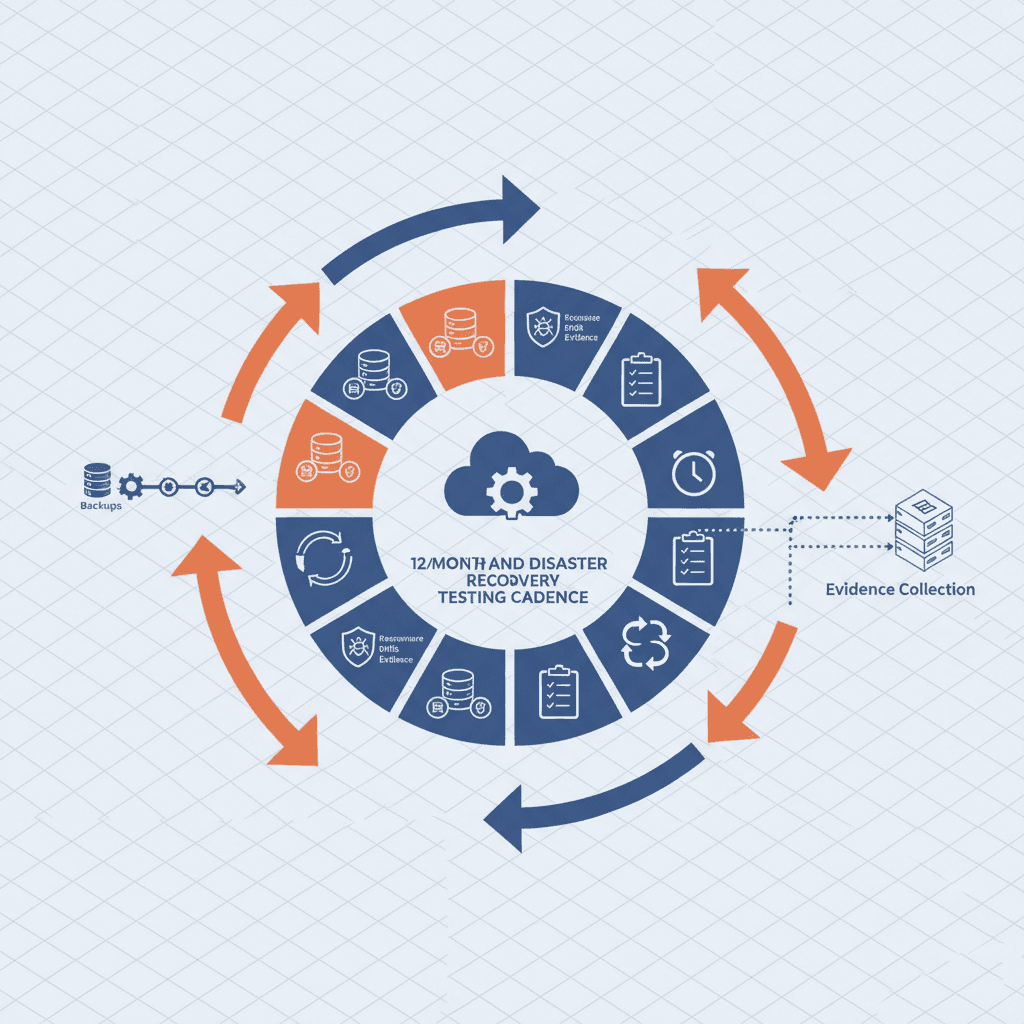
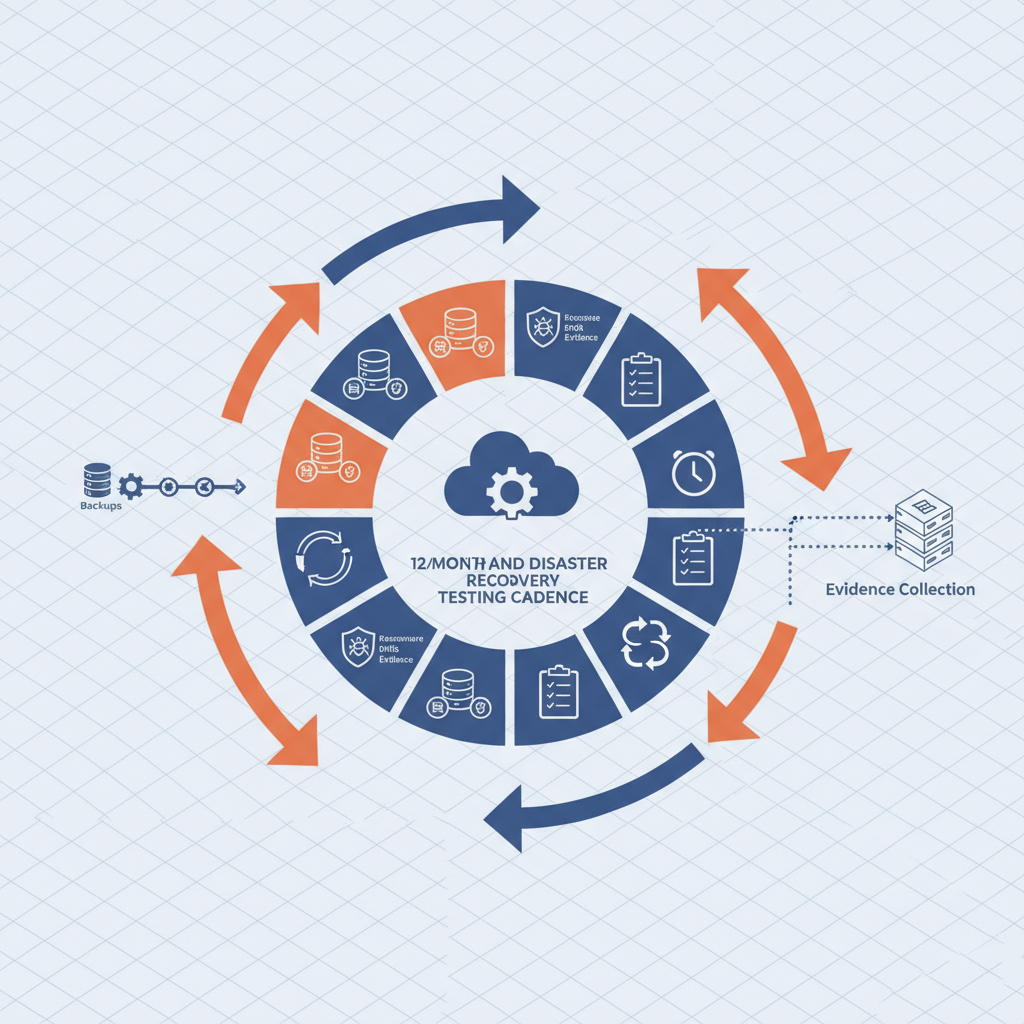
What is the backup & disaster recovery testing schedule for NJ & NY SMBs to minimize ransomware downtime?
SMBs should validate backups through automated daily checks, monthly restores, quarterly failovers, and an annual full DR run to ensure ransomware recoverability. This schedule balances operational risk, regulatory expectations in New York and healthcare compliance, and the practical constraints of small IT teams.
Below is a practical, step-by-step guide to building a repeatable backup testing schedule for NJ & NY SMBs, with concrete examples, a reusable backup verification checklist, a sample 12-month calendar, and how an MSP/MSSP can augment your program.
Introduction — why regular backup and DR testing is essential against ransomware
Without testing, backups are assumptions, not insurance. For New Jersey and New York small and midsize businesses, a documented backup testing schedule reduces ransomware downtime, satisfies insurer requirements, and provides evidence for regulators such as NYDFS when applicable. For more on this, see Prevent ransomware nj ny.
Start by defining measurable outcomes: a recovery time objective (RTO) and a recovery point objective (RPO) per system. For many SMB SaaS-adjacent sites and servers, a useful starting rule is: aim for an RTO under 8 hours for core systems and an RPO under 4 hours for transactional databases. That target should be adjusted per business needs and industry rules.
Quotable definition: "A backup testing schedule is a documented cadence of automated and manual tests that prove data recoverability within defined RTO and RPO targets."
Who this is not for
This guide is not for organizations that already run continuous active-active replication across regions with verified SLA-backed failover, nor for businesses whose data retention and recoverability are governed by specialized platforms that prohibit offline testing. Do not apply these steps if you cannot snapshot production data for compliance reasons; instead, engage a specialist to design a compliance-safe test harness. Also, if you lack access to any immutable or offsite backup copies, do not perform full-site failovers without prior coordination with your backup vendor or MSP.
Types of recovery tests
Restore verification
Restore verification proves that backup files are readable and usable. Automated verification runs daily or weekly: checksum validation, backup catalog reconciliation, and a random file restore of critical files. For example, verify yesterday's nightly image by restoring a representative application config and confirming its checksum and timestamp. This directly supports a backup verification checklist and forms the first line of defense against silent backup corruption.
Full failover
A full failover launches systems in a separate environment from backup images and tests end-to-end business functions. Perform a full-site failover at least annually; medium-risk SMBs should run partial failovers quarterly. During a failover, validate authentication, database integrity, and payment processing. Record RTO and RPO achieved and compare to target thresholds in your rpo rto guidance for smbs.
Table-top exercises
Table-top exercises simulate incident response and decision-making without touching production. Include stakeholders from IT, legal, operations, and finance. Run ransomware recovery drills during these exercises to validate communications, third-party contact lists, and insurance notifications. Table-top drills should happen at least twice a year for regulated SMBs. For more on this, see Ransomware preparedness nj ny.
Daily automated checks find silent failures; monthly restores prove human-run recoveries; quarterly failovers test process and people.

Setting RTO/RPO targets for regulated NJ & NY SMBs
Set RTO and RPO per application and regulation. Use concrete thresholds: transactional databases (RPO < 1 hour, RTO < 4 hours), email & collaboration (RPO 4–24 hours, RTO 4–24 hours), archives and backups (RPO 24+ hours, RTO 48+ hours). These numbers are starting points for rpo rto guidance for smbs; adjust after business-impact analysis.
Industry examples:
- Healthcare (HIPAA): protect ePHI with daily verification and monthly restores; record immutability and retention matching required retention policies.
- Finance: transaction systems require sub-hour RPOs and rapid RTOs; test restores weekly for transaction logs.
- Legal: client files may tolerate longer RTOs but require strict chain-of-custody evidence for restored materials.
New York insurance and NYDFS guidance expect demonstrable recoverability and immutable copies. Store air-gapped or immutable snapshots in a geographically separate location (keep NJ/NY proximity in mind—avoid storing all copies within the same metro flood/utility zone).
Recommended testing cadences
Use a layered disaster recovery testing cadence to balance cost and confidence. Here’s a practical cadence to adopt immediately:
- Daily: automated backup verification (catalog match, checksum) and alerting.
- Weekly: restore verification of a handful of files or service components; validate database transaction logs (log shipping checks).
- Monthly: full VM or application restores to an isolated environment, run sanity checks, and update documentation.
- Quarterly: partial failover for critical services (email, core database) including a planned DNS cutover test and business-process validation.
- Annual: full-site DR run that brings all critical systems online in a DR environment and exercises staff roles end-to-end.
These elements form your disaster recovery testing cadence and should be part of automated runbooks where possible. For many SMBs, baas testing nj ny with a managed provider makes it feasible to run monthly restores and quarterly failovers without hiring full-time staff.
SMBs should validate backups through automated daily checks, monthly restores, quarterly failovers, and an annual full DR run to ensure ransomware recoverability.
Step-by-step restore test playbook
Pre-test checklist
- Identify scope and test window; notify stakeholders and change control.
- Confirm immutable/air-gapped copy exists and is accessible.
- Snapshot current production configs and export live logs for comparison.
- Prepare isolated test network to avoid accidental DNS or mail sprawl.
Validation criteria
- Pass: services boot within target RTO and data restores within target RPO; application smoke tests pass (login, read/write, report generation).
- Fail: missing data, corrupted files, or services that don't reach expected performance levels.
- Metrics to record: restore time, data loss window, test operator actions, and ticket identifiers.
Rollback plan
Always have a rollback plan: re-point DNS to production, destroy test environment, and document differences. If the test touches live systems, ensure backups of changed configs before rollback.
Evidence collection for insurance and regulators
Collect structured evidence during every test: logs, screenshots, test reports, and a signed validation checklist. Maintain a test-run archive that includes:
- Automated verification logs (daily checksum and catalog records)
- Restore session recordings or screenshots with timestamps
- Test report showing RTO/RPO achieved and variance vs. targets
- Change control ticket and stakeholder sign-off
Insurers and regulators often request chronological evidence of recoverability. For NY-regulated firms, retain test artifacts according to NYDFS guidance; include chain-of-custody notes when tests involve ePHI or financial records.
Automating verification & reporting with BaaS/DRaaS
BaaS and DRaaS platforms can automate verification, schedule restores, and generate compliance-ready reports. When evaluating vendors, look for automated daily checksum verification, API access to test results, and immutable snapshot support. Use "baas testing nj ny" as a procurement requirement to ensure providers can run regional tests and store copies outside the immediate metro area.
Automated reporting should produce:
- Daily health summary emails
- Monthly restore reports with timestamps and operator notes
- Quarterly failure-mode analysis from failover tests
Sample 12-month testing calendar and templates for SMBs
Below is a compact, copy-ready 12-month calendar. Replace items with your actual systems and stakeholders.
| Month | Activity | Notes |
|---|---|---|
| Jan | Monthly restore + verify backups | Database subset restore |
| Feb | Daily automation check review | Resolve alerts |
| Mar | Quarterly partial failover | Email + auth tests |
| Apr | Monthly restore | File servers |
| May | Ransomware recovery drill (table-top) | Legal + Ops participation |
| Jun | Quarterly partial failover | DB + web front-end |
| Jul | Monthly restore | Backup catalog reconciliation |
| Aug | Daily automation review | Security posture check |
| Sep | Quarterly partial failover | Payment processing |
| Oct | Monthly restore | Archives |
| Nov | Annual full-site DR run | End-to-end validation |
| Dec | Document updates and evidence archive | Prepare insurance packet |
How an MSP/MSSP can run or augment testing programs
An MSP or MSSP can run automated daily checks, schedule monthly restores in isolated environments, and operate quarterly failovers to cut your operational overhead. Eighty Seven Solutions' managed approach includes 24/7 monitoring and senior-engineer-led support that can perform baas testing nj ny on your behalf and produce insurer-ready reports. Engaging an MSP reduces coordination burden and brings practiced runbooks for ransomware recovery drills and disaster recovery testing cadence planning.
Conclusion — next steps and audit-ready documentation
Adopt a clear disaster recovery testing cadence now: daily automated checks, monthly restores, quarterly failovers, and an annual full-site DR run. Document every test, preserve logs/screenshots, and store immutable copies outside the local NJ/NY utility zone. Use the backup verification checklist above and the 12-month calendar as a template for your team.
For help designing a schedule aligned to your RTO and RPO targets and to run baas testing nj ny, review our services or request a demo at our services. To discuss specifics, contact us, visit the main site at contact us, or learn more about the team at contact us.
FAQ
What is backup & disaster recovery testing schedule for nj & ny smbs to minimize ransomware downtime?
A backup & disaster recovery testing schedule for NJ & NY SMBs is a documented cadence of automated checks, scheduled restores, failover tests, and table-top drills that proves recoverability within defined RTO and RPO targets.
How does backup & disaster recovery testing schedule for nj & ny smbs to minimize ransomware downtime work?
The schedule works by combining automated daily verification with manual monthly restores, quarterly failovers, and an annual full DR run to validate backups, exercise people and processes, collect evidence for insurers/regulators, and adjust RTO/RPO targets based on measured outcomes.