

TL;DR
- Choosing between in-house and outsourced technology management hinges on control, cost drivers, and strategic priorities.
- In-house suits firms needing tight integration and IP control; outsourcing suits firms that prioritize speed, predictable operating costs, and external expertise.
- Use the decision checklist and comparison table below to run a quick cost comparison and select the best technology management option for your business.

What you need to know
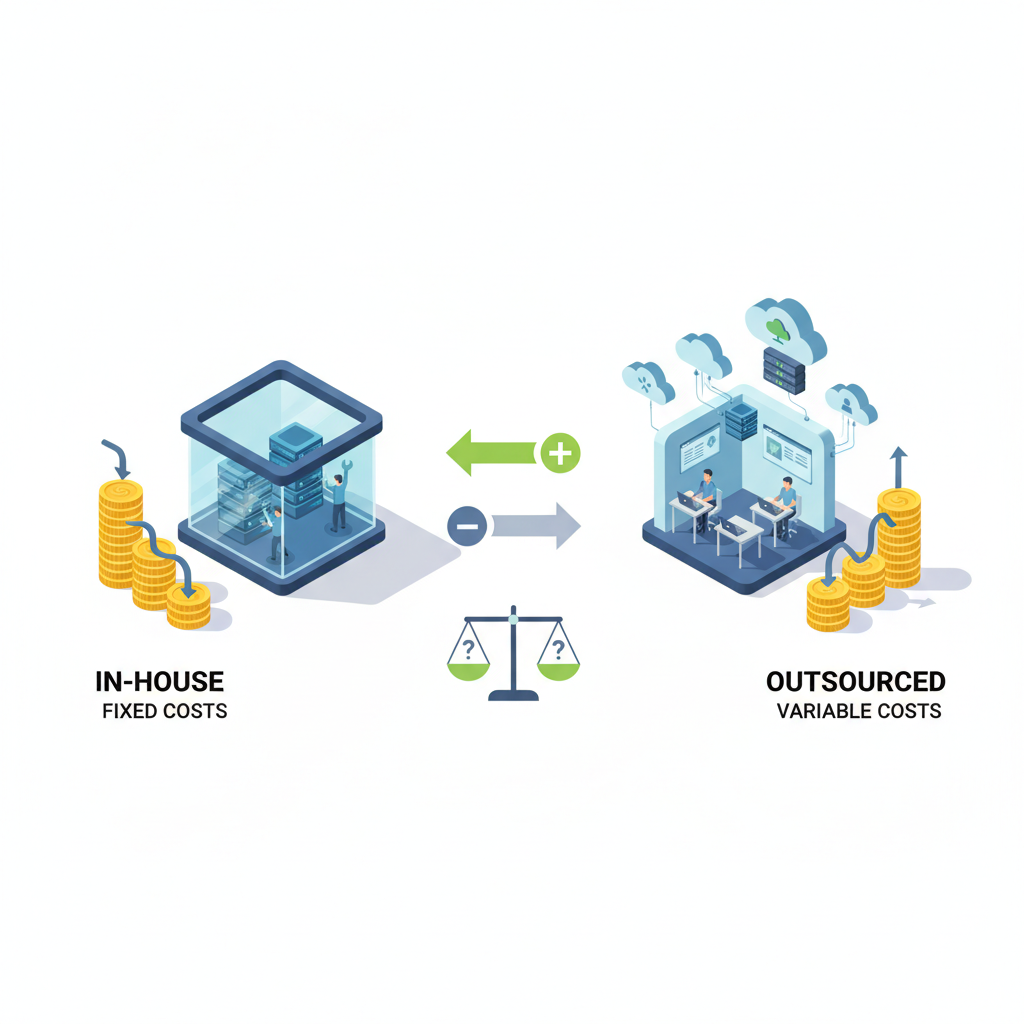
If you’re weighing in-house vs outsourced technology management, start with one clear distinction: in-house keeps capability inside your organization; outsourcing moves execution and some governance to an external provider.
This article explains core concepts, compares common technology management options, and gives practical decision rules you can use today. You’ll find concrete examples, a cost comparison framework, and two reusable artifacts: a decision checklist and a side-by-side comparison table.
Key concepts
- In-house management: Your teams hire, run, and maintain systems. You own IP and day-to-day decisions.
- Outsourced management: A third-party provides and operates services under contract, often with SLAs and fixed monthly pricing.
- Hybrid approaches: Combine in-house strategy and vendor-operated infrastructure, or keep core systems in-house and outsource commodity tasks.
Decide based on the work you must protect: protect strategic IP in-house, outsource routine ops for steady cost.
Practical framing: treat the choice as a portfolio decision, not an all-or-nothing bet. Many firms split responsibilities: product engineering and strategy stay internal, while monitoring, backups, and cloud infrastructure are outsourced or managed through cloud vendors. For more on this, see Choosing managed IT services guide.
Outsourcing transfers execution risk, not strategic responsibility.
How it works
This section explains the typical process for evaluating and implementing each technology management option, then lays out a step-by-step decision method you can use right away.
Process overview
Both in-house and outsourced models follow a lifecycle: assess requirements, select people or providers, onboard systems, operate, and iterate. The difference is who supplies the people, tools, and operational discipline.
- Requirements — Define performance, security, compliance, and integration needs.
- Selection — Hire staff or procure a managed service.
- Onboarding — Transfer knowledge, set up monitoring, and establish escalation paths.
- Operation — Day-to-day runbook execution, incident response, and patching.
- Governance — Reporting, audits, KPIs, and contract reviews.
Step-by-step decision method
Use this 6-step checklist as a practical decision rule. If you hit three or more thresholds favoring one model, prefer that model.
- List mission-critical systems and mark those with IP sensitivity (yes/no).
- Estimate annual TCO for internal teams (salary, benefits, tools, training) and for vendor alternatives.
- Set performance thresholds: for typical SaaS apps, target P95 response times under 200ms; for batch jobs, set RPO < 4 hours if data is critical.
- Rate compliance needs: if regulations require on-site control or specific audits, score high for in-house.
- Assess hiring capacity: if you cannot hire skilled staff in 3–6 months, outsourcing gains points.
- Decide a hybrid split: keep high-score IP systems in-house; outsource low-score operational tasks.
When internal hiring takes longer than three months or costs exceed vendor pricing by 30%, prefer outsourcing for non-strategic services. For more on this, see Our services.
In-house control costs more but buys flexibility.
Comparison table: quick reference
| Factor | In-house | Outsourced |
|---|---|---|
| Control | Full control over code, deployment, and governance | Limited control; contract and APIs define boundaries |
| Cost structure | High fixed costs: salaries, tools, office | Lower fixed, higher variable; predictable monthly billing |
| Speed to scale | Slower (hiring and training required) | Faster (ramp via provider resources) |
| Expertise | Dependent on recruitment success | Access to specialized teams and broader experience |
| Security and compliance | Easier to enforce strict internal controls | Provider certifications help, but audits required |
Use the table above to compare specific technology management options in your business and run a targeted cost comparison between vendor quotes and internal TCO estimates.
Best practices
This section lists actionable tips for running either model well, plus common mistakes that derail projects. Follow these to reduce risk and keep costs predictable.
Tips for both models
- Define measurable KPIs before you start: uptime, mean time to recovery (MTTR) target, deployment frequency, and mean time to detect (MTTD).
- Document ownership: map services to clear owners whether they sit inside or outside the company.
- Use contract guardrails: require SLAs, security attestations, and regular reporting when outsourcing.
- Run quarterly cost reviews comparing vendor invoices to estimated in-house cost to spot drift.
- Automate observability: standardize logs, metrics, and alerts so either team can operate effectively.
Common mistakes and how to avoid them
- Hiring before defining needs — Avoid expanding headcount without clear role definitions and KPIs.
- Over-contracting — Don’t lock into long vendor deals without exit clauses and data portability terms.
- Underestimating integration work — Vendors often assume clean interfaces; allocate 15–25% extra project time for integration tasks.
- Ignoring governance — Even with trusted vendors, schedule audits and review access logs monthly.
For technology management options that mix in-house and outsourced teams, use an integration owner who coordinates releases, security, and incident response across boundaries.
Monitoring without clear ownership turns alerts into noise; assign a single pager per service.
Practical checklist: choosing between in-house and outsourced
Copy this checklist and score each item 0 (no) or 1 (yes). Sum the scores: 0–2 suggests outsourcing; 3–4 suggests hybrid; 5–6 suggests in-house.
- Does the system contain strategic IP? (yes = 1)
- Does the system require custom integration that vendors can’t provide? (yes = 1)
- Can you hire the required talent within 3 months? (yes = 1)
- Does regulation require on-premise control or dedicated audits? (yes = 1)
- Will peak load patterns demand rapid scaling beyond vendor terms? (yes = 1)
- Is predictable monthly budgeting more important than capital investment? (yes = 1)
FAQ
What is business technology management?
Business technology management is the practice of planning, operating, and governing the IT systems that support a company's products and operations, including decisions about whether to run those functions in-house or outsource them.
How does business technology management work?
It works by mapping business needs to technical capabilities, choosing personnel or vendors, setting performance and security KPIs, and operating systems through a lifecycle of deployment, monitoring, incident response, and continuous improvement.
These answers reflect common industry practice rather than a formal standard, and they align with approaches reviewed in academic and operational literature (see citations below).
Final takeaway: Treat the decision as reversible and tactical: start with a pilot, measure costs and outcomes for three to six months, then scale the model that meets your KPIs.