
TL;DR
- Compare in-house it vs managed it cost by calculating total cost of ownership (TCO) including salaries, benefits, downtime, and vendor discounts.
- Example ranges: systems administrator ~$75,000–$110,000; network engineer ~$90,000–$140,000 (update with BLS/Indeed).
- For many NJ/NY regulated businesses, predictable MSP pricing can reduce unexpected IT spending and simplify budgeting for compliance.
Quick answer — which is cheaper for typical NJ/NY SMBs?
You’re juggling rising headcount, a small IT budget, and the risk that a single outage costs more than a monthly retainer. The short answer: for most 10–200 employee SMBs in New Jersey and New York, an experienced managed IT provider often costs less or provides better predictable value than hiring full-time staff. That conclusion depends on how you calculate in-house it vs managed it cost using total cost of ownership rather than just base salary.
"Quotable fact: "Total cost of ownership (TCO) accounts for salaries, benefits, downtime, and vendor discounts — not just paychecks." Use that as a rule when you compare proposals, especially when evaluating IT and cybersecurity solutions."
How to calculate true IT costs (TCO) — methodology
TCO is the complete annual cost to run IT functions for your business. Calculate it with these steps: list direct labor (salaries + benefits + payroll taxes + recruiting), add recurring third-party spend (licenses, cloud, MSP retainer), amortize capital (hardware, upgrades), and estimate indirect costs (downtime, lost productivity, training, and turnover). For NJ/NY specifically, add regional employer taxes and higher wage baselines when modeling in-house IT versus managed IT cost. If you have questions or need assistance, feel free to contact us for support.
Practical checklist to compute TCO:
- Direct labor: base salary + 30–40% benefits and payroll overhead.
- Hardware/software: amortize desktops, servers, and licenses over 3–5 years.
- Outage cost: estimate hourly revenue/productivity lost and multiply by expected downtime hours.
- Recruiting & training: average hiring cost per role plus onboarding productivity lag.
Note: many companies treat MSP fees as OPEX and in-house hiring as CAPEX + OPEX — include both in your spreadsheet to compare apples to apples.
Direct costs: salaries, benefits, hardware, software
Direct costs are the easiest to quantify. For example, an NJ-based systems administrator market median is approximately $75,000–$110,000 and a network engineer about $90,000–$140,000 (update with current BLS/Indeed figures). Add benefits and employer payroll taxes — a conservative estimate is 30–40% on top of salary, which raises a $100,000 salary to $130,000–$140,000 fully loaded.
Hardware and software add predictable line items: laptops ($1,000–$2,000 each), servers or cloud spend, and enterprise software licenses. If you hire in-house, you also absorb device replacement cycles, warranty costs, and license renewals. If you use a managed service, many of those line items appear as monthly fees or are bundled into a retainer.
Indirect costs: downtime, productivity loss, recruitment, training
Indirect costs are where in-house teams often look cheaper on paper but more expensive in reality. A single unplanned outage that affects 50 employees for two hours can easily cost tens of thousands in lost work. Recruitment for a skilled IT hire in NJ/NY can take 60–120 days; during that period productivity and project velocity fall.
Include in your TCO model: average annual downtime hours, mean time to repair (MTTR), expected turnover rate for IT roles, and annual training budgets. For regulated businesses in NJ/NY, noncompliance fines or audit remediation costs are additional indirect risks that MSPs often help mitigate through documented processes.
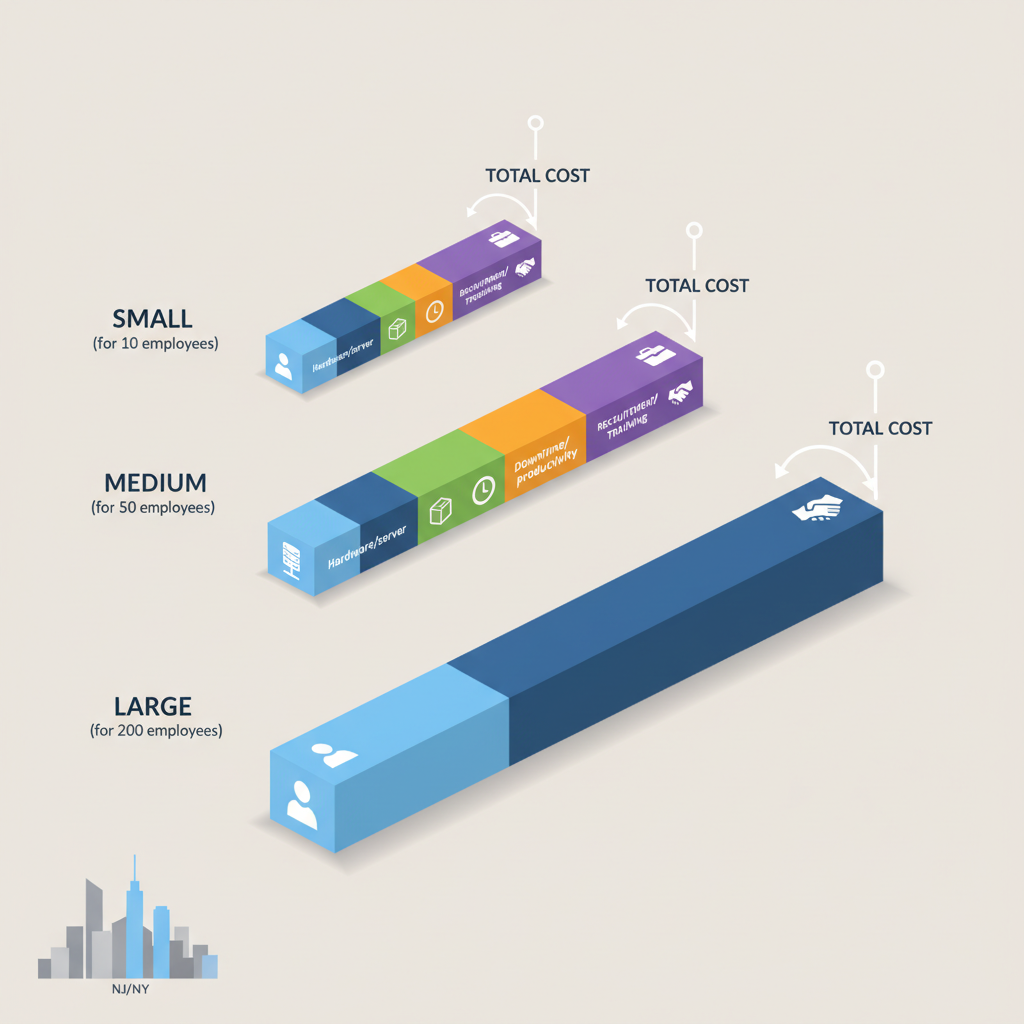
Sample TCO scenarios (3 company profiles: 10, 50, 200 employees)
Illustrative example: use these local break-even figures as a starting point when doing an it outsourcing cost comparison. These are sample, illustrative totals — update with your real data.
| Company size | In-house TCO (annual, illustrative) | Managed IT TCO (annual, illustrative) |
|---|---|---|
| 10 employees | $120,000 (1.0 FTE IT + hardware, licenses) | $30,000–$50,000 (MSP retainer + per-device) |
| 50 employees | $320,000 (2–3 FTEs + capital) | $120,000–$200,000 (MSP retainer + services) |
| 200 employees | $1,000,000+ (team + managers + projects) | $450,000–$800,000 (hybrid MSP + internal leads) |
These scenarios show when scale starts to favor an internal team: above ~150–200 employees you often need dedicated architecture and security leadership in-house. Below that, managed IT is typically more cost-effective or offers better predictable value.
In-house cost breakdown per profile
Break down the illustrative in-house numbers: for 50 employees, two sysadmins (each $90,000) plus a part-time network engineer, benefits, tools, and capital refresh add up to the $320,000 . Include recruiting costs (~15% of first-year salary per hire), and a 3-year hardware refresh amortized annually. This gives a clearer view of fixed and variable expenses when doing a direct it outsourcing cost comparison.
Managed IT cost breakdown per profile (retainer, per-device, per-user)
MSP pricing models vary: fixed monthly retainer, per-device, or per-user pricing. For a 50-person company, MSPs commonly price between $50–$120 per user per month depending on included services (24/7 monitoring, backup, security). A blended MSP retainer plus per-device fees often delivers predictable budgeting and shifts capital spend to operational spend.
Predictable MSP pricing reduces surprise capital requests and smooths budgeting for regulated firms.
Hidden savings MSPs often provide (24/7 monitoring, bulk vendor rates, backup/DR)
MSPs secure savings you may miss: 24/7 monitoring reduces mean time to detection; bulk licensing and vendor relationships lower software and hardware costs; standardized backup and disaster recovery reduce recovery time and regulatory exposure. These hidden savings directly affect the total cost of ownership it over time.
Example: an MSP-managed backup/disaster recovery program can reduce expected annual downtime by a measurable percentage. When you model expected outage hours, apply that reduction as cost savings in your TCO spreadsheet.
Break-even analysis: when outsourcing becomes more economical
Decision rule: outsourcing tends to become more economical when the fully loaded annual cost of required in-house hires (including training and turnover risk) exceeds 1.5x the MSP annual fees for the same service coverage. For small firms (10–50 staff), MSPs usually win; for 150–200+ employees, hybrid models with internal leadership plus MSP execution often break even better.
If hiring a single senior engineer raises fixed IT spend above 1.5x an MSP alternative, choose the MSP or a hybrid model.
Financing and predictable budgeting with MSPs vs variable internal costs
MSPs convert capital projects into predictable monthly fees. That predictability helps CFOs plan cash flow, allocate OPEX, and manage compliance budgets. Internal teams, by contrast, create variable costs from hiring, unexpected projects, and emergency work. Use a 3-year rolling forecast showing cash-flow differences to make a finance-driven decision.
Local considerations for NJ & NY (salary ranges, office costs, tax implications)
NJ/NY employers face higher wage baselines and payroll taxes than many regions. When modeling in-house it salary nj and managed it costs nj, include state unemployment insurance, local payroll taxes, and the higher cost of recruiting in metro areas. Office real estate and commuter benefits for staff also raise the total employment cost for in-house teams in the region.
Quotable sentence: "For many NJ/NY regulated businesses, predictable MSP pricing can reduce unexpected IT spending and simplify budgeting for compliance." Use that in internal memos and vendor comparisons.
Decision checklist & next steps for CFOs and IT leaders
Use this checklist to decide between hiring and outsourcing:
- Calculate current TCO using direct and indirect costs.
- Get 12-month MSP pricing (retainer, per-user, per-device) and service inclusions.
- Estimate outage reduction and vendor discount values MSPs offer.
- Run a 3-year cash-flow comparison and a break-even rule (1.5x threshold).
- Request references and SLAs that map to your compliance needs.
Next steps: run an it outsourcing cost comparison spreadsheet and schedule a technical review with a senior-engineer-led provider to validate assumptions.
FAQ: common cost questions
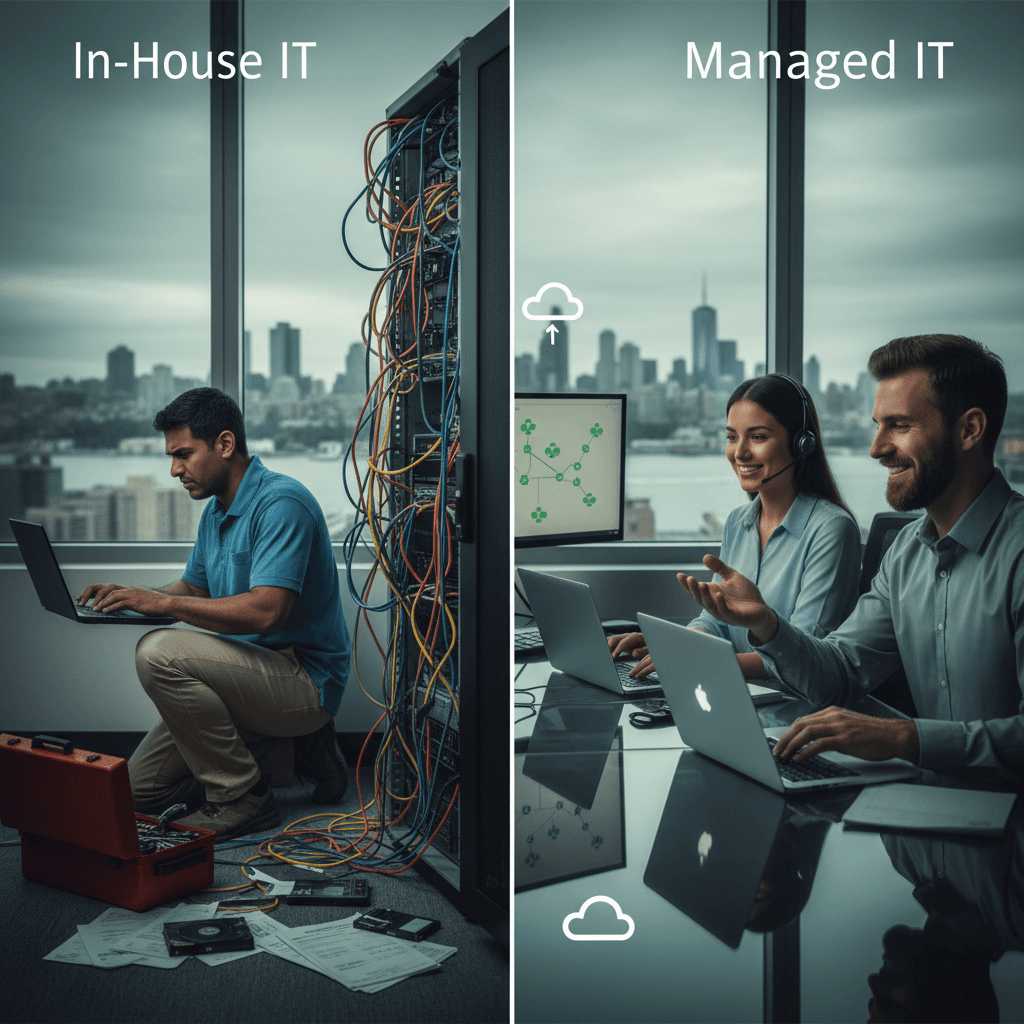
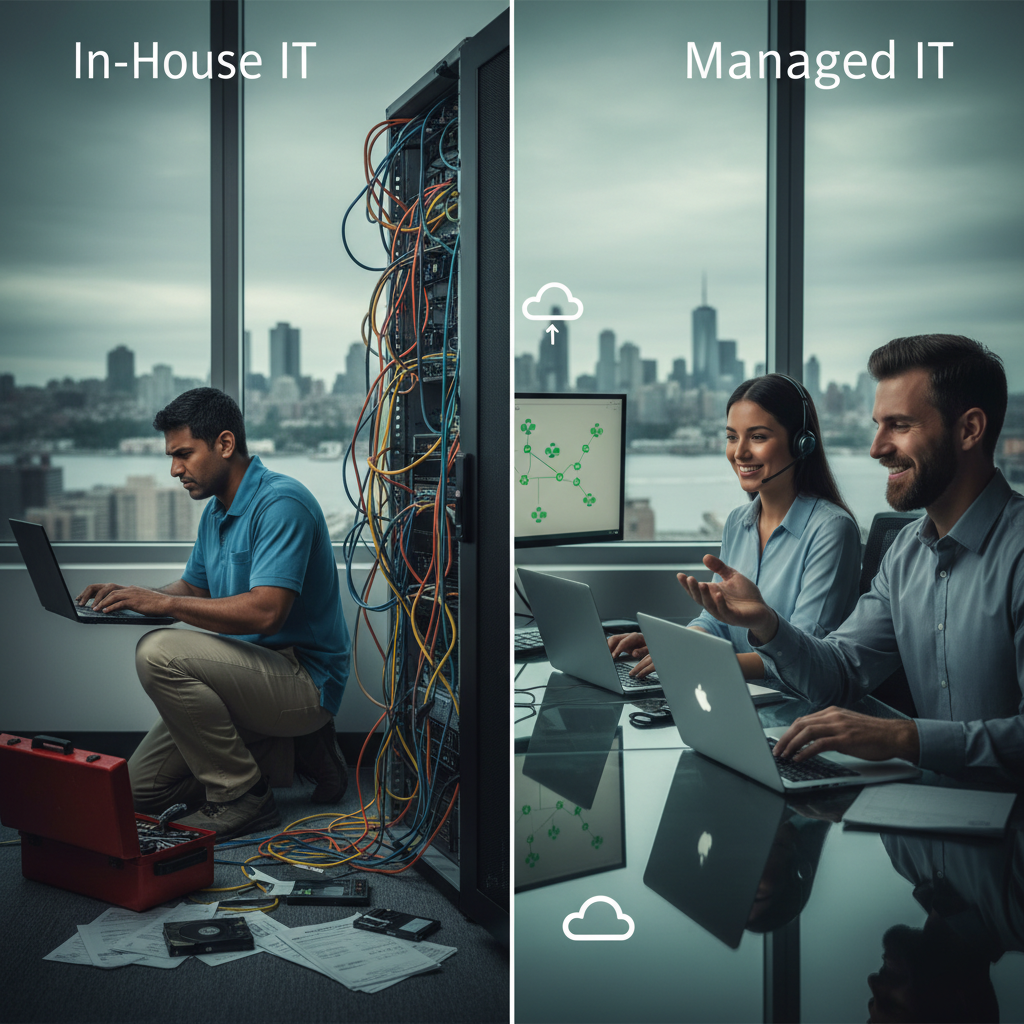
What is in-house it vs managed it? In-house IT means hiring employees to perform IT functions within your company, while managed IT means contracting a third-party provider to deliver those services under a retainer or per-user/device model. This answer focuses on cost drivers rather than organizational preference.
How does in-house it vs managed it work? In-house IT uses salaried staff responsible for support, projects, and operations; managed IT uses an external team that provides 24/7 monitoring, engineering-led support, and vendor management. Costs shift from capital and hiring to operational fees when you outsource. For more on this, see In-house vs outsourced technology management.
Conclusion and call to action (free IT assessment/consultation)
Compare complete TCO, not just salaries, when evaluating in-house it vs managed it cost. For a practical, local comparison, run the 3-year model above with your data and include NJ/NY payroll and tax rates. If you want a vendor-side view or a free assessment, review our services and request a consultation via the contact us page or the main site contact us entry. You can also book a demo of specific service bundles at our services.