
Question: What are the required and recommended steps for ransomware reporting nj ny — who to notify and when?
Answer: Notify regulators and relevant stakeholders promptly; maintain an incident timeline and preserve evidence for regulator and insurer review. Begin internal containment and assessment immediately, then follow a 24–72 hour window for initial regulator and law enforcement notification while observing state-specific rules.
This guide breaks down practical, actionable steps for website owners, marketers, and developers operating in New Jersey and New York. It explains who to contact inside your organization, when to alert law enforcement, what state regulators expect, and provides ready-to-use templates, checklists, and a filing timeline. The primary goal: get you from discovery to compliant notification without destroying evidence or delaying containment.
Overview: Why prompt regulatory reporting matters for regulated entities
Ransomware reporting nj ny matters because regulators and insurers use early and accurate reports to assess systemic risk, offer guidance, and determine coverage. Early notification helps protect customers, preserves investigative evidence, and can limit regulatory penalties when you document good-faith response actions. For many regulated businesses, failing to report or delaying meaningful action creates legal exposure and harms reputation. For more on this, see Post-ransomware compliance reporting nj ny.
A concise, quotable definition: "Initial ransomware notification is a factual summary of the incident, scope, and immediate mitigation steps, submitted to regulators and stakeholders to enable coordinated response." Follow this with a preserved incident timeline and evidence package for review. For more on this, see Ransomware preparedness nj ny.
Who this is NOT for: This guidance is not for individuals managing a single personal device, businesses outside NJ/NY with no customer data in those states, or organizations under federal-only reporting regimes where other rules apply. If you are unsure, consult counsel or your managed provider before reporting.
NJ-specific guidance: NJCCIC and state agency notification considerations
New Jersey entities should monitor NJ-specific advisory channels and report incidents to the New Jersey Cybersecurity & Communications Integration Cell (NJCCIC) when appropriate. NJCCIC issues alerts and guidance for active threats; reporting there helps the state track campaigns and issue mitigations. For public agencies and government contractors, state law requires reporting of cybersecurity incidents—start with incident containment, then notify the relevant contracting officer and NJCCIC.
Practical example: if an attacker encrypts a business-critical database and customer data originates in NJ, document affected records, containment steps, and the time of discovery; then submit an NJCCIC report with a summary and preserved logs. Use the phrase: "Notify NJCCIC with summary of incident, affected systems, remediation steps, and expected customer impact." For many NJ incidents, initial assessment and notification should aim for a 24–72 hour window while preserving forensic artifacts.
Notify regulators and stakeholders promptly; maintain an incident timeline and preserve evidence for regulator and insurer review.

NY-specific guidance: NYDFS expectations and covered entities (overview)
NYDFS applies to covered financial entities and enforces cybersecurity regulations that require timely incident reporting and post-incident remediation plans. If you are a covered entity, follow NYDFS guidance for ransomware reporting and the broader 23 NYCRR 500 framework for incident response and notification. For insurers and financial institutions, NYDFS expects a factual timeline, impact assessment, and description of steps taken to restore systems.
Example language for initial contact: "Notify NYDFS with summary of incident, affected systems, remediation steps, and expected customer impact." If you operate in New York and serve financial services customers, prioritize nydfs reporting ransomware as a checklist item during your incident response and include it in your 24–72 hour assessment phase.
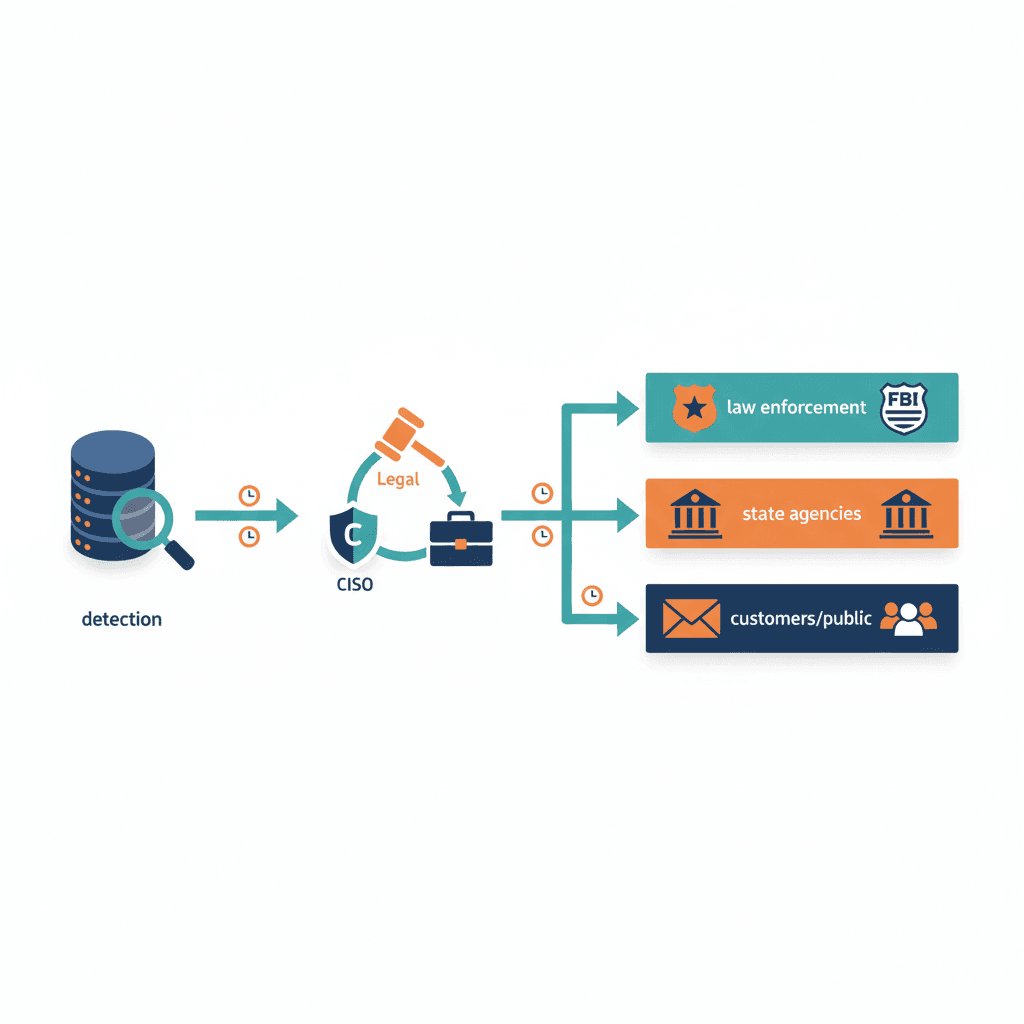
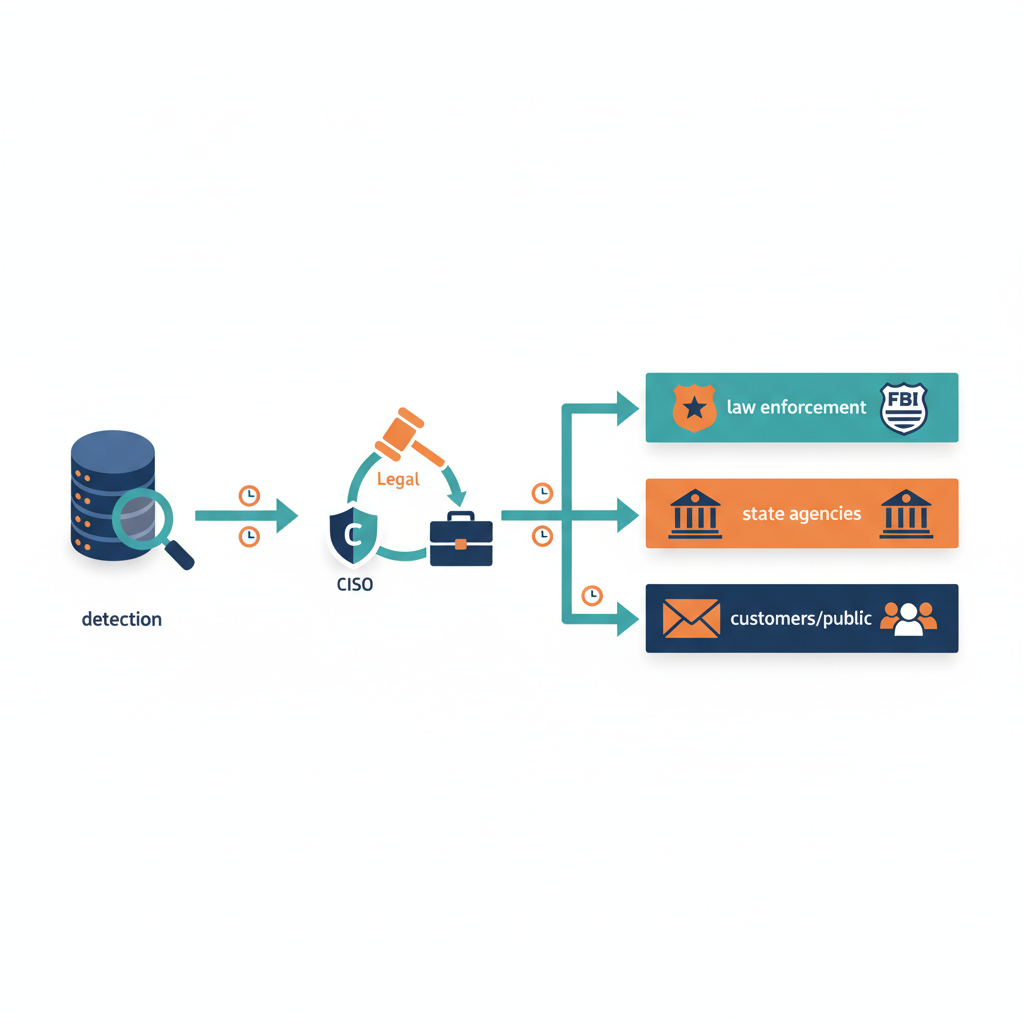
Who to notify internally and externally (ordered checklist)
When you detect ransomware, follow a tight notification sequence to reduce confusion and preserve evidence. Below is an ordered checklist you can copy into incident runbooks and ticketing systems.
- Containment: Isolate affected systems and preserve volatile data.
- Initial internal alert: Notify IT ops, CISO or delegated security lead.
- Assessment: Determine scope, affected data types, and likely ransomware family.
- Law enforcement: Prepare for contact (see next section).
- Regulator assessment: Evaluate NJCCIC and NYDFS applicability and prepare initial notifications.
- Customer notification plan: Draft communications and legal review.
- Insurer notification: Send timeline and preserved evidence for claims.
This sequence keeps response actions focused: containment first, then documentation and external notifications.
Internal stakeholders (CISO, legal, compliance, executive)
Notify your CISO or security lead immediately—this person coordinates technical containment and forensic work. Legal and compliance must receive the incident timeline and initial scope within the first few hours to evaluate regulatory and contractual obligations. Executives (CEO, board) require a concise impact statement: systems affected, customer exposure, expected downtime, and next steps.
Concrete artifact: use a one-page incident summary template with fields for discovery time, affected systems, data types, containment steps, and decision points. Example KPI thresholds: time to isolate infected host within 60 minutes, restore critical service under 24 hours where possible. These thresholds guide executive decisions on escalation and public statements.
Law enforcement (local, FBI) — when to call
Call local police for immediate harm and the FBI for cross-jurisdictional or extortion cases. Contact the FBI’s Internet Crime Complaint Center (IC3) or your regional field office when the attack includes extortion, significant data theft, or impacts critical infrastructure. Law enforcement preserves criminal evidence and can advise on ransom payment risks; however, they will not always recommend payment.
Make law enforcement contact after initial containment and evidence preservation. Provide them with the incident timeline, hash values of malicious binaries, and preserved logs. Keep the call factual: timeframe, affected systems, and available artifacts.
Regulators (state agencies, NYDFS) and customer notification
Regulators expect an initial factual report followed by updates. For NJ, route appropriate reports to NJCCIC when state impact exists. For NY, covered entities should follow NYDFS reporting guidance and 23 NYCRR 500 obligations. Customer notification timing depends on breach laws and regulator advice—prepare an outreach plan but coordinate with legal to avoid releasing information that harms investigations.
Use template instruction: "Notify [Regulator Name] with summary of incident, affected systems, remediation steps, and expected customer impact." Repeat this language in insurer and regulator filings to keep descriptions consistent.
Data protection authorities and breach notification laws (where applicable)
If personal data of residents is affected, review applicable breach notification laws. New York and New Jersey have laws governing consumer data; some incidents trigger direct consumer notices. Document affected records, types of personal data, and risk level. When in doubt, consult counsel and your insurer before sending consumer notices.
Concrete checklist item: map affected data sets to jurisdictional triggers—e.g., Social Security numbers require immediate privacy team review; contact lists with emails may require a lower-threshold notice. Keep records of decision logic in your incident report.
Timeline templates: What to file within 24, 48, and 72 hours
Use this timeline table as a filing template for regulators and internal tracking. Aim to submit initial factual reports within 24–72 hours while following regulator-specific rules.
| Timeframe | Primary actions | Artifacts to include |
|---|---|---|
| Within 24 hours | Containment, initial scope, notify CISO and legal | Discovery timestamp, affected hosts list, brief impact statement |
| 24–48 hours | Notify law enforcement and prepare regulator draft | Preserved logs, hashes, sample ransom note, forensic snapshot info |
| 48–72 hours | Submit regulator/insurer initial reports and customer notification plan | Incident timeline, remediation plan, expected customer impact |
Preserve forensic evidence first; draft regulatory language second.
Sample notification language and communication templates
Use short, factual templates to speed filings. Example regulator template: "Notify [Regulator Name] with summary of incident, affected systems, remediation steps, and expected customer impact." Example customer template: "We detected unauthorized encryption of certain systems on [date]. We have isolated affected systems, engaged forensic specialists, and will inform impacted customers when we confirm affected records." Keep language consistent across filings.
Evidence and attachments regulators expect
Regulators commonly request: an incident timeline, log excerpts, malware samples or hashes, scope of affected data, and remediation actions. Prepare a zipped evidence package with readme.txt describing contents. For insurers and regulators, include chain-of-custody notes for any artifacts preserved by third-party forensics.
Practical tips: coordinating notifications while preserving investigations
Coordinate notifications through a single incident commander to avoid mixed messages. Preserve logs on write-protected media and snapshot systems where possible. Use short internal briefs to keep executives informed without revealing forensic details externally. When engaging third-party forensics, require immediate evidence preservation and a documented handoff.
- Decision rule: Delay public customer messages only until legal confirms no investigative harm; do not delay regulator or law enforcement notifications.
- Checklist: preserve logs, image affected hosts, capture ransom notes, record decision timestamps.
Keep a single incident timeline as the authoritative source for all notifications.
Conclusion and local resources (links to NJCCIC and NYDFS guidance)
Follow the 24–72 hour assessment window while complying with NJ and NY guidance. Notify regulators and relevant stakeholders promptly; maintain an incident timeline and preserve evidence for regulator and insurer review. For NJ-specific alerts and reporting, consult NJCCIC. For NY covered entities, consult NYDFS guidance for reporting ransomware and broader incident obligations.
If you need managed support for containment, monitoring, or recovery, reference our our services and request help through the site’s contact options: contact us, contact us, or contact us. For guided demonstrations of enterprise-grade monitoring, see our services.
FAQ
Who to Notify and When: Regulatory Reporting Checklist for Ransomware Incidents in NJ & NY?
Notify internal incident leads immediately, preserve evidence, and prepare notifications for law enforcement, NJCCIC (for New Jersey impact), and NYDFS (for covered New York entities) within a 24–72 hour assessment window; follow regulator-specific filing requirements thereafter.
References
- Cybersecurity Incident and Ransom Payment Reporting — NY Division of Homeland Security and Emergency Services
- 23 NYCRR Part 500 — NYDFS Cybersecurity Requirements for Financial Services Companies
- Data Security Breach Management — NY Department of State
- New Jersey Act requiring public agencies and contractors to report cybersecurity incidents