

TL;DR
- Compare cyber insurance policies by matching coverage lines, sublimits, retroactive date, and waiting periods to your operational risk.
- Insurers evaluate data sensitivity, industry, controls, and recent incidents — supply evidence (EDR, SIEM logs, backup tests) to improve terms.
- Watch for cyber insurance exclusions ransomware and failure-to-patch clauses; include MSP attestation letters for NYDFS or HIPAA scrutiny.
- Use a reproducible policy comparison checklist and coverage matrix when procuring — the table below is copy/paste-ready.

If you need to compare cyber insurance policies, this article guides you through underwriting factors, how coverage lines work, common exclusions, and exactly how MSP/MSSP practices change eligibility and price. You’ll get practical templates: a coverage comparison table, a procurement checklist, and a coverage matrix suitable for legal and procurement review. The primary goal: give you reproducible artifacts so your team—developers, marketers, and site owners—can evaluate options quickly and accurately.
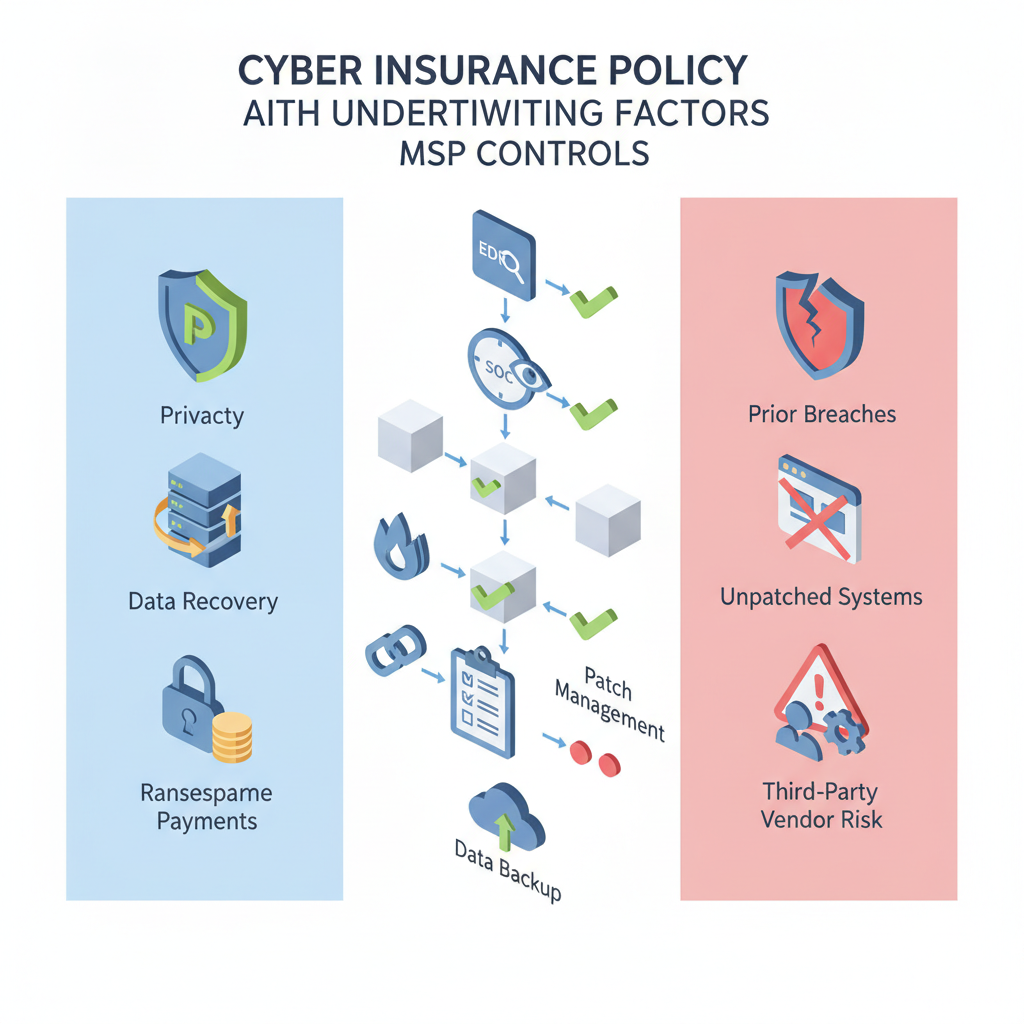
How Underwriters Evaluate Risk — data, industry, controls, and recent incident history
Underwriters price and approve cyber insurance by turning technical controls and business context into measurable underwriting factors. They ask three core questions: how sensitive is the data you process; what controls reduce likelihood of a breach; and what in your incident history suggests repeat risk. Answering those questions with documentation shortens application review and can lower premiums. For more on this, see Cyber insurance readiness nj ny.
Data: insurers segment risk by data sensitivity. Credit-card numbers, health records, and regulated financial data sit at higher risk and higher premium bands. If you store or transmit Protected Health Information (PHI), note that HIPAA-covered entities face higher scrutiny; include documented encryption-at-rest, MFA for remote access, and backup integrity tests in your submission. For more on this, see Our pricing.
Industry: some industries carry systemic exposure—healthcare and finance remain price-sensitive. New York State Department of Financial Services (NYDFS)-regulated entities often get extra scrutiny; if you’re NYDFS-regulated, mention it in the application and attach MSP attestation letters describing security operations and incident response arrangements.
Controls: insurers evaluate the specific tools and operational practices you run. Typical cyber insurance underwriting factors include presence of enterprise EDR, managed detection and response, multifactor authentication coverage for administrative accounts, segregated backup strategy, and patching cadence. A concise list insurers request commonly looks like this:
- EDR product and policy status (version, coverage percentage)
- 24/7 SOC or managed detection hours
- Backup frequency and encryption of backups
- Patching SLA (time from published critical CVE to applied patch)
Recent incident history: underwriters examine claims and breach notices from the last 24–36 months. A single ransomware claim can raise deductibles or introduce ransomware-specific carve-outs. When you compare cyber insurance policies, disclose incidents proactively and supply containment reports — omission or inaccurate answers are common grounds for denial.
Underwriters treat controls as measurable inputs: documentation replaces negotiation.
Practical example: a mid-size New Jersey healthcare practice applying for a $2M limit will get a better quote if it supplies EDR telemetry showing endpoint coverage, quarterly backup restore tests, and an MSP attestation confirming 24/7 SIEM monitoring. Without those artifacts, underwriters add sublimits for forensic costs and raise premiums to cover guessed risk.
Core Coverage Types and What They Mean
When you compare cyber insurance policies, map each policy to core coverage types so you’re comparing like for like. Policies bundle first‑party and third‑party coverages, but the names and limits vary. Read the definitions below and check the coverage matrix later in this article.
Core coverage types commonly include first‑party benefits (losses the insured absorbs directly) and third‑party benefits (claims from customers, regulators, or vendors). The exact split determines how much money you’ll see quickly after an incident versus how much goes to defense, settlements, or fines.
Quotable definitions for featured snippets:
- Retroactive date: the earliest date when incidents are eligible for coverage under a claims-made policy.
- Sublimit: a fixed cap within a policy limit that applies to a specific coverage element, such as ransomware payments or forensic expense.
- Waiting period: the time delay after an incident before certain benefits, like business interruption, begin paying.
- Known-issue exclusion: a clause that excludes coverage for incidents caused by vulnerabilities or conditions known to the insured before policy inception.
Below is a copy-ready comparison table suitable for quick vendor comparisons or AI snippets. Use it to extract core differences when doing a cyber insurance policy comparison.
| Coverage type | What it pays | Common exclusions |
|---|---|---|
| Business interruption (first‑party) | Loss of income + continuing expenses during downtime | Waiting periods, systems not covered, post-breach mitigation outside approved vendors |
| Data recovery & system restoration (first‑party) | Costs to restore/clean data and rebuild systems | Known-issue exclusion, failure-to-patch, incomplete backups |
| Ransomware & extortion payments (first‑party) | Negotiation costs, payment of ransom where permitted | Acts of war, sanctioned payments, deliberate noncompliance with controls |
| Privacy liability (third‑party) | Defense costs, settlements, regulatory fines (where insurable) | Intentional wrongdoing, criminal acts by insured |
First‑party coverage: business interruption, data recovery, ransomware payments
First‑party coverage reimburses the insured for operational losses. Business interruption covers income lost when systems are down; insurers usually calculate loss based on revenue history and agreed business interruption period. Data recovery covers forensics, restore, and rebuild work—often capped by a sublimit. Ransomware or extortion coverage is a first‑party line, but many policies add sublimits or require insurer approval before payment.
Example: a marketing firm running cloud workloads should verify whether the policy covers cloud provider outages and whether waiting periods apply. A 72‑hour waiting period for business interruption can mean you absorb three days of payroll and client refunds before coverage begins. When comparing cyber insurance policies, put these waiting periods side-by-side.
Third‑party coverage: privacy liability, regulatory fines, legal defense
Third‑party coverage handles claims from customers, vendors, or regulators. Privacy liability pays defense and settlements for data-breach lawsuits; regulatory fines coverage depends on local law—some jurisdictions limit insurability of fines. Legal defense costs often erode policy limits unless defense costs are outside the limit, so check whether the policy reduces the available limit when defense spends are made.
Concrete step: when evaluating policies, ask for sample endorsements showing whether regulatory fines (for example, under HIPAA or state privacy laws) are covered and whether defense costs are inside or outside the policy limit.
Common Exclusions and Red Flags (and how to avoid them)
Exclusions shrink real protection. When you compare cyber insurance policies, identify exclusions that commonly surprise buyers: known-issue exclusions, failure-to-patch clauses, silent network exclusions, and war/terrorism or nation-state carve-outs. Avoid traps by documenting your security posture and, when needed, negotiating endorsement language that excludes fewer operational realities.
Known-issue exclusions: carriers exclude vulnerabilities you knew about before policy inception. If you’re patching a zero-day during application, document the remediation plan and dates to prevent a post‑claim denial.
Failure-to-patch clauses: some policies require patching within a specific SLA for critical vulnerabilities. If you use an MSP, get an attestation stating your patch cadence and exceptions; include evidence from your patch management system or vulnerability scanner showing timelines.
Ransomware-specific carve-outs have increased. Some carriers impose sublimits on ransomware payments, exclude certain ransomware families, or require pre-approval for payments. To manage this risk, keep immutable, encrypted backups and documented incident response steps, and obtain an MSP attestation confirming backup encryption and restore testing.
Missing attestation documents during underwriting often converts an otherwise acceptable risk into a restrictive policy.
Practical avoidance checklist (short):
- Compile evidence of EDR and SIEM coverage (logs for 90 days)
- Export recent backup restore test reports (last 12 months)
- Obtain MSP attestation letters describing patch cadence and SOC hours
- List recent incidents with containment reports and remediation timelines
Known-issue exclusions, failure-to-patch clauses, and ransomware-specific carve-outs
A known-issue exclusion excludes coverage for an incident that exploits a vulnerability the insured knew about before the policy’s retroactive date. Retroactive date matters on claims-made policies: if an incident stems from an exposure before that date, the carrier can deny coverage. When comparing cyber insurance policies, check retroactive dates against your incident and vulnerability timelines.
Failure-to-patch clauses often demand patching critical CVEs within a defined window—commonly 30 to 90 days in underwriting questionnaires. If you can’t meet that window, document exceptions and compensating controls (network segmentation, compensating EDR rules) in an MSP attestation. For New York or healthcare clients, that attestation often materially improves terms.
Ransomware carve-outs may require approval for payments or cap payments at a sublimit. If a policy has such a sublimit, verify that forensic and business interruption sublimits still meet your tolerance for downtime and cost. If not, negotiate or look for an insurer offering broader first‑party ransomware coverage.
How MSP/MSSP Services Interact with Policies
Your MSP or MSSP is not just a vendor; underwriters treat them as part of your control environment. Policies often ask for MSP names, services provided, and attestation language. A strong MSP attachment—showing 24/7 monitoring, senior-engineer-led support, enterprise-grade backup/disaster recovery, and documented threat hunting—reduces perceived likelihood of severe incidents and can lower premiums or sublimits.
In practice, insurers expect concrete artifacts: contracts that show continuous monitoring, SLAs, escalation paths, and samples of alert triage timelines. If your MSP offers EDR and SIEM but does not provide attestation language, insurers may assume gaps exist. Eighty Seven Solutions’ documented services — 24/7 monitoring, senior-engineer-led support, enterprise-grade backup/disaster recovery, and cybersecurity (EDR, SIEM, zero-trust, threat hunting) — are exactly the type of evidence that underwriters request when evaluating coverage for NJ and NY firms.
Actionable steps to prepare your MSP package for underwriting:
- Request a written attestation on letterhead that lists monitoring hours, tool names, and escalation contacts.
- Export SOC alerting and remediation timelines for the last 6–12 months (anonymize client data if needed).
- Provide backup restore test reports and configuration that shows encryption and immutability settings.
Attach MSP attestation letters to every insurance application for regulated entities; they shorten underwriting and reduce surprises.
Why insurer asks about managed detection, EDR vendor, and SOC hours
Insurers translate monitoring into time-to-detection metrics. The faster an incident is detected, the lower the expected loss. Insurers therefore ask which EDR vendor you use, whether it's deployed fleet-wide, how many hours your SOC operates, and whether threat hunting runs regularly. Provide vendor telemetry (coverage %) and SOC runbooks when possible.
Example: an insurer compares two applicants. Company A runs EDR on 95% of endpoints with a 24/7 SOC; Company B has EDR on 60% of endpoints and no SOC. Company A typically receives lower deductibles and better limits. Documented evidence is the differentiator, not just the product name.
Minimum service-levels and required attestation language from MSPs
Insurers often list minimum service-level requirements on their application forms. Typical requirements include 24/7 monitoring, EDR coverage on all endpoints, monthly vulnerability scans, and encrypted, immutable backups with restore testing. Attestation language should be explicit about scope: agent deployment percentage, average time-to-detect, backup retention and encryption, and the number of restore tests performed.
Suggested attestation template fields your MSP should include:
- Service scope and hours (e.g., 24/7 monitoring, incident response escalation)
- Tools and versions (EDR, SIEM) and approximate coverage percentage
- Backup frequency, retention period, and restore test results
- Statement of no known unresolved critical vulnerabilities at time of attestation
Policy Comparison Framework — a reproducible checklist for procurement teams
Procurement teams need a reproducible framework to compare offers. Use this checklist and scoring model to normalize quotes across carriers. Score each policy on the same axes and use weighted scoring to select the best fit rather than the lowest premium alone.
Checklist (copy/paste):
- Confirm policy type: claims-made vs occurrence and retroactive date
- List total limit and all sublimits (ransomware, forensics, BI)
- Verify waiting periods and business interruption valuation method
- Check whether defense costs are inside or outside the limit
- Identify exclusions: known-issue, failure-to-patch, war/nation-state
- Collect MSP attestation letters and EDR/SIEM evidence
- Confirm regulatory fines coverage for your jurisdiction
- Score carrier incident response panel and breach coach availability
Decision rule example: prioritize policies where defense costs are outside the limit and ransomware sublimit >= 50% of total limit, unless your appetite dictates otherwise. For regulated NJ & NY firms, weight MSP attestation presence double in the scoring model.
Coverage matrix (limits, sublimits, retroactive date, waiting periods)
Below is a template coverage matrix procurement teams can paste into procurement spreadsheets. Fill each column with insurer responses and use the scoring column to normalize decisions across vendors.
| Carrier | Total limit | Ransomware sublimit | Forensic sublimit | Retroactive date | Waiting period | Defense costs inside limit? | MSP attestation? | Score (1–10) |
|---|---|---|---|---|---|---|---|---|
| Insurer A | $X | $Y | $Z | YYYY-MM-DD | 72 hours | No | Yes | 8 |
Negotiation Tips & Application Best Practices for Regulated NJ & NY Firms
If you operate in New Jersey or New York or handle protected health information, prepare for tighter scrutiny. Start applications early and include MSP attestation letters, EDR/SIEM coverage statistics, backup test reports, and a short incident timeline for past 36 months. These artifacts shorten underwriter questions and reduce the chance of restrictive endorsements.
Negotiation tip: ask for endorsements that explicitly remove ransomware sublimits or move defense costs outside the limit. If the carrier resists, trade concessions: agree to a higher deductible in exchange for broader ransomware coverage or commit to a 90-day patching SLA signed by your MSP.
Application best practices (step-by-step):
- Compile technical artifacts (EDR coverage, SIEM retention, backup tests)
- Request MSP attestation letters that match carrier questionnaire language
- Pre-fill underwriting questionnaires and cross-check for accuracy
- Submit claims and incident summaries with remediation actions and dates
- Negotiate endorsements rather than accepting blanket exclusions
Example: a NY healthcare clinic that included signed backup restore reports and an attestation from their MSP demonstrating weekly restore tests moved from a 30% ransomware sublimit to a 60% sublimit during negotiation.
Case Study: Applying the Comparison Framework to a NY healthcare practice
A fictional but realistic scenario: a New York outpatient clinic needs $1.5M of cyber limit and handles PHI. The procurement team collected three insurer quotes. They applied the coverage matrix, and weighted MSP attestation double because the clinic is HIPAA-covered. The team required copies of EDR rollout logs and evidence of enterprise backup immutability.
Step-by-step walkthrough:
- Gather artifacts: SIEM retention screenshot, EDR deployment report, backup restore reports, and MSP attestation.
- Populate the coverage matrix with limits, ransomware sublimits, waiting periods, retroactive dates, and whether defense costs are inside the limit.
- Score each carrier: weight MSP attestation and regulatory fines coverage higher due to HIPAA obligations.
- Negotiate: the procurement lead requests an endorsement excluding the known-issue clause for disclosed, remediated vulnerabilities; insurer B accepts with a 10% premium increase.
- Finalize: the team picks the carrier with a slightly higher premium but better sublimits and an endorsement covering regulatory defense costs outside the limit.
Result: by using the checklist and requiring MSP artifacts up-front, the clinic reduced underwriting delays and secured a policy that matched its regulatory exposure without excessive sublimits for ransomware or forensic response.
Conclusion — selecting a policy aligned with your MSP/MSSP roadmap
Compare cyber insurance policies by aligning policy mechanics with your technical controls and MSP commitments. Don’t pick on price alone: focus on sublimits, retroactive dates, waiting periods, and exclusions that affect real recovery. For NYDFS-regulated entities and HIPAA-covered entities, include MSP attestation letters in the application package to shorten underwriting and improve terms.
Actionable closing checklist: assemble EDR and SIEM evidence, backup restore test reports, MSP attestation, and a concise incident summary. Then use the coverage matrix and procurement checklist above to score offers. If you want MSP-led artifacts, review our services or request a demonstration of our operational evidence process at our services. For questions about policy-ready documentation, contact us, visit contact us, or check contact us for team credentials and capabilities.
FAQ
What is comparing cyber insurance policies?
Comparing cyber insurance policies is the process of matching policy features—limits, sublimits, retroactive dates, waiting periods, exclusions, and the treatment of defense costs—against an organization’s technical controls, incident history, and regulatory exposure to determine the best fit.
How does comparing cyber insurance policies work?
Comparing cyber insurance policies works by collecting standardized information from each insurer into a coverage matrix, scoring policies against weighted procurement criteria (for example, MSP attestation relevance for regulated entities), and negotiating endorsements to close coverage gaps identified in the matrix.