

TL;DR
- Problem: You must prove who owns each control for HIPAA, PCI, NYDFS and state rules — but internal teams are stretched and evidence is scattered.
- Quick answer: Use a compliance scorecard to map controls, assign ownership, and choose co-managed IT when you need 24/7 monitoring, documented SLAs, and vendor evidence.

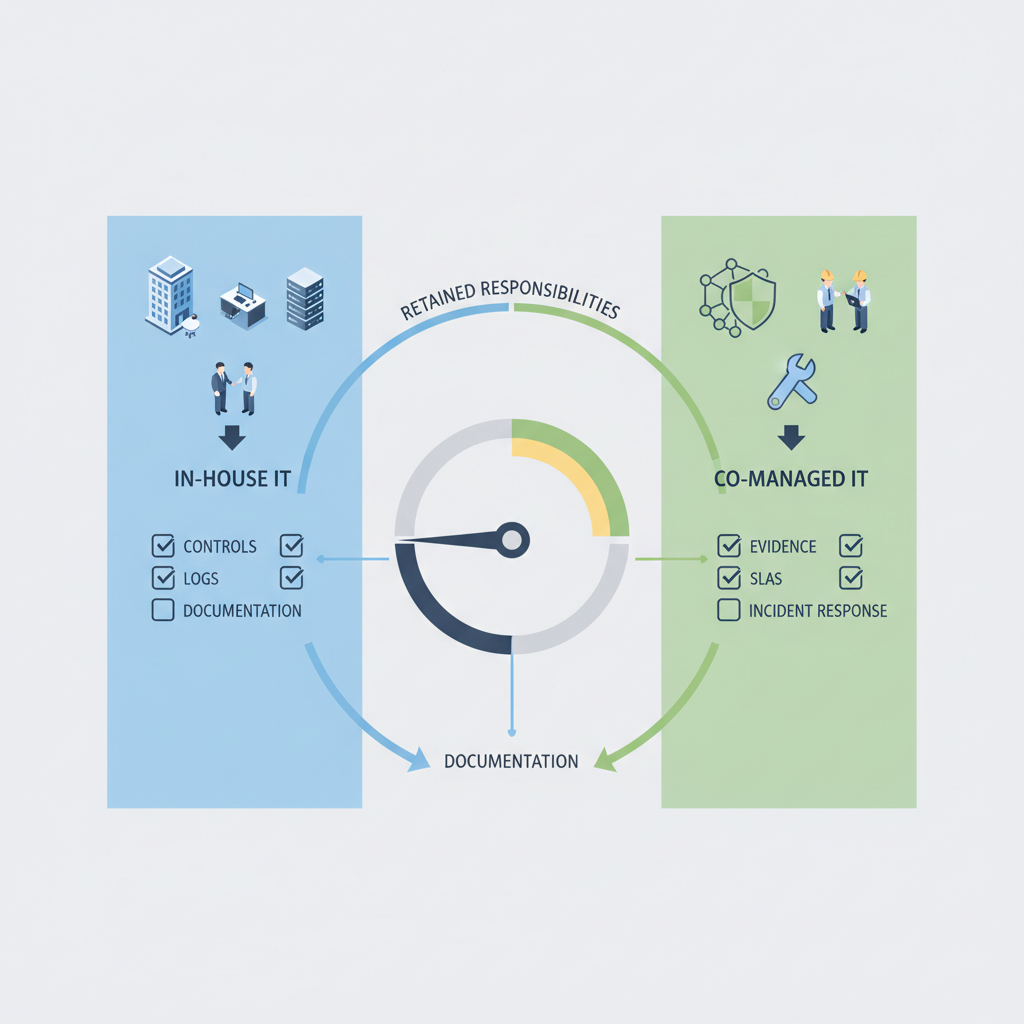
Overview — why compliance should drive IT sourcing decisions
If your site collects health data, processes payments, or serves New York financial customers, fragmented controls and missing evidence will create audit risk and regulatory fines. Many NJ and NY small-to-medium businesses find their in-house teams are excellent at day-to-day ops but under-resourced for continuous compliance tasks. The primary problem is not technical competence — it’s proving control ownership, maintaining continuous logs, and producing evidence on demand.
Use the compliance scorecard to produce audit-ready evidence showing who owns each control — crucial for NYDFS-regulated entities. The primary question is: keep everything in-house, or adopt a co-managed model where vendors share responsibility and documentation? This article compares in-house vs co-managed it compliance and gives practical steps you can apply today.
Definitions (quotable): NYDFS: New York State Department of Financial Services, regulator for financial institutions. NY SHIELD Act: New York law requiring reasonable safeguards for private data. HIPAA: federal law protecting health information for covered entities and business associates. PCI: payment card industry standard for cardholder data security. For NJ & NY SMBs, HIPAA applies to healthcare providers and business associates; PCI applies to any merchant handling card payments; NYDFS applies to entities the regulator supervises, including some financial services firms.
The compliance scorecard: factors and weighting (controls, evidence, SLAs, incident response)
A compliance scorecard converts legal and control requirements into measurable criteria. Key factors to include: control completeness (20%), evidence quality (25%), monitoring and log retention (20%), SLAs and vendor attestations (15%), and incident response and notification plans (20%). Assign numeric weights so decisions are defensible during audits.
Example scoring rule: a control scores 0–3 for coverage and 0–3 for evidence; multiply coverage by the factor weight and evidence by its weight, then sum. Concrete thresholds: require log retention of at least 12 months for NYDFS-relevant access logs (adjust per regulation), SIEM alerts with 90% triage within SLA window, and documented runbooks for incident response. For HIPAA, include a hipaa it outsourcing checklist entry: signed BAA, documented risk assessment, and periodic penetration testing evidence.
Quotable summary: "Score each control on coverage and evidence, then publish the scorecard before an audit to show ownership and proof."
Comparing responsibilities: matrix for in‑house vs co‑managed
Why this matters: auditors ask who performs a control and where the evidence lives. A clear matrix prevents finger-pointing. Below is a compact view of who typically owns tasks in each model; use it to fill your organization’s scorecard.
| Control | In‑house | Co‑managed |
|---|---|---|
| Policy authoring | Primary owner | Shared review and templates |
| Endpoint protection | Deploy & monitor | Vendor manages EDR + alerts |
| SIEM & log retention | Administer | Vendor provides collection, retention, and evidence |
| Patch management | Scheduling & deploy | Vendor automation + reporting |
| Incident response | Lead response | Vendor supports 24/7 containment |
Policies: an in-house team owns the content; a co-managed relationship often gives you standardized policy templates and documented evidence. This structure reduces in-house it compliance risks because it centralizes artifacts and produces audit-ready reports. For more on this, see Co-managed it nj ny.
Policies & documentation
Policies must be versioned, approved by named owners, and mapped to controls. For an effective policy program, require: a master policy index, a record of approvals, policy review dates, and a mapping to specific technical controls in the scorecard. Example artifact list: Acceptable Use, Access Control, Backup, Incident Response, and Vendor Management. Co-managed arrangements typically supply templates and a policy implementation plan; in-house teams must produce those documents themselves, increasing workload.
Monitoring & log retention
Monitoring is a compliance hinge. Regulators expect continuous monitoring and searchable logs. Define retention policy per regulation (e.g., NYDFS section suggests maintain logs to support investigations) and enforce it through SIEM. A practical threshold is to retain authentication and admin activity logs for at least 12 months and system events for 90 days, though you should confirm specific retention for NY SHIELD Act or NYDFS obligations. Teams lacking 24/7 monitoring commonly see longer dwell time and slower containment; co-managed providers often supply 24/7 SOC coverage and centralized logs, reducing response gaps.
Incident response & breach notification
Regulators look for who declares a breach and who notifies. Your incident response plan must name decision-makers, timelines, and notification templates for HIPAA, NY SHIELD, and NYDFS. Include a clear escalation matrix, evidence collection checklist, and a communication log. Co-managed models often provide runbooks and forensic evidence capture; in-house teams must ensure forensic readiness and legal coordination. For HIPAA-covered entities, include a hipaa it outsourcing checklist item: documented breach notification procedures and a contact list for legal counsel.
Assign ownership for every control before onboarding a vendor; audits fail on ambiguity, not gaps.
Typical gaps when keeping IT fully in‑house (staffing, tooling, 24/7 monitoring)
Keeping IT entirely in-house exposes several compliance risks: limited staffing to cover nights/weekends, tool gaps (no enterprise SIEM, weak EDR), and missing vendor attestations. Practical examples: a small internal team may not maintain continuous log retention, so when an auditor requests 12 months of access logs, the business can't comply. Another common gap is the lack of formal SLAs and independent evidence — auditors expect vendor reports and attestations; if your in-house team performs controls but lacks third-party attestations, that creates findings.
Address specific in-house it compliance risks by listing required artifacts: configuration snapshots, change logs, access review records, and signed policy approvals. If your team can't produce these within 48 hours, consider co-management.
How co‑managed arrangements can close compliance gaps (examples)
Co-managed arrangements let you keep control of strategy and day-to-day decisions while vendors supply 24/7 monitoring, documented evidence, and scalable tooling. Example: a co-managed provider can onboard EDR and deliver weekly evidence exports for audits, run quarterly access reviews with named reports, and provide SIEM dashboards that map to your scorecard items.
For NYDFS compliance co-managed setups, vendors can supply vendor risk assessments, penetration test reports, and continuous monitoring evidence necessary for regulator reviews. Co-managed it compliance nj ny has a practical edge for regulated firms that need documented proof without hiring full SOC staff.
Documented evidence beats confident assertions: produce logs, SLA reports, and signed BAAs before an audit.
Decision checklist: when to keep in‑house, when to co‑manage, when to outsource
Use this checklist to decide your sourcing model. Keep in-house when you have: dedicated compliance engineers, documented runbooks, and capacity for 24/7 monitoring. Choose co-manage when you need tooling or SOC coverage but want control of strategy. Outsource fully when you want minimal IT overhead and accept vendor-led strategy.
- Do you need 24/7 monitoring? If yes → consider co-manage or outsource.
- Can you produce audit evidence within 72 hours? If no → co-manage.
- Do you require regulatory attestations (NYDFS)? If yes → co-manage preferred.
- Is HIPAA in scope and do you need a hipaa it outsourcing checklist completed? Require BAA and documented controls before outsourcing.
Sample scorecard (fill-in template) and case study vignette
Below is a sample scorecard table you can copy and populate for audits.
| Control | Owner | Coverage (0–3) | Evidence (0–3) | Score | Notes |
|---|---|---|---|---|---|
| Access reviews | IT Manager | 2 | 1 | 3 | Quarterly report missing |
| Endpoint detection | Co‑managed SOC | 3 | 3 | 6 | Weekly EDR export available |
Case vignette: a New Jersey healthcare billing company moved to a co-managed model to address in-house it compliance risks. The vendor supplied a hipaa it outsourcing checklist, executed a BAA, and delivered monthly evidence packs. During a HIPAA review, the company produced the scorecard and audit artifacts within 48 hours and received no findings.
Next steps & recommended evidence for audits
Action steps: build your scorecard, map each control to an owner, and collect artifacts (config snapshots, SIEM exports, patch reports, BAAs, and penetration test summaries). For NYDFS-bound entities, maintain vendor risk assessments and proof of continuous monitoring. When selecting a co‑managed partner, cite regulator guidance and request formal attestations and SLA-backed reports.
For managed IT and cybersecurity services that provide documented evidence, see our services or schedule a demo at our services. To discuss specifics or request a free assessment, contact us, visit contact us, or learn about the team at contact us.
FAQ
What is compliance scorecard? A compliance scorecard is a documented matrix that maps regulatory controls to owners, coverage scores, and evidence locations so organizations can present audit-ready proof of who is responsible for each control.
How does compliance scorecard work? The scorecard assigns numeric scores to control coverage and evidence, aggregates weighted scores, and highlights gaps; auditors use the scorecard to verify ownership and request artifacts linked to each control.