
Overview — why MSP reliance creates unique insurance questions
What are the coverage gaps when you rely on an MSP? The short answer: policies can exclude losses tied to third-party services, contractual liabilities, or client-side failures, and those exclusions often surface after an incident. This guide explains coverage gaps msp cyber insurance exclusions nj ny, why they matter for businesses in New Jersey and New York, and concrete steps to close the most common holes.
MSP-managed environments sit between your insurer and your operations. That middle layer creates evidence and responsibility questions: who patched what, who validated backups, and which party's misconfiguration triggered the breach. Insurers increasingly ask for MSP logs, contracts, and proof of routine controls before paying claims, and state rules such as NYDFS 23 NYCRR 500 can affect whether an insurer accepts MSP-provided evidence.
Who this is not for: If you run a one-person blog, have no regulated data, and host everything on a consumer email account, much of this detail is unnecessary. This guide targets organizations that outsource core IT to an MSP and that operate in regulated NJ or NY sectors.
Common policy exclusions relevant to MSP-managed environments
Many cyber policies include specific exclusions that bite companies using MSPs. Read your policy language for three phrases: "services provided by others," "contractual liability," and "failure to maintain." These phrases can trigger a denial when the root cause is an MSP-managed system. For more on this, see Compare cyber insurance policies.
Common exclusions that matter: (1) third-party vendor exclusions that remove coverage for failures in vendor products or services; (2) exclusions for failure to follow minimum security requirements; and (3) exclusions tied to known but unremediated vulnerabilities. For example, if an MSP-managed endpoint lacked a vendor-approved patch for 90 days and the policy excludes loss from unpatched systems, an insurer may deny coverage unless the insurer accepts evidence that the MSP attempted remediation.
Practical step: during underwriting, present the insurer with your MSP contract, runbook excerpts showing patch cadence, and sample SIEM alerts. This reduces surprises at claim time and gives underwriters confidence in controls.
Include MSP runbooks and proof of routine checks in your insurance application to reduce claim friction.

Contractual liability and third-party service exclusions
Contractual liability clauses and third-party vendor exclusions are frequent culprits. Policies may refuse to cover liabilities that you contractually assume for another party's failure, or they may carve out incidents caused by third-party providers. That’s the difference between a covered cyber event and an uncovered contractual liability claim.
Example: your MSP signs a maintenance agreement that limits their liability to a service credit. If your contract with a client requires you to indemnify them for breaches, an insurer can argue the loss is a contractual liability, not an insured cyber loss. To avoid that, clarify indemnity flows and ensure the insurer understands which party bears which risk.
Use the exact phrase "third-party vendor exclusions cyber policy" when discussing this with brokers so they review policy wordings for vendor-related carve-outs and negotiate endorsements where possible.
Failure to patch or misconfiguration exclusions
Insurers expect routine patching and secure configuration. Many policies include language excluding loss that results from failure to maintain or update systems. That becomes a problem when responsibilities for patching or hardening are split between the MSP and the client.
Example scenario: an MSP manages servers but the client retains responsibility for in-application configuration. A ransomware incident exploits a misconfigured application setting that the client controlled — the insurer may deny coverage if policy terms require the insured to maintain secure configurations. To prevent this, include clear patching SLAs and who verifies patch success in the MSP contract, and document those verification steps for the broker and underwriter.
Acts of war/terrorism and governmental exclusions
Acts of war, state-backed attacks, and governmental interference are often excluded or subject to special wordings. After several state-sponsored campaigns, many carriers added or tightened state-backed attack exclusions and restrictive wording about nation-state incidents. These exclusions can be particularly problematic for firms with public-facing infrastructure or critical sector ties.
Example: a data exfiltration traced to a state-sponsored campaign might fall under a "state-backed" exclusion. Some markets offer separate endorsements for nation-state coverage at extra premium; others deny it. If you operate in a regulated sector, coordinate with your broker to understand whether your insurer offers specific wording for these events.
The shared responsibility model — mapping duties between client, MSP, and insurer
Define "shared responsibility" for cyber insurance as the explicit allocation of operational tasks (patching, monitoring, backups) and evidence obligations (logs, change records) between the client and the MSP. A clear allocation reduces disputes about who failed to act. For more on this, see Cyber insurance readiness nj ny.
Quotable definition: "Shared responsibility in MSP contexts means a written mapping of operational duties and evidence rights between client, MSP, and insurer."
Regulated firms in New York should note NYDFS 23 NYCRR 500 guidance and ensure their MSP contracts and insurance applications reflect compliance steps. For NJ & NY regulated firms, coordinate MSP contracts with broker review to prevent exclusions tied to third-party services.
A clear contract allocating responsibilities for patching, backup verification, and incident response significantly reduces the risk of a denied claim.
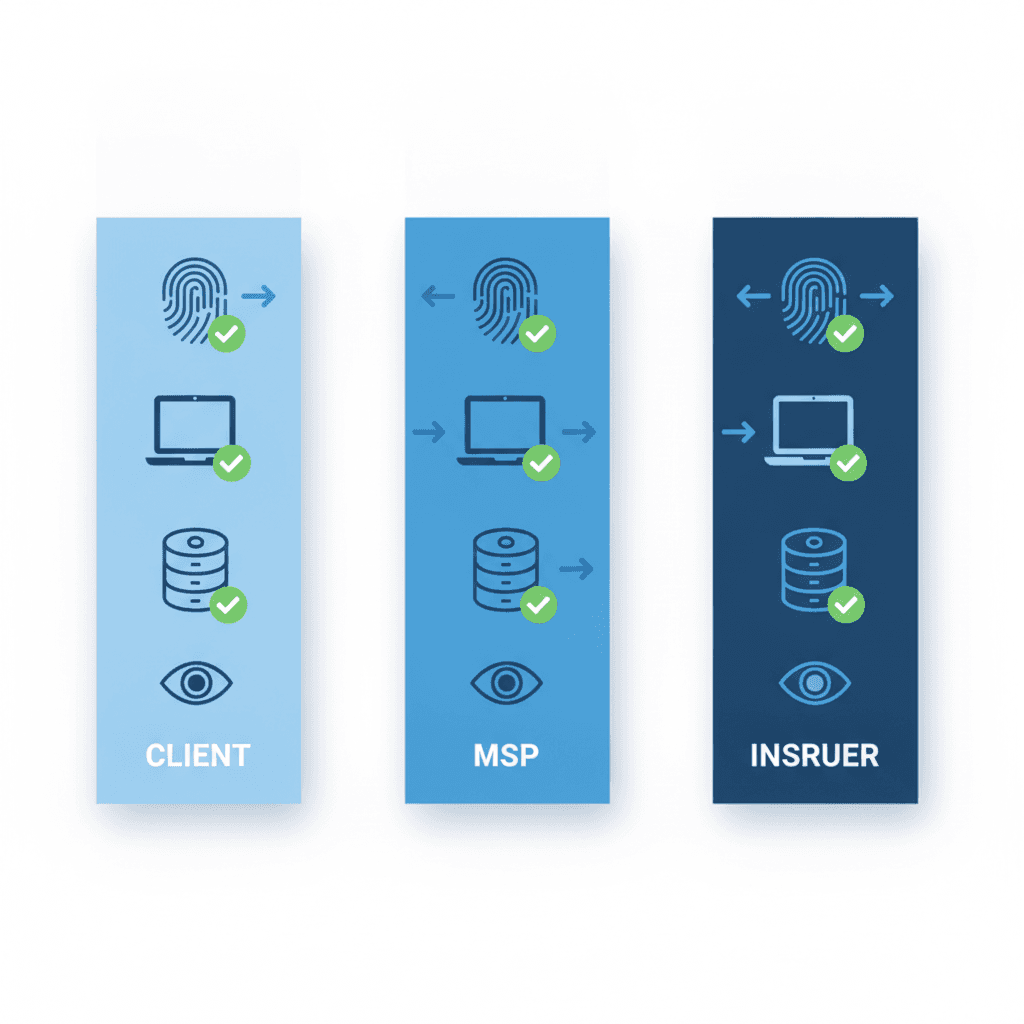
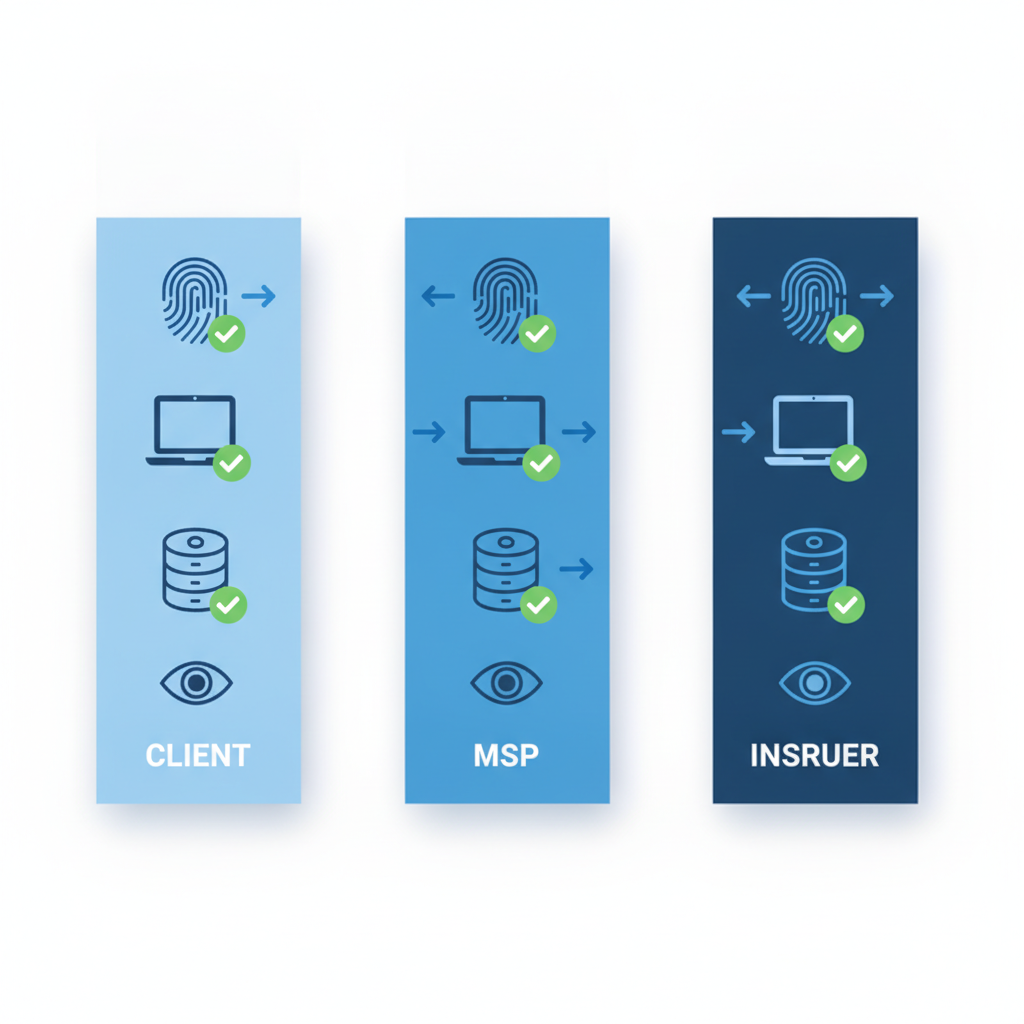
Typical responsibility split (identity, endpoints, backups, monitoring)
Below is a practical mapping you can adapt. This is a typical split but make it explicit in your MSP contract:
- Identity and access: Client owns user provisioning; MSP enforces segmentation and MFA for managed accounts.
- Endpoints: MSP deploys and manages EDR; client approves software installations and local admin rights.
- Backups: MSP executes backups and provides verification reports; client retains restoration authority and tests restores quarterly.
- Monitoring & logging: MSP maintains SIEM and alerting; client provides context for alerts and authorizes incident response actions.
When negotiating, require the MSP to grant evidence rights (logs, runbooks) to your insurer or broker under a confidentiality clause so claims investigators can validate controls quickly.
Claim scenarios: who gets blamed — three real-world hypotheticals
Scenario 1 — missed patch: An MSP schedules OS patches but a third-party application required a separate vendor patch. Ransomware exploited the app. Insurance denied coverage because the policy excluded loss from failure to maintain application updates. Lesson: list patch responsibilities and proof of attempted remediation in your broker submission.
Scenario 2 — backup failure: Backups ran nightly, but backup verification failed for weeks; an endpoint encryption event required a restore. The carrier requested verification logs; because periodic restore tests were missing, the insurer restricted recovery coverage. Lesson: keep restore-test artifacts and include them in your insurer's binder.
Scenario 3 — third-party service outage: A cloud provider outage caused cascading failures. The insurer treated the loss as a third-party vendor event and applied a vendor exclusion. Lesson: consider vendor-coverage endorsements and document your redundancy plan.
Contract clauses to clarify responsibilities and improve claims outcomes
Contracts should explicitly allocate responsibility and evidence rights. Key clauses to include: scope of managed services, patching cadence, backup verification schedule, incident response roles, and log-access rights. Avoid vague phrases like "manage security." Instead, require the MSP to perform defined tasks and deliver artifacts.
Concrete clause examples you can adapt: "MSP will perform monthly patching for approved OS images and provide patch reports within 72 hours of deployment" and "MSP will produce weekly backup verification reports and retain them for 12 months." Those clauses create the artifact trail insurers want.
SLA language, indemnity, and evidence rights clauses
SLA items should include measurable targets: patch window (e.g., apply critical OS patches within 14 days), backup success rate (e.g., 99% completed backups), and mean time to acknowledge SIEM alerts (e.g., 15 minutes). Insurers like measurable controls because they reduce ambiguity.
Indemnity clauses must be aligned: avoid taking on unlimited contractual liability for MSP failures. If you accept indemnity, ask for reciprocal liability or insurance-backed limits from the MSP. Also include an evidence-rights clause that permits your broker or insurer to review logs and runbooks under confidentiality restrictions.
How brokers and underwriters view MSP-managed incidents in NJ & NY regulated sectors
Brokers and underwriters focus on control maturity, documentation, and regulatory compliance. Underwriters often ask for copies of MSP contracts, evidence of SIEM retention, and sample incident reports. For entities subject to NYDFS 23 NYCRR 500, underwriters will check that vendor management and third-party controls are documented.
In practice, a well-organized binder that includes MSP runbooks, SLA examples, and backup-test artifacts shortens underwriting and claims review. If you're in a regulated NJ or NY sector, instruct your broker to flag regulator-specific items so underwriters can price risk accurately rather than lean on blanket exclusions.
Practical mitigation steps: contractual, technical, and insurance-side
Three parallel tracks close coverage gaps: negotiate contract language, harden technical controls, and align with your broker. Do all three.
- Contractual: Add patching cadence, backup verification, and evidence-rights clauses to your MSP agreement.
- Technical: Require EDR, SIEM retention, and periodic restore tests (document results).
- Insurance: Share MSP artifacts with your broker during underwriting and request endorsements for third-party vendor exclusions or nation-state events when necessary.
Copyable checklist (use this when preparing for underwriting):
- Collect MSP runbooks and SLA excerpts for patching, backups, and monitoring.
- Export three months of SIEM alerts, EDR detections, and patch reports.
- Document restore tests and retain evidence for 12 months.
- Have broker review MSP contract for indemnity and third-party exclusions.
Comparison table: before vs after aligning contracts and insurance
| Before | After |
|---|---|
| Vague MSP duties | Explicit patching/backups responsibilities |
| No evidence rights | Insurer/broker access to logs under NDA |
| Vendor exclusions unreviewed | Endorsements negotiated or priced |
Conclusion: checklist to reduce coverage surprises
Summary checklist to reduce surprises: 1) update your MSP contract with explicit duties and evidence rights; 2) collect and store artifact evidence (patch reports, backup tests, SIEM logs); 3) have your broker review policy wordings for third-party vendor exclusions, contractual liability, and state-backed attack clauses. For NJ & NY regulated firms, map your NYDFS 23 NYCRR 500 controls to MSP responsibilities before underwriting.
Primary keyword usage reminder: this guide covered coverage gaps msp cyber insurance exclusions nj ny and actionable steps to reduce them.
If you want help aligning operational controls with insurance-ready artifacts, review our services or our services demo to see typical artifacts and runbook examples. For direct inquiries, contact us, visit contact us, or use contact us to schedule an assessment.
FAQ
What is coverage gaps when you rely on an MSP?
Coverage gaps when you rely on an MSP are situations where an insurer denies or limits a cyber claim because the loss is tied to third-party services, contractual liabilities, excluded causes such as unpatched systems, or other policy carve-outs.
How does coverage gaps when you rely on an MSP work?
Coverage gaps arise when policy language excludes losses caused by third-party vendors, requires the insured to maintain specific controls, or treats certain incidents (like state-backed attacks) as excluded; resolving gaps requires documented responsibilities, evidence artifacts, and broker engagement.
References
- Cyber Insurance Report (NAIC)
- Risk considerations for MSP customers (CISA)
- SP 800-161 Rev. 1 (NIST)
- Market bulletin on state-backed cyber attack wordings (Lloyd's)
- Cybersecurity Resource Center (NYDFS)