

TL;DR
- SMBs in NJ and NY face targeted ransomware and regulatory audit risk; EDR closes the gap.
- Quick answer: deploy a managed EDR with phased rollout, 90-day searchable telemetry, tuned alerts, and MSSP 24/7 coverage to reduce mean time to containment.
- Use the KPI table and deployment checklist below to run a 30–90 day proof-of-value.

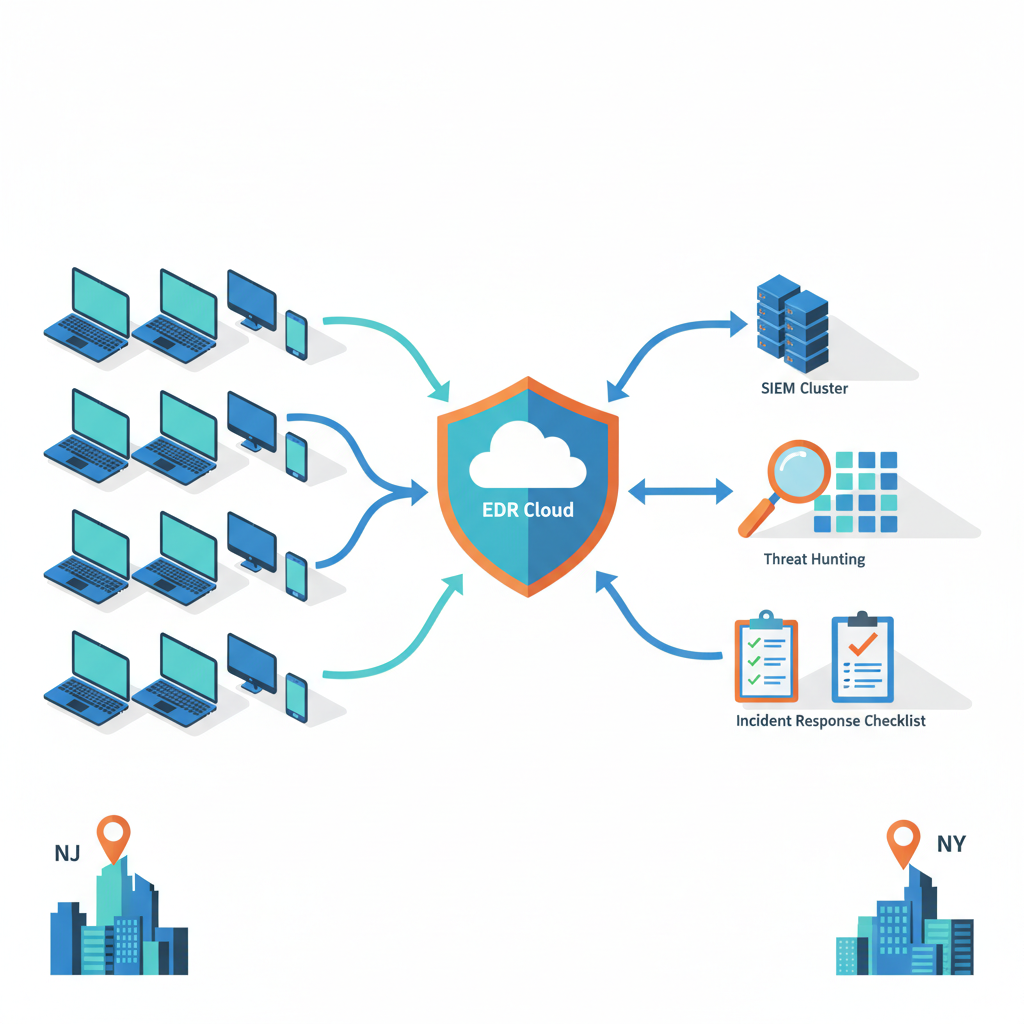
Introduction — purpose of an EDR playbook for SMBs
You probably run a small or mid-sized business in New Jersey or New York and worry about ransomware, credential theft, and losing access to customer data — while still needing to prove compliance for regulators. If your site or office relies on Windows endpoints, remote workers, and SaaS apps, detecting threats early is the difference between an isolated cleanup and a week-long outage. This playbook explains practical steps for edr for nj smbs: choosing, deploying, tuning, and operationalizing endpoint detection so you stop ransomware before it spreads.
Quick answer: implement an enterprise-grade EDR with a phased deployment, collected telemetry retained for audits, tuned detection rules, integration with SIEM and incident response playbooks, and optional MSSP monitoring for 24/7 coverage. "EDR collects endpoint telemetry, detects suspicious behaviors, and enables automated or human-led containment to stop ransomware spread." For more on this, see Prevent ransomware nj ny.
What is EDR and how it stops ransomware (H3: detection vs prevention, H3: telemetry and response capabilities)
EDR is focused on endpoint visibility and response. Unlike simple signature antivirus, EDR monitors process behavior, file writes, PowerShell usage, and credential activity to detect anomalies. In practice, that means catching an attacker who bypassed email filters but then tries to run a custom encryptor on a workstation.
detection vs prevention
Prevention layers (patching, MFA, secure email) reduce attack surface; EDR detects active compromise and prevents lateral movement. Use prevention first, but expect gaps — EDR's containment actions (network isolation, process termination) limit blast radius when prevention fails.
telemetry and response capabilities
EDR collects process, network, and file telemetry; these artifacts support forensics and regulators. For NJ/NY regulated SMBs, plan to keep at least 90 days of searchable telemetry and 12 months of archived logs for audits and breach investigations. Integrate EDR alerts into incident playbooks so containment is automated for high-confidence detections and routed to analysts for suspected false positives.
Retention: keep 90 days of fast-search telemetry and 12 months of archived logs to meet common audit needs.
Choosing the right EDR for regulated NJ & NY SMBs (H3: licensing, telemetry retention, managed detection)
Regulated organizations must balance features, telemetry retention, and compliance. When evaluating endpoint detection and response nj options, ask vendors about licensing by endpoint vs. concurrent sessions, how long raw telemetry is retained, and whether they provide audit artifacts that meet NYDFS 23 NYCRR 500 or HIPAA evidentiary needs for healthcare providers in NJ/NY.
Concrete selection criteria: (1) confirm telemetry export (raw events and file samples), (2) insist on immutable audit trails for at least 365 days where possible, (3) evaluate managed detection capability (24/7 vs. business hours), and (4) verify compatibility with your SIEM and backup tools. For many SMBs, a vendor that supports both granular telemetry search and MSSP integration will shorten investigation times and simplify compliance reporting.
Pick vendors that let you export raw events and file samples as part of standard licensing.
Deployment checklist (H3: phased rollout, H3: exclusions and compatibility, H3: agent hardening)
Deploying EDR without a plan creates outages and false positives. Follow this edr deployment checklist ny to avoid common failures: start with a pilot group, validate exclusions, harden agents, and scale by business unit.
- Phase 1 (week 1–2): Pilot 10–20 endpoints from different roles (admin, R&D, finance).
- Phase 2 (week 3–4): Expand to 30–50% of endpoints; collect baseline telemetry for 14 days.
- Phase 3 (week 5–8): Full rollout with automated containment enabled on high-confidence rules.
Exclusions and compatibility: document approved kernel drivers, backup agents, and endpoint encryption tools; create rule exemptions only with ticketed justification. Agent hardening: enable tamper protection, enforce signed updates, restrict local admin changes, and document rollback steps.
Alert tuning and false-positive reduction (H3: baseline telemetry, H3: playbooks for common alerts)
Raw EDR alerts will overwhelm you at first. Reduce noise by building a baseline: record normal process and network behavior for 14–30 days, then tune detection thresholds. Use alert categories (high, medium, low) and map response actions to each category.
Playbooks for common alerts: (1) suspicious ransomware-like file writes — isolate host, collect file samples, and snapshot backups; (2) credential dump attempts — disable compromised account, rotate keys, and search telemetry for lateral hops; (3) abnormal PowerShell — capture command line, block execution, and run threat hunting queries. Maintain a playbook library so responders follow the same steps each time. For more on this, see Ransomware preparedness nj ny.
Integrating EDR with SIEM, threat hunting, and incident response (H3: automated containment, H3: escalation paths)
Integration multiplies value. Forward EDR telemetry to your SIEM for correlation, retention, and compliance reporting. Use SIEM rules to escalate multi-source incidents and to enrich EDR alerts with identity and cloud logs. This supports threat hunting for smbs by enabling queries across endpoints and infrastructure.
Automated containment: allow EDR to take predefined containment steps for confirmed detections, and require analyst sign-off for lower-confidence actions. Define escalation paths: Tier 1 analyst -> Tier 2 engineer -> leadership — include SLA windows (e.g., 15 minutes for high-confidence containment) in your incident response plan.
Tabletop exercises & incident drills using EDR data
Tabletop exercises convert playbooks into muscle memory. Run quarterly drills using real EDR incidents or simulated telemetry: recreate a ransomware chain, practice containment, restore from backups, and exercise communications with customers and regulators. Use EDR's recorded telemetry to replay attacker steps during the exercise and measure detection and containment times.
After each drill, capture artifacts: incident timeline, root cause, removed exclusions, changed detection thresholds, and a remediation ticket list. These artifacts become proof for compliance audits and inform the next tuning cycle.
Metrics and reporting for leadership and compliance (H3: MTTR, detection time, containment rate)
Leadership needs concise KPIs. Track detection time, mean time to contain (MTTC), containment rate, and false-positive rate. For compliance, include audit artifacts like raw event exports and containment logs.
| Metric | Definition | Target |
|---|---|---|
| Detection time | Time from compromise to first detection | < 60 minutes (target) |
| Mean time to contain (MTTC) | Time from detection to host isolation | < 2 hours (target) |
| Containment rate | % of high-confidence incidents contained automatically | > 70% |
| False-positive rate | % of alerts needing escalation but benign | < 15% |
Operationalizing an MSSP-led EDR model for 24/7 coverage
Many SMBs lack 24/7 security staff. An MSSP model provides continuous monitoring, triage, and escalation. If you pursue an MSSP, require playbook ownership, monthly reporting, and joint runbooks that define which containment actions the MSSP can perform without prior approval.
Operational rules: weekly tuning calls, monthly breach drills, and quarterly SLA reviews. Ensure the MSSP can provide audit artifacts for NYDFS or HIPAA requests and that responsibilities for notification and remediation are contractually defined.
Conclusion — recommended next steps and proof-of-value tests
Next steps: run a 30–90 day proof-of-value pilot using the deployment checklist above, collect baseline telemetry, measure the KPI table metrics, and perform at least one tabletop drill. If you need managed coverage, evaluate vendors for MSSP integration, telemetry export, and audit artifact delivery.
For hands-on help, review our services or schedule a demo at our services. To discuss requirements and compliance concerns, contact us, see company background at contact us, or request a consultation at contact us.
FAQ
What is edr playbook for nj & ny smbs?
An edr playbook for NJ & NY SMBs is a documented set of detection rules, containment actions, retention plans, and escalation paths tailored to regional regulatory needs and common ransomware tactics.
How does edr playbook for nj & ny smbs work?
The playbook works by collecting telemetry, defining tuned detections, automating high-confidence containment, routing complex alerts to analysts, and preserving audit artifacts for NYDFS and HIPAA review.
References
- #StopRansomware Guide — Cybersecurity and Infrastructure Security Agency (CISA)
- Joint cybersecurity advisory on ransomware — CISA
- NIST SP 1800-28B — National Cybersecurity Center of Excellence
- Hospital cybersecurity requirements — New York State Department of Health
- EDR spotlight module — Center for Internet Security