
Introduction — endpoint challenges for hybrid workforces in NJ & NY
What should IT leaders in New Jersey and New York choose when evaluating edr vs xdr for hybrid workforce nj protection?
Short answer: pick the toolset that gives you strong detection across remote devices while keeping endpoint performance and operational overhead manageable. For NJ & NY regulated hybrid workforces, choose solutions that balance detection capability with low endpoint performance impact and co-managed operations.
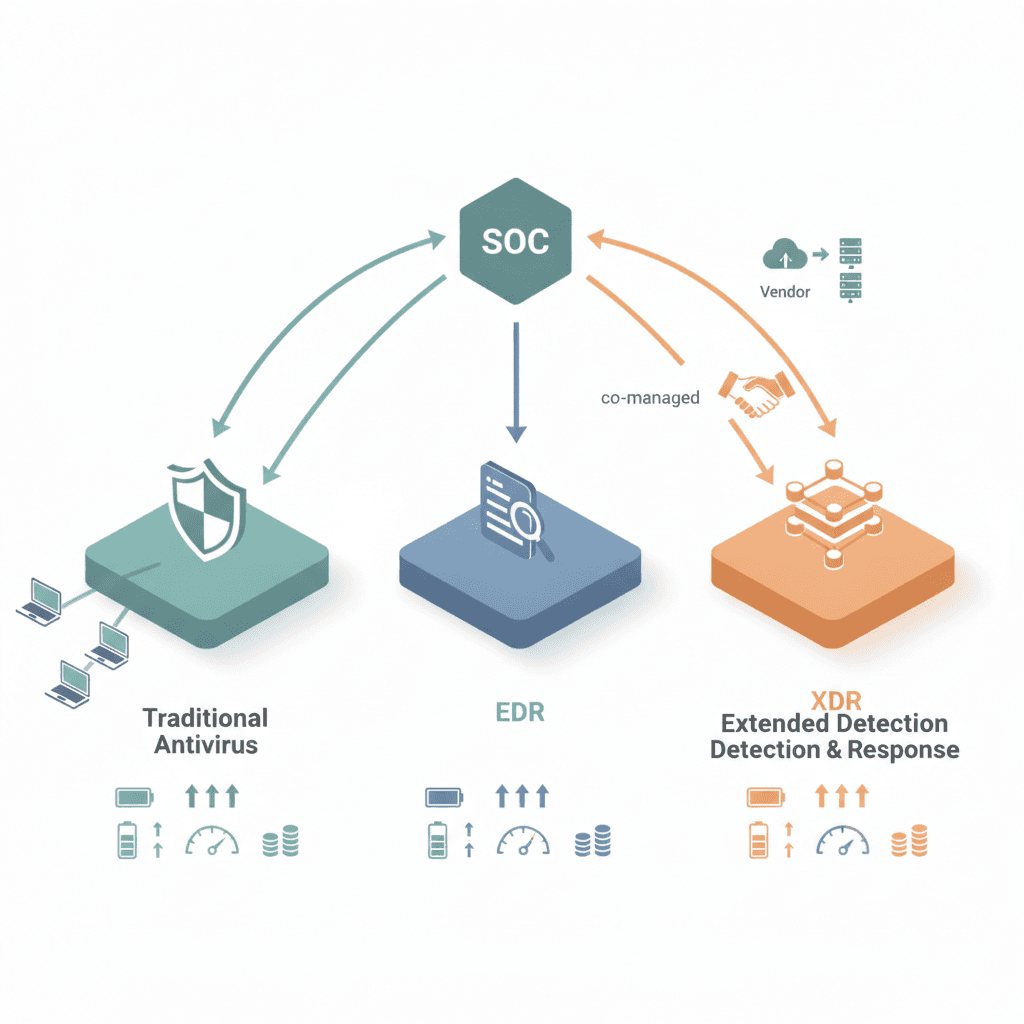
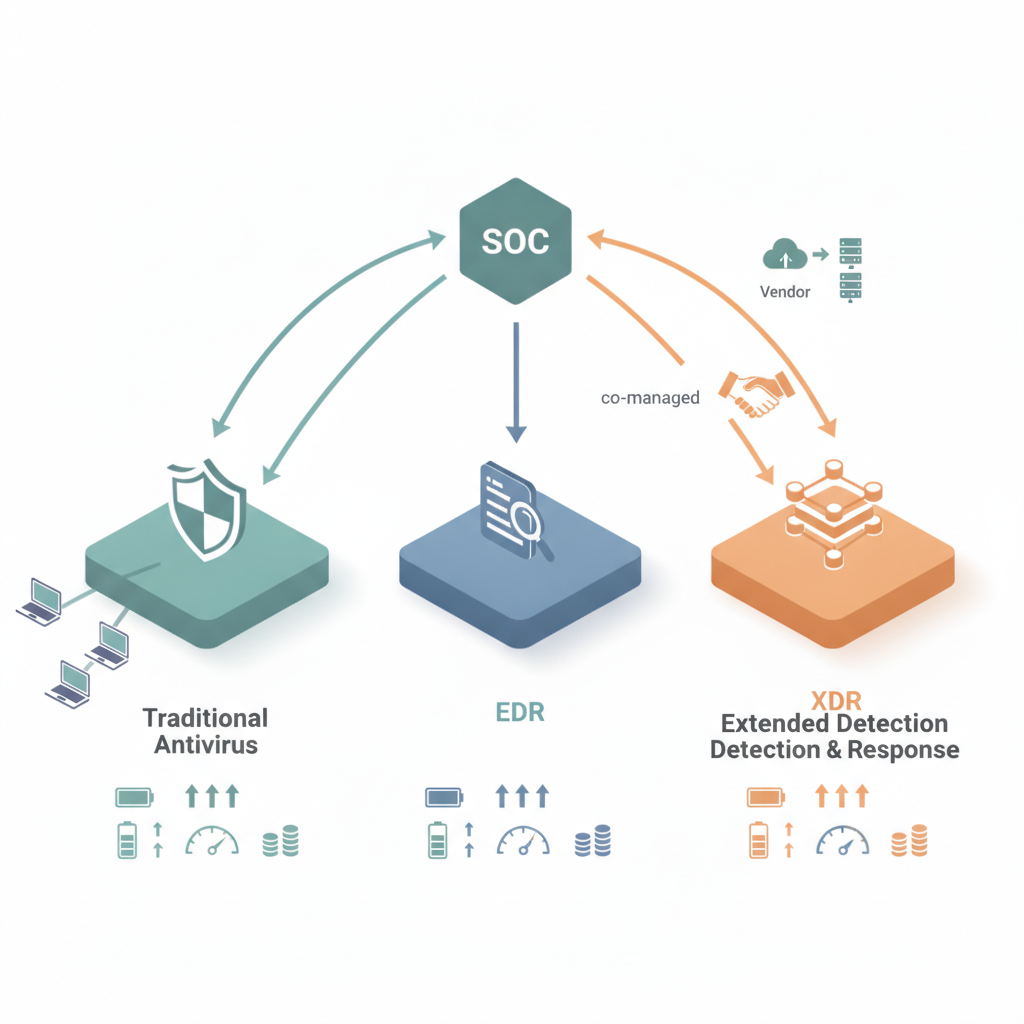
Hybrid teams in NJ and NY—salespeople on trains, accountants at home, clinicians accessing records from branch sites—create a broad attack surface. Traditional antivirus alone stops known malware signatures but misses fileless attacks and lateral movement. EDR (endpoint detection and response) monitors and records endpoint activity for investigation and containment. XDR (extended detection and response) pulls telemetry from endpoints, network, email, and cloud to correlate threats. In practice, you’ll weigh detection fidelity against device battery life, bandwidth for remote laptops, and staff time needed to triage alerts. This article compares EDR, XDR, and traditional AV with practical, vendor-neutral guidance and concrete artifacts you can reuse while planning deployments for regulated businesses in New Jersey and New York. For more on this, see Edr vs mdr vs xdr vs traditional.
Side‑by‑side technology comparison (EDR, XDR, Traditional AV) — capabilities table
This comparison helps you map feature needs to reality when deciding edr vs xdr for hybrid workforce nj teams. For more on this, see Edr & threat.
| Capability | Traditional AV | EDR | XDR |
|---|---|---|---|
| Primary focus | Signature-based malware prevention | Endpoint telemetry, detection, response | Cross-layer telemetry correlation and response |
| Detection scope | Local files/processes | Local processes, behaviors, rollback | Endpoints, network, email, cloud services |
| Suitable for hybrid workers | Basic protection; minimal footprint | Strong endpoint visibility for remote laptops | Best for centralized correlation across remote users |
| Operational cost | Low | Moderate (triage effort) | Higher (integration + SOC needs) |
Visibility beats prevention alone: you can’t investigate what you don’t log.

Detection approaches: signature vs behavioral vs telemetry correlation
Signature detection matches known bad files; it’s fast and light but blind to new attacks. Behavioral detection looks for suspicious actions—process injection, persistence changes, credential dumping—and is the core of EDR. Telemetry correlation—XDR’s advantage—combines endpoint events with email, network, and cloud logs to reveal multi-stage attacks that look benign in isolation.
Example: a compromised remote laptop in NJ receives a phishing attachment (email telemetry). The attachment runs a script that spawns a suspicious process (endpoint telemetry). XDR correlates both streams, raising a higher-fidelity alert than EDR or AV alone. For teams in NY with constrained SOC hours, telemetry correlation reduces false positives and prioritizes incidents that need human response.
Quotable: "Telemetry correlation turns noisy alerts into actionable investigations."
Performance and resource impact on remote devices (battery, bandwidth, latency)
EDR and XDR provide deeper visibility but can affect battery life, CPU, and network usage on remote laptops. When assessing edr performance remote laptops, measure agent CPU under typical workloads and bandwidth used for telemetry uploads.
Typical operational thresholds to target: P95 agent CPU < 8% during user peak, telemetry upload bursts under 500 KB/s, and local scan durations under two minutes for cold-start scans. If you can’t measure, run a 7‑day pilot on a representative fleet to gather metrics. In my experience, teams skip pilot sampling and then see helpdesk tickets spike from slow machines—the common trap to avoid.
Concrete adjustment: enable local caching for signature updates, set telemetry batching during off-hours, and throttle deep scans to when devices are on AC power. These settings reduce user impact while keeping detection effective for hybrid workers across NJ & NY.
Licensing, cost models and total cost of ownership for SMBs
Cost is often the deciding factor. Traditional AV licensing is typically per-seat and low-cost. EDR adds per-endpoint fees and may require storage for telemetry. XDR often bundles multiple data sources and can charge per ingested GB or per endpoint plus connectors.
For an SMB in New Jersey, an endpoint protection cost comparison should include license fees, expected SOC staffing (hours/week), storage for telemetry, and incident handling costs. Example comparison items to quantify: yearly per-seat license, average monthly ingress GB, and estimated analyst hours per incident. Use a 12‑month TCO table to avoid sticker shock from hidden storage or integration work.
Quotable: "Low upfront license costs can hide ongoing analyst and storage expenses; include both for true cost comparison."
Operational overhead — staffing, alert volume, and SOC maturity
Operational overhead shifts with the product choice. Traditional AV needs almost no ongoing triage. EDR surfaces behavioral alerts that require an analyst to investigate. XDR reduces false positives but increases integration work and can centralize alerts into a SOC workflow.
Concrete guidance: estimate alerts per 100 endpoints—if your SOC is small, plan for 10–30 triage actions weekly per 100 endpoints on EDR, and 5–12 on XDR with good tuning. When hiring or outsourcing, measure median time-to-triage and mean time-to-contain; a realistic target for regulated firms is mean time-to-contain under 4 hours for confirmed incidents (adjust by compliance needs).
Staffing matters more than feature lists: a powerful tool without trained analysts is only logging.
Co‑managed and hybrid deployment patterns for regulated companies
Regulated firms in New Jersey and New York often prefer co-managed endpoint strategies that split responsibilities between the in-house IT team and an MSSP. Co-managed patterns let your internal team own policy decisions while the managed partner handles 24/7 monitoring, threat hunting, and incident response.
Example pattern: keep policy control and whitelist/blacklist decisions in-house; outsource alert triage, enrichment, and escalation to a partner. This preserves control for compliance audits while reducing 24/7 operational hiring. Use clear SLAs and a documented runbook for handoffs between teams.
Use cases and recommended stacks by business size and regulation level
Decision table: match business size and regulation to approach.
| Business profile | Recommended stack | Rationale |
|---|---|---|
| Small, low-regulation | Traditional AV + basic EDR | Cost-effective, limited SOC needs |
| Mid-size, regulated (NJ/NY) | EDR + co-managed SOC | Endpoint visibility with outsourced response |
| Enterprise, multi-cloud | XDR with SOC | Cross-telemetry correlation and centralized response |
For many growing companies in New Jersey and New York, starting with EDR and a co-managed model provides a strong balance of detection and manageable cost. If you already run central logs across email, network, and cloud, upgrading to XDR may pay off by cutting investigation time.
Decision checklist for IT leaders in NJ & NY
Use this checklist to evaluate candidates and prepare a pilot.
- Define required telemetry sources (endpoints, email, network, cloud).
- Run a 7–14 day pilot on representative remote laptops; collect CPU, battery, and bandwidth metrics.
- Estimate alerts/week per 100 endpoints and map required analyst hours.
- Compute 12-month TCO: licenses, storage, integration, SOC hours.
- Verify compliance features: audit logs, evidence export, and retention policies.
Implementation best practices for hybrid workforces (MFA, conditional access, segmentation)
EDR/XDR is one layer. Implement multi-factor authentication, conditional access policies, and network segmentation to reduce risk surface. For remote laptops, require device posture checks before granting access to sensitive systems.
Step-by-step: enable MFA for all users, configure conditional access requiring compliant endpoints for high-risk apps, and segment internal services so a compromised laptop doesn’t reach critical servers. Include the endpoint agent in your change window and communicate scan schedules to users to avoid surprise performance complaints.
Conclusion — recommended next steps and pilot plan
Recommendation: for most regulated hybrid workforces in New Jersey and New York, begin with EDR plus co-managed operations; move to XDR when you’ve standardized additional telemetry sources and need centralized correlation. Pilot on 10–20 representative remote laptops, measure edr performance remote laptops metrics, and perform an endpoint protection cost comparison over 12 months.
Take the next step: review your options and consider a co-managed deployment using the company Services to cover monitoring and response. To discuss a pilot or get a free assessment, visit our services or request a demo at our services. For direct contact, use the contact pages: contact us, contact us, or contact us.
References
- Market Guide for Extended Detection and Response (Gartner)
- ATT&CK® Evaluations (MITRE)
- NIST SP 800-61 revisions (NIST)
FAQ
What is edr vs xdr vs traditional av for hybrid workforces in nj & ny?
EDR is endpoint detection and response that records and analyzes endpoint activity; XDR extends correlation across endpoints, network, email, and cloud; traditional AV uses signature-based detection for known malware and offers the lightest endpoint footprint.
How does edr vs xdr vs traditional av for hybrid workforces in nj & ny work?
Traditional AV scans files for known signatures; EDR runs an agent that collects process, file, and behavior telemetry to enable investigation and containment; XDR ingests multiple telemetry sources and correlates them to surface higher-fidelity incidents across a distributed hybrid workforce.