

TL;DR
- Transition vendor risk management to an MSSP when internal capacity, audit readiness, or regulator exposure exceeds your team’s bandwidth.
- Use a decision matrix (in-house / co-managed / fully outsourced), a 30/60/90 phased pilot, and a vendor inventory plus evidence package before going live.
- Require MSSP compliance experience with NYDFS 23 NYCRR 500 and HIPAA, SIEM integration, continuous monitoring, and on-site forensics capability for NJ/NY firms.
- Use a short pilot: track remediation time, evidence collection, and SLA adherence; typical pilots target a 40–60% reduction in remediation time.

Introduction: Transitioning vendor risk management to an MSSP is a project, not a checkbox. If you’re responsible for security, compliance, or operations at a New Jersey or New York regulated company, this guide gives you an actionable path: spot the trigger points, choose the right operating model, gather the exact artifacts an MSSP needs, run a tight pilot, and lock post-transition governance. This article uses practical examples and includes a copyable vendor risk outsourcing checklist ny and an mssp vendor risk transition plan you can adapt.
When NOT to transition vendor risk management to an MSSP
Do not outsource vendor risk management if you meet any of these conditions: (1) you have an internal security team that regularly conducts vendor assessments, evidence collection, and remediation within SLAs and you have direct control of contracts and forensics; (2) your vendor relationships are few, highly specialized, and require proprietary technical expertise that external teams cannot replicate without a long knowledge-transfer period; (3) your budget or procurement rules prevent contractual SLAs or data-sharing terms required by an MSSP; (4) regulatory constraints prohibit vendor-of-vendor access to sensitive data in your jurisdiction.
In practice, teams often try outsourcing too early. The usual trap is handing an MSSP a partial vendor list and expecting immediate audit-ready evidence. Fix inventory and evidence gaps first.
Signs your organization should consider outsourcing vendor risk management
If you want to transition vendor risk management to mssp, watch for three clear signals. First, remediation cycles are long: you still wait days or weeks for a vendor to produce evidence or fix issues. Second, audit pain: SOC 2 surveys, NYDFS 23 NYCRR 500 attestations, or HIPAA audits repeatedly flag third-party controls. Third, scale and complexity: a rapid increase in SaaS vendors, cross-border data flows, or high-risk suppliers (payments, identity, hosting) that exceed your team’s bandwidth.
Example: a mid-sized NJ financial services firm had 47 vendors, 12 of them in-scope for NYDFS, and the security lead spent 40% of her time chasing evidence each quarter. That operational drag and regulator exposure are classic reasons to outsource vendor risk management or adopt a co-managed model.
Quotable: "Long vendor evidence cycles and repeated audit findings are the clearest operational signals to outsource vendor risk management."
Decision framework: in-house, co-managed, or fully outsourced (quick matrix)
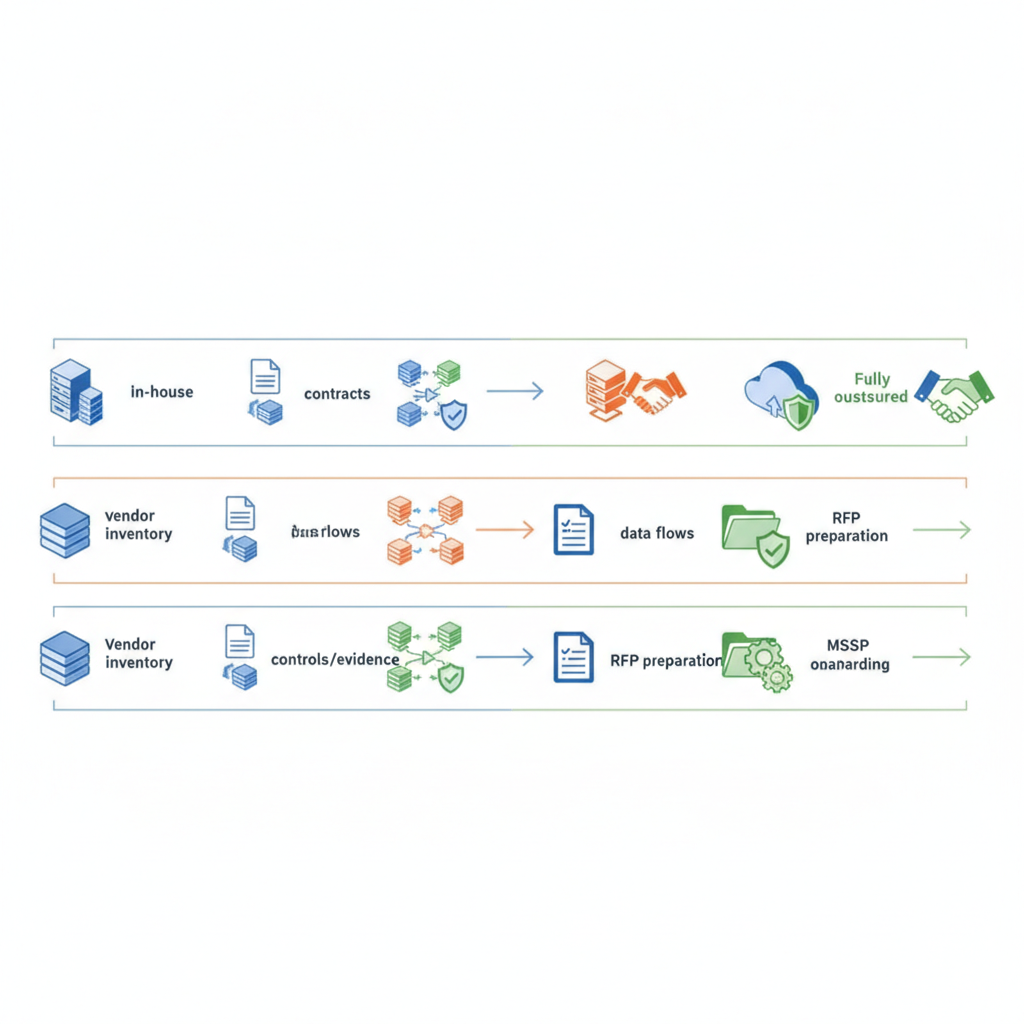
Decide by scoring three dimensions: risk exposure (regulatory & data sensitivity), internal capacity (headcount & tools), and cost tolerance. Assign each dimension 1–5 and sum. Score <7: keep in-house with tooling improvements. Score 7–11: co-managed vendor risk nj is appropriate — share tooling and responsibilities. Score >11: pursue a full MSSP vendor risk transition plan and outsource vendor risk management.
Outsource when your remediation backlog exceeds your team’s available hours for one quarter.
Concrete example: a regulated healthcare company (HIPAA) with limited staff and repeated audit findings typically lands in the co-managed to fully outsourced band. A co-managed approach keeps legal and procurement in-house while delegating assessments and continuous monitoring to the MSSP.
Preparing for transition: internal stakeholders and documentation to gather
Begin by assembling a core transition team: security lead (project owner), procurement, legal, IT ops, compliance, and an executive sponsor. Create a single transition binder (digital) that contains: current vendor inventory, master service agreements (MSAs), data flow diagrams, recent penetration test and SOC 2 reports, incident response plans, and previous vendor assessments. Include a contact matrix with vendor escalation paths.
Actionable checklist: gather these artifacts before an RFP—vendor list, contract copies, network/data flow diagrams, recent audit reports, current evidence packages (attestations, encryptions, SLA proof). This reduces the MSSP discovery phase and compresses the 30-day onboarding.
Inventorying vendors, contracts, and data flows
Inventory every vendor with these fields: vendor name, service category, data types processed, contract effective/renewal dates, point of contact, hosting locations, and regulatory in-scope flags (NYDFS/HIPAA/SOC 2). Add a simple risk score per vendor (1–5) based on data sensitivity and access privileges. Prioritize vendors scoring 4–5 for immediate assessment.
Current controls & evidence packages
Map each vendor to the controls you already collect: encryption at rest/in transit, MFA, EDR/anti-malware, SOC 2 report availability. For each control, attach evidence: screenshots, scan reports, or signed attestations. If evidence is missing, note the remediation owner and target date—this becomes your first pilot workstream.
Selecting an MSSP: RFP checklist focused on vendor risk capabilities
Write an RFP section specifically for vendor risk management. Require: demonstrated experience with NYDFS 23 NYCRR 500 and HIPAA, SIEM integration, continuous monitoring, standardized evidence packages, and the ability to perform on-site forensic support in NJ/NY. Ask for past anonymized case studies and a clear SLA table for evidence delivery and remediation support.
An MSSP must produce audit-ready evidence within contracted SLAs or provide a documented remediation plan within 48 hours.
Quotable: "Require NYDFS and HIPAA compliance experience in the RFP to reduce regulator friction."
Technical capabilities (assessments, continuous monitoring, SIEM integration)
Technical must-haves: automated vendor risk questionnaires, continuous monitoring feeds into your SIEM (or joint SIEM access), vulnerability scanning on vendor-facing assets, and a defined integration approach (API, SFTP, portal). Define target thresholds where possible—e.g., critical vulnerabilities P95 < 72 hours to triage—so the MSSP responds predictably.
Compliance experience (NYDFS, HIPAA, SOC 2)
Ask MSSPs for concrete evidence of regulator work: involvement in NYDFS 23 NYCRR 500 readiness, HIPAA risk assessments, and SOC 2 evidence collection. Local NJ/NY MSSPs often have advantages for on-site forensics and regulator interactions; note that in the RFP. Cite standards such as NIST guidance when evaluating their supply chain practices (NIST).
Phased transition plan (30/60/90 day milestones)
Use a phased approach. Day 0–30: onboarding and discovery—validate vendor inventory, collect missing evidence, integrate monitoring feeds. Day 31–60: pilot remediation—target 5–10 high-risk vendors, run assessments, and test evidence pipelines. Day 61–90: scale and handoff—apply lessons to remaining vendors, finalize runbooks, and move to steady-state SLA reporting.
Pilot scope, KPIs, and success criteria
Pilot KPIs: vendor remediation time (median and P95), percent of vendors with complete evidence packages, time to escalate incidents, and SLA compliance. Success criteria: 40–60% reduction in average remediation time and consolidated evidence sets for audit reviewers. (Transition pilots typically aim to reduce vendor remediation time by 40–60% and consolidate evidence collection for audits, improving audit readiness for NYDFS/HIPAA reviews.)
Knowledge transfer and runbook creation
Create runbooks that cover evidence requests, escalation flows, and how to accept or reject vendor attestations. Transfer must include sample evidence packages, API credentials, onboarding checklists, and a shared ticketing workflow. Store runbooks in a versioned repository and schedule quarterly tabletop exercises with the MSSP and internal SOC.
Integration points: legal, procurement, SOC, and incident response
Vendor risk touches contracts, procurement, and incident response. Legal must approve contract clauses permitting the MSSP to access vendor evidence and perform forensic work. Procurement should include security SLAs in MSAs. The SOC needs SIEM access and playbooks for vendor-involved incidents. Ensure incident response templates list vendor contact priorities and evidence preservation steps.
Cost, ROI, and procurement tips for NJ & NY regulated buyers
Procurement tip: build cost evaluations around time-to-evidence and remediation rather than raw headcount. Ask MSSPs to price a pilot and a steady-state per-vendor fee. For NJ/NY buyers, factor in potential on-site forensic visits and regulator engagement time. Use ROI framing: reduced audit prep hours, fewer failed attestations, and reduced breach windows. Typical procurement teams treat the MSSP as a specialized services contract with measurable KPIs and periodic reviews.
Post-transition governance: SLAs, reporting, and periodic audits
Set recurring governance: monthly security reviews, quarterly audit readiness reports, and annual SLA renewals. SLAs should define evidence delivery times, remediation windows, escalation times, and penalties or credits. Include a regular third-party audit or red-team review and require the MSSP to provide a SOC-like evidence portal for internal and external auditors.
Case study template & lessons learned (anonymized example applicable to NJ/NY)
Use this anonymized template: challenge, scope, approach, pilot KPIs, results, and lessons learned. Example entry: challenge—47 vendors with inconsistent evidence; scope—pilot 8 high-risk vendors; approach—co-managed evidence collection plus SIEM integration; KPI—remediation median time reduced; lessons—inventory completeness cut discovery time by two-thirds. Replace specifics with your metrics and include regulator interactions if applicable.
Checklist: go/no-go checkpoints before decommissioning in-house processes
Use this checklist before decommissioning your internal vendor risk workflow. Each item must be verified and signed off by the transition team.
- Vendor inventory complete and validated (name, data type, contracts).
- Evidence package template standardized and populated for top 20% risk vendors.
- SIEM integration tested and alerts flowing to MSSP and internal SOC.
- Legal approved MSSP access and forensic clauses included in MSAs.
- Pilot KPIs met: remediation time target and evidence consolidation goals achieved.
- Runbooks and knowledge transfer sessions completed and recorded.
- Governance cadence established (monthly/quarterly) and reporting templates agreed.
Two reusable artifacts you can copy: a simple decision matrix and this vendor risk outsourcing checklist ny above. Use the checklist as your final go/no-go gate and preserve a rollback plan for 30 days post-decommissioning.
Final CTA: to learn how managed teams integrate these steps operationally, review our services or request a demo at our services. For procurement or compliance questions, contact us or visit the company page at contact us and contact us.
References
- NIST: Cybersecurity supply chain risk management practices
- NYDFS guidance on managing risks related to third-party service providers
- CISA advisory on protecting managed service providers and customers
FAQ
- What does it mean to transition vendor risk management to an MSSP?
Transitioning vendor risk management to an MSSP means shifting responsibility for vendor assessments, evidence collection, continuous monitoring, and remediation coordination from your internal team to an external managed security provider under defined SLAs.
- How do you transition vendor risk management from in-house to an MSSP?
Transitioning involves scoping and inventorying vendors, gathering contracts and evidence, issuing an RFP with compliance requirements (NYDFS/HIPAA), running a 30/60/90 pilot, completing knowledge transfer and runbooks, and setting post-transition governance and SLAs.