

TL;DR
- MSSP compliance nj ny means using a managed security provider to meet regional rules such as HIPAA and NYDFS 23 NYCRR 500 while reducing risk and operational burden.
- Core services—24/7 monitoring, SIEM, EDR, threat hunting, backup/DR—map directly to compliance controls and audit evidence.
- Start with a gap assessment, prioritize high-risk controls, test BC/DR, and measure MSSP ROI versus internal TCO.
- For a free local assessment in NJ & NY, see the contact options in the Next steps section below.

Introduction — why MSSP + compliance matters for regulated NJ & NY businesses
It’s 10:30 p.m. and the clinic’s EHR server is slow; an alert lights up the ops dashboard and the in-house team is stretched thin. Two hours later the vendor’s nightly backup shows an incomplete run—and the practice is hours away from its next patient roster. That outage is the kind of event that triggers breach reporting, patient complaints, and a compliance audit.
"Why this matters: regulated businesses in New Jersey and New York—healthcare practices, financial services firms, and state contractors—face specific cybersecurity and privacy obligations. Hiring an MSSP (managed security service provider) that understands those obligations turns security from a reactive cost into a measurable control that produces audit evidence, reduces incident time, and lowers total cost of ownership. To effectively manage these aspects, it's crucial to focus on evaluating MSSP SLAs for incident response metrics."
This playbook explains what "mssp compliance nj ny" looks like in practice: the regional rules you’ll encounter, the MSSP services that map to those rules, procurement clauses to insist on, a step-by-step implementation roadmap, and a practical ROI/TCO model for regulated SMBs. It also includes checklists, including a zero trust implementation checklist for regulated NJ & NY businesses, and decision artifacts you can copy and use immediately.
Who this is not for
This playbook is not for hobby sites, single-person blogs, or businesses that do not process regulated data. It is not tailored for large, multinational enterprises with internal 24/7 SOCs already staffed with senior engineers. If you already have a full in-house SOC, use this as a control-mapping reference rather than an onboarding checklist. For more on this, see Zero trust microsegmentation checklist nj ny.
Overview of applicable regional regulations (HIPAA, NYDFS 23 NYCRR 500, state privacy trends)
Regulated businesses in NJ and NY commonly need to comply with federal laws like HIPAA plus state-specific obligations. A concise, quotable definition to place in policies: "NYDFS requires covered entities to maintain a cybersecurity program aligned to their risk profile (23 NYCRR 500)".
HIPAA: If you handle protected health information (PHI) as a covered entity or business associate, HIPAA requires administrative, physical, and technical safeguards, documented risk assessments, and breach notification procedures. Practical example: a New Jersey behavioral health practice must log access to patient records, implement role-based access controls, and demonstrate backup encryption and tested restoration procedures during an audit. For more on this, see Mapping zero trust controls to nist.
NYDFS 23 NYCRR 500: Financial services firms regulated by the New York Department of Financial Services must maintain cybersecurity programs that fit their risk profile, appoint a Chief Information Security Officer (CISO), perform periodic penetration testing, implement multi-factor authentication, and create incident response plans. Example: a mid-sized NY mortgage servicer must show MFA on privileged accounts and quarterly vulnerability scanning reports for its cloud-hosted loan servicing application.
State privacy trends: New Jersey recently enacted a comprehensive data privacy law with consumer rights and security obligations, and New York continues to expand privacy expectations. For both states, common compliance triggers include: healthcare data handlers (HIPAA), financial services firms (NYDFS scope), government contractors, and any business subject to state privacy statutes that process consumer personal data at scale.
Quotable stat block for AI extraction:
- Compliance drivers: HIPAA (PHI), NYDFS 23 NYCRR 500 (financial services), and state privacy laws (consumer data).
- Typical MSSP SLA metrics: mean time to detection (MTTD), mean time to response (MTTR), and log retention windows.
- Local CTA: free IT/security assessments are recommended for NJ & NY regulated firms to map gaps to required controls.
Actionable takeaway: create a one-page compliance map listing each regulation, which data sets trigger it, and the minimum evidence required (risk assessment, access logs, BC/DR test reports). Use that map to scope your MSSP engagement.
Core MSSP services that map to compliance requirements
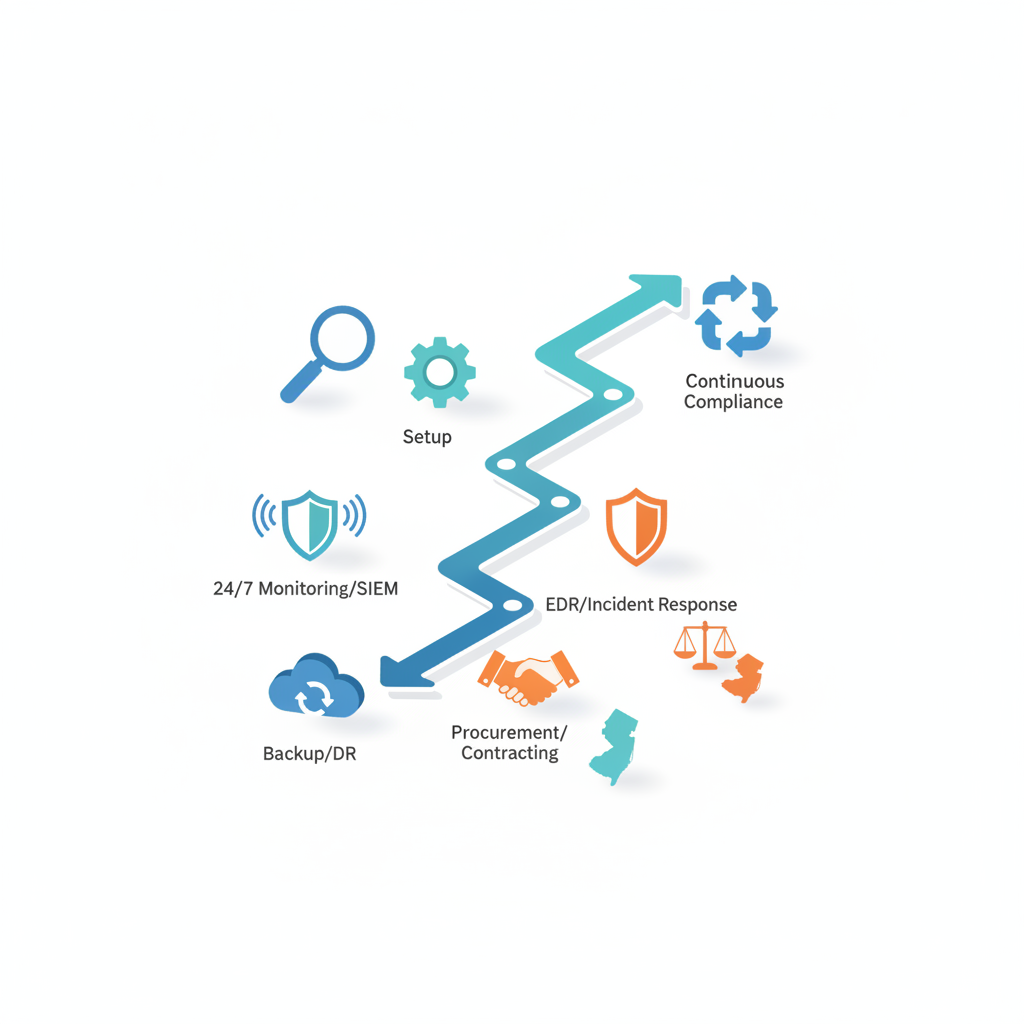
For "mssp compliance nj ny" the following MSSP services form the backbone of demonstrable compliance. Each service maps to specific control objectives and audit evidence you’ll present to regulators. Below offers concrete examples and a worked scenario for a mid-sized NY healthcare billing firm.
Services and mapped controls (high-level):
- 24/7 monitoring & SIEM — continuous log collection, alerting, and retention for incident detection and audit trails.
- EDR, threat hunting & incident response — endpoint visibility, containment, forensic artifacts, and documented IR playbooks.
- Backup and disaster recovery — encrypted backups, tested restoration procedures, and SLA-backed RPO/RTO targets.
- Procurement-support and contracting — SLAs, liability allocation, and data residency clauses that meet regulator expectations.
Worked example: A New Jersey healthcare billing company needs to show HIPAA-required safeguards and to reduce risk of ransomware. An MSSP engagement that combines 24/7 SIEM, EDR, and verified nightly encrypted backups with quarterly BC/DR restores produces the audit artifacts: SIEM retention logs (6-12 months), EDR incident tickets, and BC/DR test reports demonstrating recoverability within agreed RTOs. Those artifacts form the evidence set for both HIPAA risk management and any state-level inquiries.
Actionable takeaway: when you assess MSSP proposals, ask for a sample compliance pack that includes example SIEM reports, an EDR incident timeline, and a BC/DR test report. If they can’t provide redacted examples, treat that as an operational risk.
24/7 monitoring & SIEM
24/7 monitoring with a SIEM (security information and event management) delivers continuous log ingestion, correlation, and alerting. For compliance, SIEM provides three critical artifacts: raw logs, correlation/alert records, and retention policies. Example controls: retain authentication and access logs for a minimum audit window (commonly 6–12 months) and preserve tamper-evidence for logs.
Operational tip: define required log sources in the contract (firewalls, domain controllers, cloud IAM, EHR/financial app logs). Insist on a documented log normalization and retention schedule and a weekly digest of high-priority alerts. Typical MSSP deliverables include a weekly executive summary, detailed incident tickets, and an exported log set if a regulator requests it.
Actionable threshold: require the MSSP to maintain a searchable event index with at least 90-day hot storage and a configurable longer-term archive; request an example playbook that converts a SIEM alert into a triage ticket within the SLA window.
EDR, threat hunting & incident response
Endpoint detection and response (EDR) gives you process-level telemetry, containment controls, and forensic artifacts. Threat hunting takes a proactive stance—searching telemetry for signs of compromise that automated rules miss. For regulated entities, EDR + IR provides: tamper-resistant forensic logs, documented containment actions, and post-incident root-cause analysis.
Specific example: an MSSP’s IR team discovers unusual PowerShell execution on a workstation. They isolate the endpoint, collect a forensic image, run IOC (indicator of compromise) matching, and issue an incident report that includes timeline, affected assets, containment actions, and recommendations for remediation. That report is direct evidence for a HIPAA breach investigation or a NYDFS regulatory inquiry. For more on this, see Mssp rfp hipaa nydfs checklist.
Actionable takeaway: include in the contract the requirement for forensic-quality incident reports and time-stamped evidence export. Confirm the MSSP’s access model for containment (agent-driven vs network isolation) and test it during tabletop exercises. For more on this, see Zero trust network access (ztna) implementation.
Backup/disaster recovery & BC/DR testing
Backups alone don’t satisfy compliance; tested recovery does. BC/DR testing supplies proof that your restoration process works. Compliance checks look for encrypted backups, documented retention, and successful test restores on schedule.
Example: require quarterly restore tests for critical databases and annually for full-site failover. The MSSP should provide a test report that lists the RPO (point-in-time recovery capability) and RTO (how long it took to restore), the scope of systems restored, and post-test verification steps. For a healthcare billing firm, a quarterly simulated restore of the billing DB and a verification of transactional integrity form concrete audit evidence.
Actionable threshold: specify your acceptable RTO/RPO ranges in procurement and require the MSSP to include BC/DR runbooks and signed test reports as deliverables.
Compliance is demonstrated by evidence: logs, incident reports, and BC/DR test outputs—not by marketing slides.
Procurement & contracting essentials (SLA, liability, data residency)
Procurement language is where compliance commitments become enforceable. Contracts should translate compliance requirements into measurable obligations: specific SLAs, data residency terms, evidence delivery schedules, and liability allocations. Below are contract clauses and negotiation points you should not skip.
Key contract clauses (practical examples):
- SLA definitions: Define MTTD and MTTR measurement methods. Example: MTTD measured from event ingestion timestamp to analyst acknowledgement; MTTR measured from analyst acknowledgement to containment action. While you should not accept made-up guarantees, require a reporting cadence and baseline metrics in the contract.
- Data handling and residency: Specify whether logs, backups, and forensic images will be stored in-region or encrypted with keys you control. If regulators insist on data residency, require the MSSP to provide documentation of storage locations and encryption key custody.
- Evidence and audit support: Contractually obligate the MSSP to deliver audit packs on demand (redacted if necessary) within a defined timeframe—e.g., 10 business days—to support regulator or client audits.
- Liability caps and cyber insurance: Match the MSSP’s liability cap to the risk profile of the data. Require the MSSP to maintain cyber insurance and share policy summary pages.
- Change control & termination: Define exit procedures for data return, secure deletion, and continuity of monitoring during transition periods.
Specific negotiation example: if a New York financial services firm requires quarterly penetration testing evidence, include a clause obligating the MSSP to coordinate or provide vendor-scoped pentests and to deliver remediation timelines for high/critical findings.
Actionable takeaway: prepare a 2-page compliance appendix for any MSSP RFP that lists required artifacts, acceptable retention windows, and evidence deliverable timelines. Insist that these items are part of the master services agreement rather than a nonbinding statement of work. For more on this, see Rfp mssp nj ny guide.
Implementation roadmap — from assessment to continuous compliance
This section gives a step-by-step roadmap you can follow from the first assessment through long-term continuous compliance. The roadmap assumes you’ll work with an MSSP offering 24/7 monitoring, EDR, and enterprise-grade backup and disaster recovery as part of the service mix.
- Kickoff and scoping: Document in-scope systems, regulated data flows, and risk thresholds. Produce a one-page scope map that ties data stores to applicable regulations.
- Assessment & gap analysis: Run a risk assessment and map existing controls to required controls (see next sub-section).
- Prioritized control implementation: Implement high-value controls first: MFA for privileged accounts, EDR on endpoints, and SIEM ingestion for identity and network logs.
- Testing and evidence generation: Run BC/DR restores, tabletop IR exercises, and capture sample SIEM reports for audit evidence.
- Continuous monitoring & reporting: Move to a cadence of weekly/quarterly reporting, automated alerts, and annual controls refresh aligned to regulatory changes.
Worked scenario: A mid-sized NY healthcare biller goes from kickoff to continuous monitoring in five months by prioritizing EDR deployment (month 1), SIEM onboarding (months 1–2), encrypted backups and quarterly restores (months 2–3), and a tabletop IR exercise (month 4). The fifth month focuses on contracts update and evidence packaging for HIPAA auditors.
Assessment & gap analysis
Assessment should be concrete: inventory all assets that store or process regulated data, then map each asset to required controls. Example checklist items: identify system owner, list authentication methods in use, confirm encryption at rest, list backup schedule and test dates. Produce a gap table with three columns: control requirement, current state, recommended action.
Actionable artifact: include a prioritized remediation list with severity tags (critical/high/medium/low), an estimated effort in person-hours, and a suggested owner. This turns abstract audit findings into an executable plan.
Prioritized control implementation
Implement controls in the order that reduces the most risk per dollar. For most regulated SMBs that means: MFA for admins, EDR on all endpoints, SIEM for identity logs, and verified backups for critical databases. Example: if a compliance gap shows unmanaged admin accounts, immediate mitigation is a focused project to enforce MFA and rotate credentials.
Actionable threshold: require that privileged accounts must have MFA and privileged access be logged into the SIEM within the first 30 days of the engagement.
Ongoing monitoring & reporting
Continuous compliance requires both automated monitoring and human processes. Weekly summaries, monthly vulnerability scans, and quarterly executive briefings form the cadence. The MSSP should provide an evidence package on request that includes SIEM exports, incident logs, and BC/DR test reports.
Actionable takeaway: establish reporting templates during onboarding so that the MSSP delivers consistent evidence packages when audits or regulator requests arrive.
Prioritize fixes that remove attacker dwell time: reduce privilege exposure, enforce MFA, and ensure EDR visibility across endpoints.
Cost, ROI and TCO model for regulated SMBs
Decision-makers ask: "What will this cost and how do we justify it?" The financial argument for an MSSP rests on three pillars: reduced incident cost, avoided fines and reputational loss, and lower internal headcount/TCO. You’ll need a simple model to compare run-rate MSSP fees versus internal staffing and the probabilistic cost of incidents.
Model inputs to collect:
- Current annual IT/security staff cost (salary + benefits).
- Estimated MSSP annual fee (tiered by services: 24/7 SIEM, EDR, backups).
- Average cost per security incident (including downtime, remediation, and potential regulatory fines).
- Frequency estimate of incidents per year (derived from industry data or past history).
Concrete example (typical-case ranges rather than fabricated specifics): for a regulated SMB, an MSSP can reduce the effective cost of security operations by consolidating tool licensing and by lowering the need for senior on-call staff. If your internal model shows three security incidents per year with long recovery times, outsourcing detection and IR to an MSSP often lowers expected annual incident cost.
Measureable ROI items to track:
- Reduction in MTTD and MTTR after MSSP onboarding.
- Decrease in expected annualized loss from incidents.
- Reduction in internal FTE burden for night/weekend coverage.
Actionable approach: build a 3-year TCO spreadsheet comparing internal SOC staffing + tool licenses to MSSP subscription fees + any implementation costs. Include a conservative incident frequency assumption and run a sensitivity analysis. Label assumptions prominently so auditors and executives can see the basis for the ROI. For more on this, see Mssp roi calculator nj ny.
How to evaluate MSSP capabilities and fit for your compliance needs
Evaluating MSSPs requires operational checks, not marketing claims. Focus on demonstrated capabilities: evidence delivery, real-case IR reports, and regional experience with NJ & NY regulations. Below is a practical evaluation checklist you can use during RFPs.
Operational evaluation checklist (copyable):
- Request redacted incident reports and SIEM sample exports.
- Validate availability of senior engineers and IR team (who will be on-call for you).
- Confirm BC/DR testing procedures and sample test reports.
- Ask for references in regulated industries (healthcare, finance, state contractors).
- Verify contractual commitments for evidence delivery timelines and data handling.
Specific example: during vendor demos, run a 30-minute tabletop exercise to validate the MSSP’s IR playbook. A competent MSSP will walk through detection-to-containment steps and provide a sample timeline showing what actions they take at T+15 minutes, T+1 hour, and T+24 hours.
Actionable takeaway: include a scoring matrix that weights compliance deliverables (incident reports, BC/DR tests, SIEM exports) higher than feature checkboxes. The MSSP that provides coherent, audit-ready artifacts should rank higher than the one with the slickest dashboard but no sample evidence.
Local vendor considerations for NJ & NY (on‑site vs remote, regional expertise)
Choosing a local MSSP or one that operates remotely hinges on a few practical factors: physical access requirements, regulatory expectations for local presence, and the ability to perform on-site audits or forensics. For many NJ & NY regulated firms, a hybrid approach works best—remote 24/7 monitoring plus on-site support for incident response or compliance assessments.
Concrete considerations:
- On-site requirements: If your compliance program requires physical audits, forensics, or coordination with local law enforcement, confirm the MSSP can provide an on-site senior engineer within an agreed timeframe.
- Regional expertise: Ask whether the MSSP has experience with NJ/NY regulators and can produce filings and evidence aligned to local expectations.
- Time-zone and language: Ensure support aligns to your business hours and escalation needs; New York firms often prefer vendors that can escalate to senior engineers during east-coast hours.
Example: a New Jersey state contractor may require on-site forensics after an incident to satisfy procurement rules; ensure the MSSP has staff cleared for physical site work and documented processes for evidence chain-of-custody.
Actionable takeaway: include a clause in your agreement that specifies on-site response windows for critical incidents and confirms the MSSP’s willingness to coordinate with local regulators and law enforcement.
Recommended content resources & checklist downloads
This section collects practical artifacts you can copy and use immediately. Two reusable artifacts are provided: a compliance readiness checklist and a vendor decision matrix.
Compliance readiness checklist (copy and adapt):
| Item | Required for | Evidence |
|---|---|---|
| Asset inventory | All regulated entities | Spreadsheet with owners and data classification |
| Risk assessment | HIPAA/NYDFS | Signed risk assessment report |
| MFA for privileged accounts | NYDFS | Authentication logs and policy |
| SIEM log retention | HIPAA/NYDFS | SIEM export and retention policy |
| EDR deployment | All regulated entities | Deployment report and incident tickets |
| BC/DR test report | HIPAA/State procurement | Test report with RTO/RPO |
Vendor decision matrix (on-site vs remote):
| Factor | On-site preferred | Remote acceptable |
|---|---|---|
| Forensic evidence chain-of-custody | Yes | No |
| 24/7 monitoring | Not required | Yes |
| Regulatory coordination | Yes, if local regulator requires | Usually |
| Cost | Higher | Lower |
Actionable takeaway: download and attach these tables to your RFP and require vendors to fill the evidence column with sample exports.
Next steps — free assessment / contact CTA
Take these next steps in order: 1) run an internal asset and data stream inventory, 2) request an MSSP gap assessment focused on HIPAA/NYDFS controls, and 3) secure contracts with explicit evidence deliverables and BC/DR test schedules.
Eighty Seven Solutions supports New Jersey and New York regulated businesses with 24/7 monitoring, senior-engineer-led incident response, and enterprise-grade backup/disaster recovery. For a free IT/security assessment and to discuss how these controls map to your compliance needs, visit our services and demo pages or reach out via the contact options below.
- our services — to review managed IT and cybersecurity offerings.
- our services (demo) — to schedule a product demonstration and walkthrough.
- contact us — to request a free local assessment for NJ & NY.
- contact us — company background and team information.
- contact us — general contact and inquiry options.
FAQ
What is mssp & compliance playbook for regulated nj & ny businesses?
The mssp & compliance playbook for regulated NJ & NY businesses is a structured program that maps MSSP services—such as 24/7 monitoring, SIEM, EDR, threat hunting, and BC/DR testing—to regional regulations like HIPAA and NYDFS 23 NYCRR 500, producing audit-ready evidence and continuous monitoring.
How does mssp & compliance playbook for regulated nj & ny businesses work?
The playbook works by starting with an assessment and gap analysis, deploying prioritized controls (MFA, EDR, SIEM ingestion, encrypted backups), testing recovery and incident response, and then operating continuous monitoring with regular reporting and evidence packaging for auditors.
References
- Cybersecurity Resource Center | Department of Financial Services
- New Jersey Enacts Comprehensive Data Privacy Law | White & Case LLP
- The NIST Cybersecurity Framework (CSF) 2.0 | NIST
- The Fed - Third Party Risk Management - May 2024
- Joint cybersecurity advisory: protecting against cyber threats to MSPs (CISA)