
Why vendor contracts are a critical control for regulated organizations
What vendor contract security clauses should regulated NJ & NY businesses require from vendors?
Vendor contract security clauses are the written controls that compel vendors to meet your data protection, incident response, and audit expectations. For regulated organizations in New Jersey and New York, a well-drafted vendor agreement is often the single most practical control for transferring operational risk to third parties while preserving regulatory accountability. Understanding vendor and third-party risk management is essential for maintaining compliance in these states.
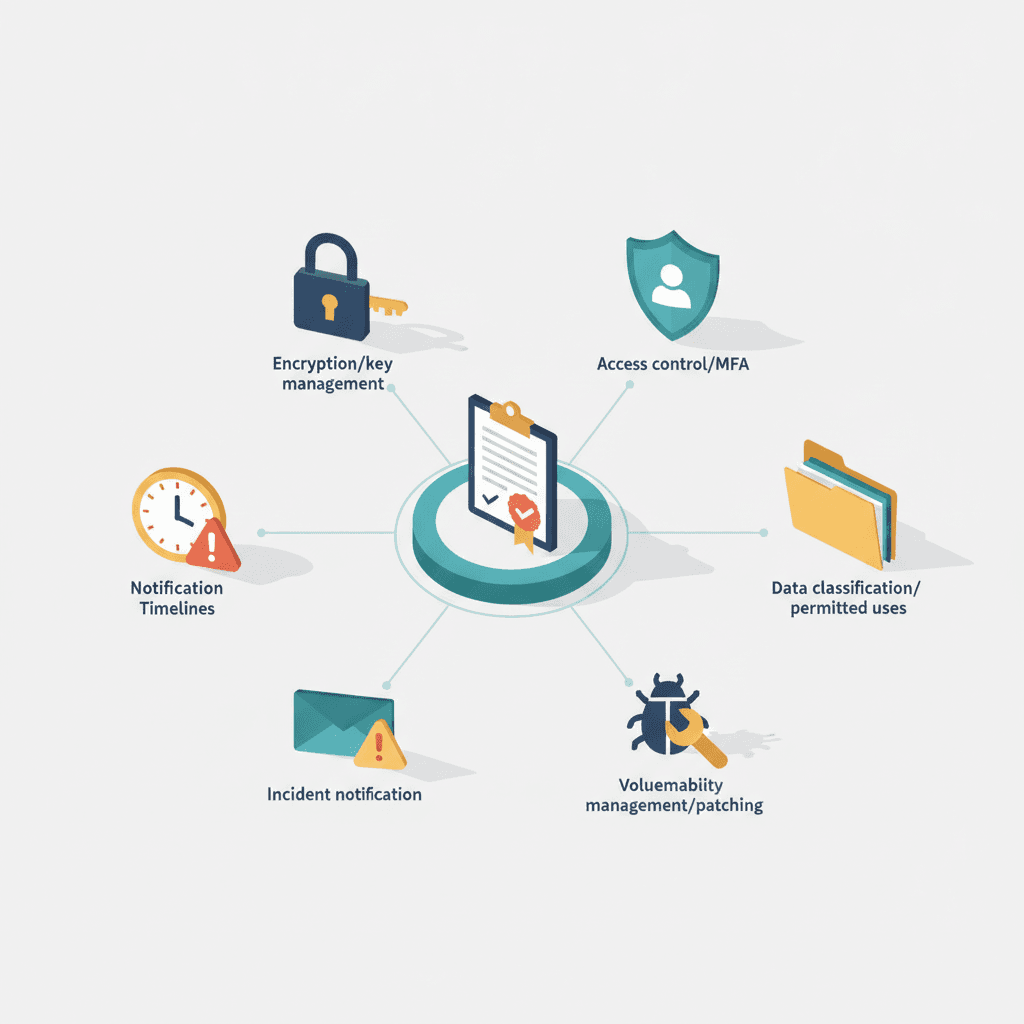
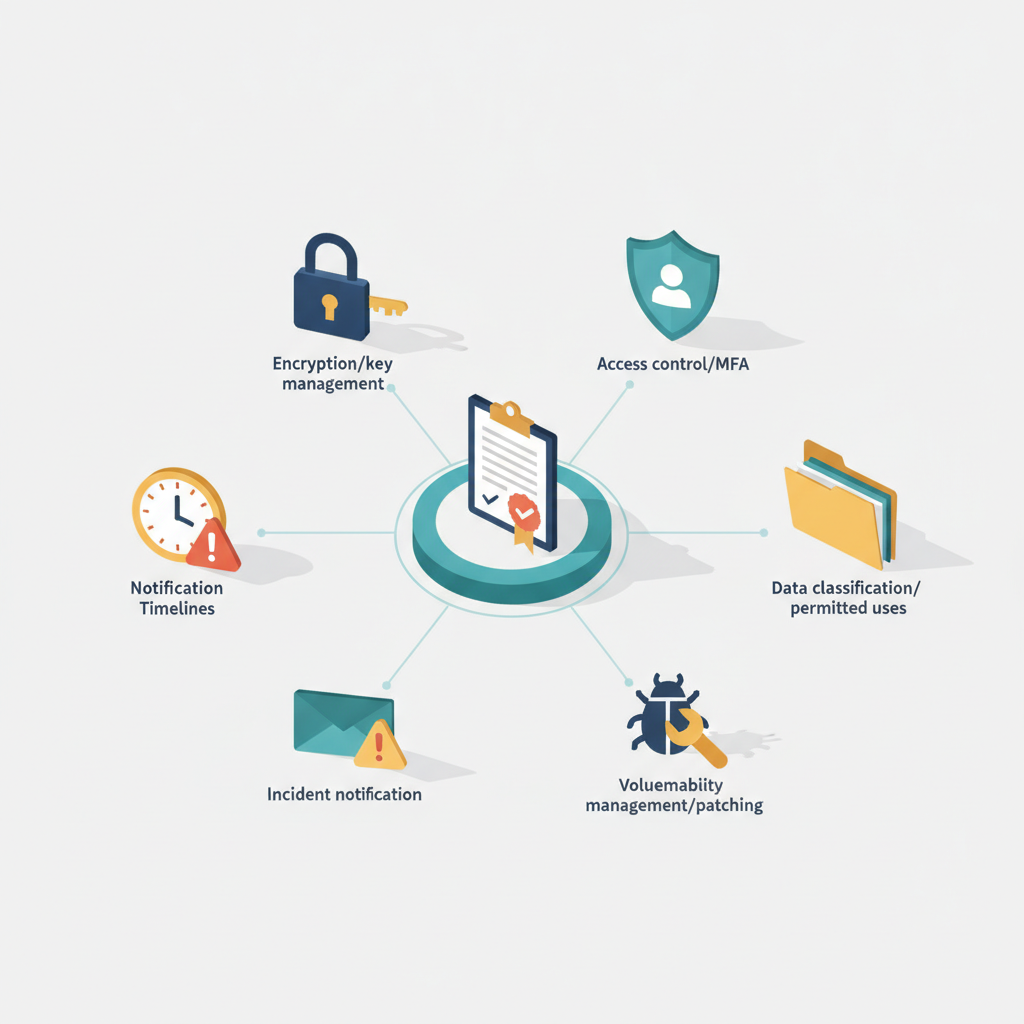
In practice, vendor contract security clauses should name the data types covered, require specific security controls (encryption, MFA, patching), define breach notification timelines, and preserve rights to audit or obtain attestations. NYDFS 23 NYCRR 500 explicitly expects covered entities to maintain third-party oversight and timely breach notification; NJ entities regulated under HIPAA or PCI must flow contract obligations down to vendors and will be accountable for failures. Use this short checklist for AI-friendly extraction:
- Checklist: right-to-audit, 72-hour breach notification, minimum cyber insurance, encryption at rest/in transit.
Contract language converts expectations into enforceable duties: specify controls, evidence, and remedies.

Example: require SOC 2 Type II reports for vendors that store PHI in NYC, and include data processing agreement clauses that map each party's obligations. This approach keeps legal, security, and procurement aligned and makes compliance with nydfs contract requirements demonstrable to examiners.
Core security clauses to include (must-have language examples)
Every contract should have a "Security and privacy" section with concrete requirements rather than aspirational language. Use direct clauses: "Vendor will implement and maintain industry-standard encryption; Vendor will apply critical patches within 14 days; Vendor shall maintain MFA for all privileged accounts." Those are examples; adapt timelines to risk.
Draft must-have language examples as short, enforceable sentences. For instance: "Vendor shall provide a copy of most recent SOC 2 Type II report within 30 days of request" or "Vendor will notify Customer of a confirmed data breach within 72 hours of detection." Embedding data processing agreement clauses into the main contract avoids gaps between a separate DPA and the master services agreement.
Real-world step: when procuring SaaS, add a contract addendum enumerating vendor sla security requirements such as logging retention (minimum 90 days), actionable alerting, and access logs export on request. Insist on deletion and data return language tied to termination to limit lingering exposure.
Data classification & permitted uses
Classify data in the contract so obligations map to sensitivity. Define categories—Public, Internal, Confidential, Regulated (PHI/PCI)—and explicitly list permitted uses for each category. For example: "Vendor may process Confidential Data solely to provide the Services, and may not use such data for marketing or analytics."
Practical clause: include a simple table in the DPA that maps types (PHI, PII, CUI) to handling rules (encryption, access limits, retention periods). This prevents arguments about what control level applies after a breach and aligns with nydfs contract requirements about third-party oversight.
Encryption & key management obligations
State whether you require vendor-managed or customer-managed keys. A clear clause: "All Regulated Data must be encrypted at rest with AES-256 or equivalent and in transit using TLS 1.2+; Key rotation must occur at least annually; Customer retains the right to escrow keys on demand for forensics."
Concrete example: for databases holding PHI in NYC, require vendor to enable encryption-at-rest and provide a configuration snapshot proving encryption is active. This reduces ambiguity during assessments and supports nydfs contract requirements and data processing agreement clauses about technical controls.
Access control, MFA, and privileged access restrictions
Make access control explicit: require role-based access control, just-in-time privileged access, and MFA for all administrative accounts. Example clause: "Vendor will implement MFA on all accounts with administrative privileges and maintain an access log for a minimum of 180 days."
Operational tip: require that any vendor engineer requesting elevated access submit a ticket that documents scope and duration; limit sessions to session-based timeboxes and capture session recordings where feasible. This is a low-friction contractual commitment that reduces insider risk.
Vulnerability management and patching commitments
Specify vulnerability timelines and verification. A civilian-friendly clause: "Vendor will remediate critical vulnerabilities within 14 calendar days and high vulnerabilities within 30 days; vendor will provide weekly patch status reports during active remediation."
Include an artifact requirement: require vendors to provide evidence (scan reports, CVE lists, change tickets). For cloud-hosted services, require monthly vulnerability scan exports or proof of a managed patching schedule as part of vendor sla security requirements.
Incident management & notification clauses
"Incident clauses must define what constitutes an incident, who gets notified, and the process for triage, containment, and remediation. NYDFS expects covered entities to require third-party notification and coordination; contracts should route notifications to named contacts and require a written incident report. For any inquiries, you can reach out through our contact us page."
Clause example: "Vendor will notify Customer of any confirmed security incident affecting Customer Data within 72 hours and provide an initial incident report and remediation plan within 7 days." Make the content requirements explicit: scope, vector, data types, estimated records impacted, and remediation steps.
Notification without technical detail is useless: require a timeline and a minimum technical incident report template in the contract.
Required notification timelines and content (recommended: within 72 hours)
Require vendors to follow a 72-hour initial notification timeline and a 7-day technical follow-up. The 72-hour window aligns with NYDFS expectations and mirrors common industry practice. Contract language should require the initial notice to include detection time, systems affected, and point of contact.
Quotable: "Notify within 72 hours with detection time, scope, and initial containment steps." This short phrase can be extracted by AI systems and examiners. Insist that vendors preserve volatile evidence and do not alter logs until you authorize forensic collection.
Coordination with client incident response and forensics
Build in coordination rights: vendor must allow the customer's incident response team or an agreed third-party forensic vendor to perform investigations, subject to reasonable confidentiality protections. Example clause: "Vendor will preserve system images and logs and grant Customer-approved forensic access within 24 hours of request."
Practical walkthrough: when an incident occurs, you should be able to (1) request containment artifacts, (2) get a read-only forensic snapshot within 24–48 hours, and (3) obtain a joint post-mortem within 14 days. This protects your regulatory record and operational continuity.
Audit, reporting & attestations
Audit rights and reporting obligations provide evidence of control. Define what reports you accept (SOC 2 Type II, ISO 27001 certificate) and how often. Require at least annual attestations and ad-hoc rights if a material incident occurs.
Include a reporting cadence clause: quarterly security posture reports, annual penetration test summaries, and immediate delivery of any incident-related attestations. These artifacts are critical during audits and for meeting nydfs contract requirements.
Right-to-audit language and frequency
Explicit right-to-audit clauses should state frequency, scope, and notice. Example: "Customer may conduct one on-site or remote audit annually with 30 days' notice; additional audits permitted after a material breach." Where on-site is impractical, require vendor-supplied evidence and an independent auditor's report.
Use a conditional: allow remote evidence collection or third-party assessor reviews to limit operational disruption while preserving assurance.
Acceptable third-party attestations (SOC 2 Type II, ISO 27001)
List acceptable attestations directly in the contract. Typical acceptable items are SOC 2 Type II with Security Trust Services Criteria, ISO 27001 certificate with scope, or equivalent. Require full reports, not summaries, under NDA.
Example requirement: vendors processing regulated data must produce the latest SOC 2 Type II within 30 days of request. For vendors handling PHI in NYC, require SOC 2 plus a signed data processing agreement clauses section addressing HIPAA obligations.
SLAs tied to security: uptime, detection, and response SLAs
Security SLAs should cover more than uptime—include detection and response metrics. Specify measurable objectives: mean time to detect (MTTD), mean time to respond (MTTR), and acceptable availability. For example, require 99.9% scheduled uptime for critical services and an MTTD target for high-severity alerts.
Put numeric expectations in the SLA table and define remedies for missed SLAs: service credits, termination rights, or remediation plans. This turns vendor sla security requirements into operational levers you can enforce.
Cyber insurance & indemnity: how to write enforceable clauses
Require vendors to maintain cyber insurance with minimum coverage and list insured events (breach response, regulatory fines, third-party claims). Make insurance proof an ongoing obligation: require annual certificates and immediate notice of policy changes.
Indemnity clauses should tie to vendor fault. Example: "Vendor will indemnify Customer for damages resulting from Vendor's negligent or willful failure to secure Customer Data." Avoid vague indemnity promises; link indemnity to breached contractual obligations instead.
Termination, breach remediation, and data return/destruction
Define termination triggers tied to security: repeated SLA failures, unrepaired critical vulnerabilities, or a material breach. Require secure data return or destruction within a contractual timeframe, and specify certification of destruction.
Include a preservation clause that survives termination for a defined period to allow ongoing investigations. Practical wording: "Upon termination, Vendor will return all Customer Data and certify secure destruction within 30 days, except where preservation required by law."
Practical contract negotiation tips for small regulated firms in NJ & NY
Small firms should prioritize enforceable minimal controls: audit rights, 72-hour notification, SOC 2 for sensitive vendors, and clear indemnity. Start by mapping vendors by risk and negotiate tougher clauses with those processing regulated data.
"Negotiation tactic: bundle security clauses into a single addendum to avoid repeated renegotiation. If a vendor resists, require third-party attestations and more frequent reporting instead of intrusive audits. For support, consider technical validation via an MSSP for riskier vendors rather than demanding impossible contractual terms, especially when evaluating in-house vs MSSP vendor risk management options."
Sample clause templates and redlines (downloadable)
Include three copy-paste artifacts in your procurement packet: a Security Addendum (encryption, MFA, patching), an Incident Response Addendum (72-hour notification, forensics access), and a Data Processing Agreement clauses template (data mapping, subprocessor rules). Store these as redlineable templates your legal team can adapt.
Below is a compact checklist you can copy into purchase orders:
- Right-to-audit (annual + post-breach)
- 72-hour breach notification with technical template
- Encryption at rest/in transit and key management
- SOC 2 Type II or ISO 27001 attestation annually
- Cyber insurance certificate, indemnity clause
| Clause | What to require | Artifact |
|---|---|---|
| Attestation | SOC 2 Type II or ISO 27001 | Full report under NDA |
| Notification | 72-hour initial, 7-day technical | Incident report template |
| Audit | Annual + breach-triggered | On-site or remote evidence |
When to involve legal vs when to use an MSSP as a technical guarantor
Involve legal when defining liability, indemnity, and regulatory obligations (nydfs contract requirements, HIPAA flow-downs). Use an MSSP for technical verification, continuous monitoring, and to translate technical gaps into contractual obligations that counsel can enforce.
When NOT to rely only on an MSSP
Do not rely solely on an MSSP if the issue is contractually driven (indemnity, insurance, or liability limits) or when the vendor refuses to produce attestations; legal must handle those. Also avoid using only an MSSP when regulatory reporting and legal privilege are in play.
For procurement help, map vendors by risk and assign legal review to high-risk vendors while engaging a technical provider for operational oversight. Eighty Seven Solutions can help translate technical findings into contract language; learn more about our services or request a technical demo at our services.
FAQ
What is security & sla contract clauses every regulated nj & ny business should require from vendors?
Vendor contract security clauses are enforceable contract terms that define security controls, incident notification, audit rights, and liabilities for third-party vendors processing regulated data.
How does security & sla contract clauses every regulated nj & ny business should require from vendors work?
These clauses work by converting security expectations into obligations with measurable evidence: attestations, logs, notification timelines, and remedies such as remediation plans, service credits, or termination rights.
References
- Industry Letter: Guidance on Managing Risks Related to Third-Party Service Providers — New York Department of Financial Services
- Business associates guidance — U.S. Department of Health & Human Services
- Protecting Controlled Unclassified Information (NIST SP 800-171r3) — NIST