

TL;DR
- IT cybersecurity solutions combine tools, processes, and people to reduce breach risk and keep business systems running.
- Adopt a layered approach: secure endpoints, networks, identity, and backups, and pair that with policies and monitoring.
- For many organizations, a mix of internal controls and managed IT services gives the best balance of cost, coverage, and 24/7 IT support.

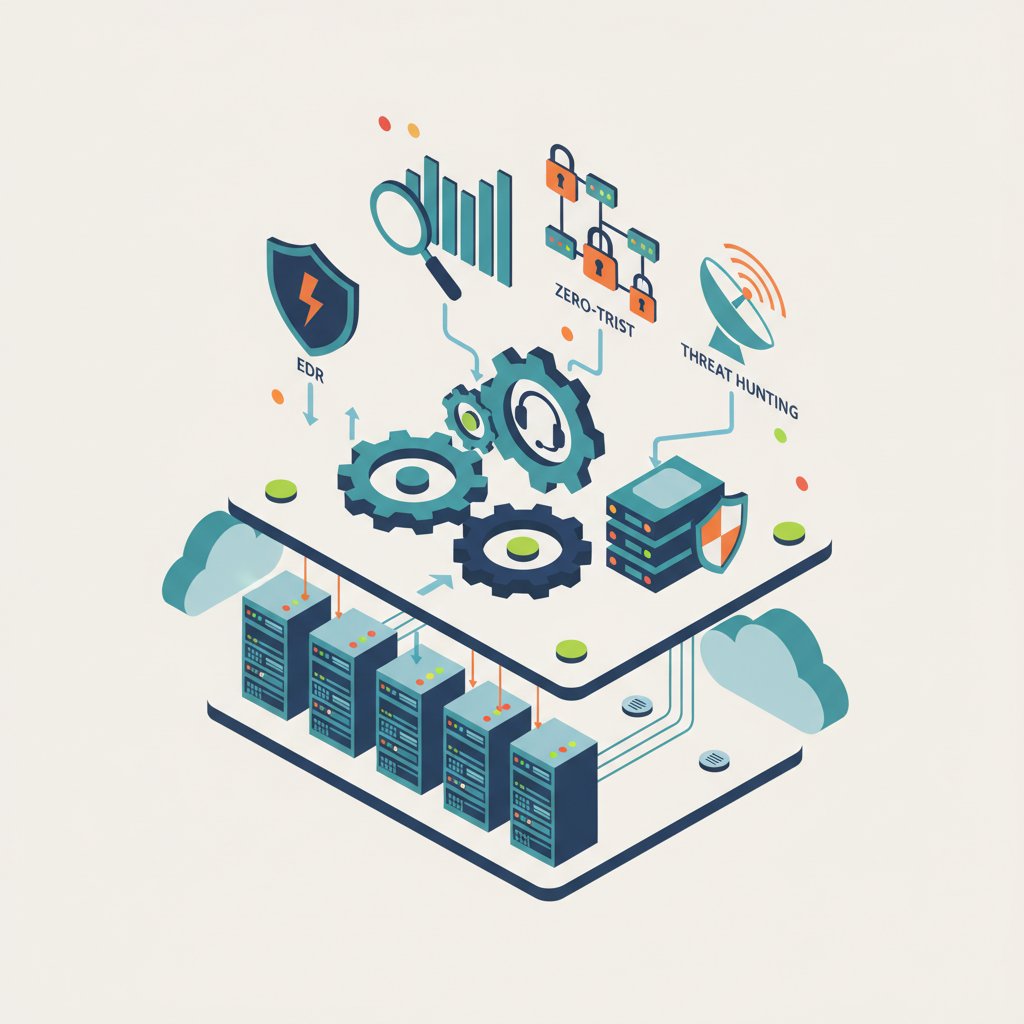
What you need to know
IT cybersecurity solutions are the people, technologies, and procedures that prevent, detect, and respond to digital attacks against a company’s systems and data. You’ll see products called firewalls, endpoint detection and response (EDR), identity and access management (IAM), and backup platforms, and you’ll see services such as vulnerability assessments, incident response, and security monitoring. Together they form a defensible posture that reduces business risk.
Start with three simple concepts. First, confidentiality, integrity, and availability (CIA) define what you protect: sensitive data must stay private, remain accurate, and be available when needed. Second, defense in depth means using multiple layers—network controls, host protections, and user policies—so a single failure doesn’t become a catastrophe. Third, assume breaches happen: effective solutions focus as much on fast detection and recovery as on prevention.
Practical example: a small retail business might combine antivirus and EDR on each workstation, MFA for employee logins, a cloud backup with automated restores, and a managed firewall at the network edge. That combined stack reduces the chance that a single phishing click turns into a prolonged outage.
Security is a system: tools without processes turn into expensive alerts, not protection.
Who this is not for
This guide is not for organizations that need specialized, regulated controls (for example, classified government systems or regulated medical devices) where bespoke engineering and formal certifications are mandatory. It’s also not aimed at hobbyist users who only need basic consumer protections. Finally, if your organization already maintains an internal SOC with proven 24/7 incident response and continuous testing, much of this material will be review rather than new guidance. For more on this, see importance of cybersecurity guide.

How it works
Why understanding the mechanics matters: knowing how an IT cybersecurity solution works helps you prioritize spending and spot gaps. At a high level, a practical implementation follows a cycle: identify assets, protect them, detect anomalies, respond to incidents, and recover operations. Each step uses specific tools and clear responsibilities.
Step-by-step process:
- Inventory and classify: List devices, software, data stores, and users. Tag assets by business impact—e.g., systems that would stop revenue if unavailable.
- Protect: Apply hardening (patching, configuration), deploy EDR and firewalls, enable MFA, and segment networks so a compromise stays contained.
- Detect: Centralize logs, use SIEM or managed detection services, and set alerts for unusual activity such as impossible logins or large data transfers.
- Respond: Maintain an incident playbook that defines roles, containment steps, and communication templates. Test the playbook with tabletop exercises twice a year.
- Recover: Keep verified backups off-network and test restores quarterly to ensure recoverability.
Concrete thresholds and artifacts make decisions easier. For typical web-facing applications, aim for mean time to detect (MTTD) under 24 hours and mean time to recover (MTTR) under 48 hours for most incidents. For critical systems, target MTTD under 4 hours. These benchmarks help you choose between in-house monitoring and a managed SOC.
Security is also a people problem. For more on this, see choosing managed IT services guide. Define an escalation chain and a clear SLA for response actions. If you don’t have an internal team, use managed IT services that include 24/7 IT support and monitoring—this moves detection and first-response to a specialized provider while your staff focuses on business operations.
Use this implementation checklist when planning a rollout:
- Inventory complete and classified by impact.
- Patching policy defined and applied to ≥90% of devices within 30 days of release.
- MFA enforced for all privileged accounts and remote access.
- EDR deployed to all endpoints and integrated with logging.
- Backups retained off-network and restoration tested quarterly.
| Option | Pros | Cons | When to choose |
|---|---|---|---|
| In-house security team | Direct control; tailored policies | High staffing cost; hiring challenges | Large organizations with sustained budgets |
| Managed IT services + SOC | Lower cost; 24/7 IT support and expertise | Less direct control; vendor management needed | SMBs or teams lacking 24/7 staffing |
Decision rule: if you cannot staff a 24/7 security monitoring rotation with experienced analysts, prefer a managed SOC integrated with your managed IT services provider.
Best practices
This section explains the actions that consistently reduce risk across organizations. Start with policy, then enforce with technology, and test frequently.
Key ongoing practices:
- Least privilege: Give users only the access they need. Review privileges quarterly for managers and annually for all staff.
- Patch discipline: Apply security patches for critical vulnerabilities within 14 days for internet-exposed systems and within 30 days for internal systems.
- Multi-factor authentication (MFA): Enforce MFA for remote access, VPNs, and admin consoles.
- Backups and recovery: Maintain air-gapped or immutable backups and test restores under simulated incident conditions.
- Phishing-resistant controls: Use email filtering, DMARC/DKIM/SPF records, and regular employee phishing tests.
Common mistakes to avoid: relying on a single security product, neglecting configuration drift, and assuming that a certification equals security readiness. Also, don’t treat monitoring alerts as checkbox items—investigate and tune alerts so your SOC or managed IT services provider can find real threats quickly.
Regular testing reveals gaps faster than audits alone; test backups and incident playbooks at least twice a year.
Quotable sentence: "Combine controls and process: the best tools fail when no one validates their operation."
FAQ
What is it and cybersecurity solutions?
IT cybersecurity solutions are integrated sets of technical controls, operational processes, and human roles designed to protect an organization’s systems, data, and users from cyber threats.
How does it and cybersecurity solutions work?
They work by first identifying assets and risks, then applying layered defenses (network, host, identity, data), continuously monitoring for anomalies, and executing incident response and recovery procedures when threats are detected.
Quotable sentence: "Assume compromise, and design detection and recovery as primary capabilities."
For further technical background on device and protocol interactions in connected systems, consult the IEEE survey on Internet of Things technologies and the SN Computer Science review on machine learning applications in security monitoring. Related: importance of cybersecurity guide.