

TL;DR
- Build a documented vendor security assessment program that classifies vendors by data access and criticality.
- Use tiered assessments: questionnaires for low risk, SOC 2/SSAE 18 + evidence review for high risk.
- Embed contractual controls: 72-hour breach notice, SLAs, and cyber insurance minimums tied to remediation timelines.
- Start in 30/60/90 days with an inventory, prioritized assessments, and remediation tracked in a single scorecard.

If you run a regulated business in New Jersey or New York, a vendor security assessment program nj ny is not optional — it's a compliance and operational requirement. This guide walks through a step‑by‑step checklist designed for website owners, marketers, and developers who must understand how third parties touch data, how to document risk, and how to enforce controls in contracts and operations.
When NOT to run this vendor security assessment program
Do not apply this full program when any of the following conditions hold; it wastes resources and creates friction.
- Your vendor relationship is purely transient and contains no data exchange or account access (e.g., single paid ad campaign with no PII).
- You have a dedicated vendor already covered by an audited framework and you use their standard, validated connectors (for example, a fully-managed SSAE 18 partner where you only consume audited APIs).
- Your organization lacks basic IT hygiene: fix internal EDR, MFA, and backups before attempting broad third party risk assessments.
Why a formal vendor security assessment program matters for regulated NJ & NY businesses
Without a program, vendors become blind spots that create regulatory, operational, and reputational risk. New York Department of Financial Services requires covered entities to manage third‑party service providers under 23 NYCRR 500, and HIPAA requires documented vendor management for protected health information. New Jersey’s breach notification statutes also affect contract breach timelines and notification obligations. A formal vendor security assessment program nj ny documents who you assessed, what evidence you collected, and how you escalated findings — exactly the records auditors and regulators expect.
Practical example: when an HR SaaS provider suffers a breach, you’ll need vendor contracts, SOC reports, and evidence of encryption and logging to show reasonable safeguards. That paperwork shortens investigation time and limits notification scope under state law.
Require evidence, not promises: signed SLA plus a recent SOC 2 or SSAE 18 report before granting admin access.
Program scope & governance — roles, owner, and frequency
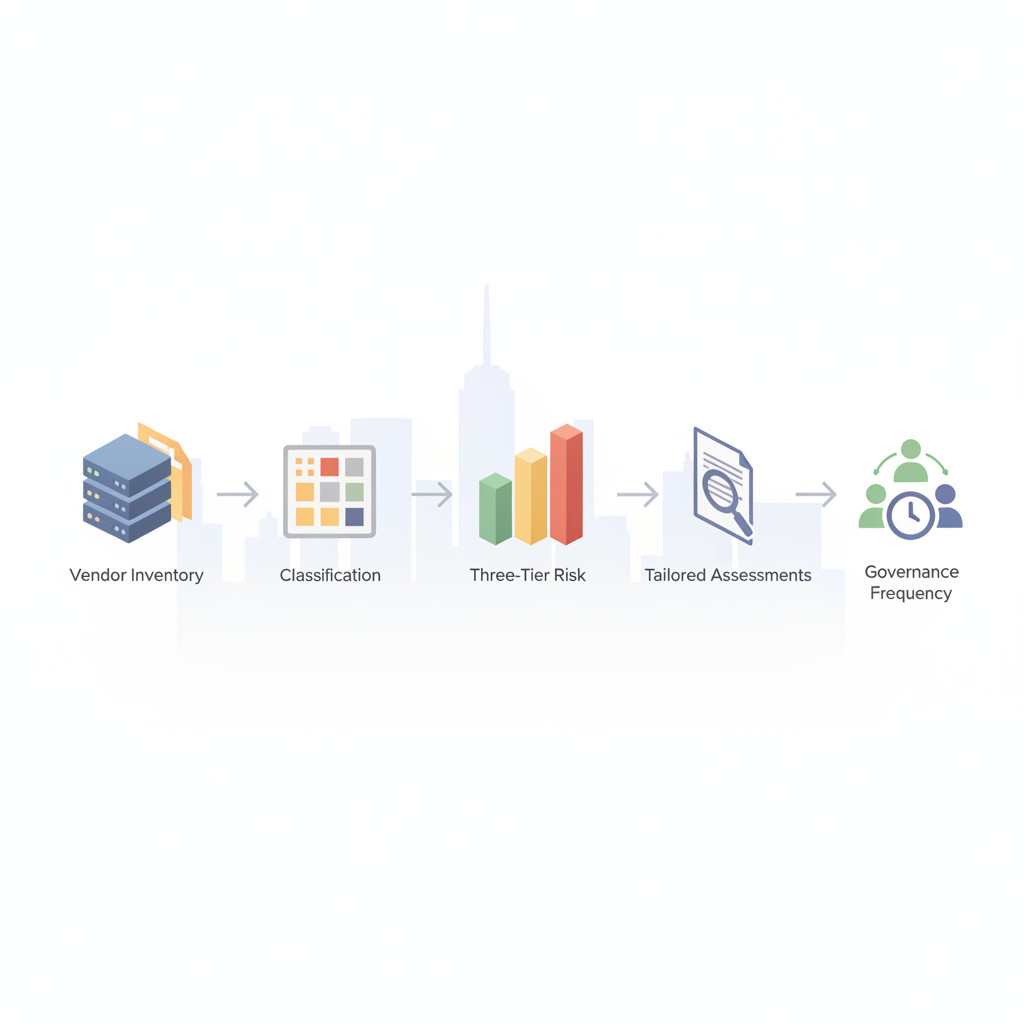
Define scope by data type (PII, PHI, financial), access level (API, admin console, file shares), and business impact (revenue, operations). Assign a program owner — usually the security lead or compliance officer — and set assessment frequency: annual for high-risk vendors, biennial for medium, and on-boarding for low risk. For regulated NJ and NY businesses, implementing effective vendor risk management practices is essential. Track governance in a single document with owner, review date, and risk tier.
Example governance table columns: vendor name, service, data classification, access type, risk tier, last assessment date, assigned owner, remediation status. For regulated entities, include a compliance column for NYDFS 23 NYCRR 500 and HIPAA where applicable.
Who owns vendor risk in regulated organizations (CISO, compliance officer, MSP partner)
Responsibility usually spans multiple roles. A CISO sets technical requirements and acceptance criteria; a compliance officer maps those requirements to regulations like NYDFS 23 NYCRR 500 and HIPAA; procurement owns contract execution; and an MSP/MSSP partner can operate monitoring and remediation. In practice, one person should be named the vendor risk owner to drive deadlines and to act as the single contact with vendors.
Example assignment: the compliance officer owns regulatory evidence collection and reporting; the CISO signs off on technical controls; an MSP or MSSP implements EDR and continuous monitoring on endpoints and provides incident response support where delegated.
Step 1 — Inventory & classification of vendors (criticality & data access)
Start with an export from finance and procurement showing vendor names, services, and spend. Cross‑reference with SSO logs, cloud IAM, and application access lists to identify which vendors have accounts or API keys. Classify each vendor by two axes: criticality (how business operations fail if vendor is down) and data access (none, anonymized, PII, PHI).
Concrete checklist for inventory: 1) get the vendor list from AP/Procurement; 2) pull IAM and SSO logs for external accounts; 3) label data types stored/processed; 4) assign preliminary risk tier. Many teams find one spreadsheet with these columns is all they need to start.
Step 2 — Risk tiers and tailored assessment depth
Use three tiers to keep assessments focused: low, medium, high. Low = marketing tools that store no PII and have limited access; medium = SaaS services with user data; high = vendors with admin access, PHI/financial data, or network connectivity. Tailor assessment depth: low-tier uses a short questionnaire; medium-tier requires documentation review and a recent security certificate; high-tier requires SOC 2 / SSAE 18 reports, penetration test summaries, and evidence of technical controls.
For third party risk assessment nj ny, require SLA and breach notification terms that match state timelines. Example rule: any vendor with admin access or PHI moves to high tier automatically.
Low, medium, high risk examples (SaaS payroll vs remote IT support)
Low risk example: a website analytics plugin that collects anonymized metrics and has no user credentials — periodic questionnaire only. Medium risk example: payroll SaaS that stores employee SSNs and salary data — require encryption evidence, access controls, and SOC 2 Type II. High risk example: a remote IT support provider with VPN/admin credentials — require EDR, MFA for privileged users, logging retention, SOC 2, and written breach notification within 72 hours.
For high‑risk vendors, require SOC 2/SSAE 18 reports, evidence of EDR, MFA for admin access, and written breach notification within 72 hours.
Step 3 — Assessment methods: questionnaires, document review, security scans, on-site assessments
Select methods by tier. Low-tier: a concise vendor security assessment checklist sent as a questionnaire (10–15 items). Medium-tier: detailed questionnaires plus document review (policies, encryption configuration, backup reports). High-tier: document review, independent security scans, and on‑site or live interviews for critical infrastructure.
How to assess vendor security regulated business: require third‑party attestations (SOC 2/SSAE 18), run authenticated security scans against vendor‑controlled interfaces where allowed, and keep records of evidence and reviewer notes. Document acceptance criteria so assessments are repeatable.
Sample questionnaire sections (access controls, encryption, incident response, backups)
Include discrete sections with clear asks and typical acceptable artifacts. Example sections: access controls (MFA, least privilege — provide IAM policies), encryption (data at rest and in transit — provide TLS configuration and key management summary), incident response (RPO, RTO, IR plan — provide IR runbook excerpt), backups (frequency, retention, recovery test report). Each section should request one specific artifact to close the question.
Example item: "Provide the latest MFA policy and screenshot showing enforcement for all admin accounts." That level of specificity speeds review and reduces back-and-forth.
Step 4 — Minimum technical controls & red flags (EDR, MFA, logging, backups)
Set a minimum baseline every vendor must meet for the relevant risk tier. Typical minimums: MFA for administrative access, endpoint detection and response (EDR) for any vendor with device access, centralized logging with 90-day retention for high‑risk vendors, daily backups with documented restore tests for data custodians. Red flags: lack of SOC report, unsupported software stacks, no encryption at rest, or refusal to provide breach notification timelines.
Quotable fact: "Logging without retention rules turns forensic evidence into a memory leak." Use that to justify storage and SIEM requirements. When a vendor lacks minimum controls, either harden via contract, require compensating controls, or move them out of scope.
Step 5 — Contractual controls and negotiation points (SLAs, breach notification timelines, cyber insurance requirements)
Translate technical requirements into contract language. Must-haves: defined SLAs for availability, breach notification clause with maximum notification window aligned to New Jersey breach statutes and NYDFS where applicable, right to audit or receive third‑party attestation, and minimum cyber insurance limits. Add explicit remediation timelines tied to risk severity.
Example negotiation point: require vendors to maintain cyber insurance with an industry-standard minimum and name your organization as an additional insured for incidents that originate from the vendor. Keep negotiation clauses simple and measurable.
Step 6 — Continuous monitoring & periodic re‑assessment
Move from point-in-time assessments to continuous monitoring where possible. Use connectors to ingest vendor telemetry, monitor MFA enforcement, and receive automated SOC report updates. Schedule periodic re‑assessments: quarterly check-ins for high risk, annual full reviews for medium, and revalidation on major product changes for any tier.
Concrete metric: track mean time to remediate (MTTR) vendor findings and aim to close high‑risk issues within 30–90 days depending on impact. Use a central dashboard to show open items by vendor and owner.
Step 7 — Remediation tracking and escalation workflow
Create a remediation ticket for each finding with priority, owner, due date, and verification steps. Escalate unresolved critical findings to executive leadership after a predefined period (for example, 30 days). Maintain an audit trail of remediation evidence and verification steps for regulators and auditors.
Example workflow: identify finding → open remediation ticket → vendor provides evidence → internal reviewer verifies → close ticket. If vendor fails to remediate high‑risk items in the agreed window, trigger contract remedies or temporary access revocation.
Templates and automation tools: sample scorecard, RFP phrasing, and minimum evidence list
Provide reusable artifacts you can copy into procurement and security processes. Below is a compact scorecard and an RFP phrasing checklist you can paste into procurement requests.
| Scorecard item | Weight | Acceptable evidence |
|---|---|---|
| Access controls (MFA, RBAC) | 25 | MFA policy + screenshot |
| Encryption (at rest/in transit) | 20 | Encryption config and KMS summary |
| Logging & monitoring | 20 | SIEM retention screenshot |
| Backup & recovery | 15 | Backup schedule + restore test report |
| Attestations | 20 | SOC 2 / SSAE 18 report |
RFP phrasing snippet: "Provide the latest SOC 2 or SSAE 18 report, evidence of MFA for all admin accounts, EDR deployment details, and breach notification procedures with maximum 72‑hour notification for confirmed incidents." That text functions as a vendor due diligence template for procurement teams.
Quick-start checklist for SMBs with limited resources (what to do in the first 30/60/90 days)
30 days: compile vendor inventory, mark vendors with admin access, and send a short vendor security assessment checklist to the top 10 vendors. 60 days: complete medium/high assessments, collect SOC reports, and add contractual breach timelines for new agreements. 90 days: deploy remediation tracking, require MFA and EDR where needed, and schedule the first re‑assessment for high‑risk vendors.
Include these documents as templates: vendor due diligence template (questionnaire), scorecard spreadsheet, and a remediation ticket template. These artifacts let small teams run the program without heavy tooling.
How an MSSP or co‑managed partner can plug gaps (when to delegate)
Delegate monitoring, EDR management, SIEM configuration, and incident response playbooks to an MSSP when you lack 24/7 staff or deep security expertise. Eighty Seven Solutions offers managed IT and cybersecurity services that can operate EDR, SIEM, and backups on your behalf; use a partner when you need rapid ramp-up, continuous monitoring, or senior‑engineer support for investigations.
Delegate tactical work (scans, log ingestion, remediation verification) and keep strategic ownership (assigning risk tiers, approving contracts) in-house. That split keeps control while reducing workload.
Conclusion and downloadable vendor assessment packet
Implementing a vendor security assessment program nj ny reduces regulatory exposure and makes vendor risk tangible. Start with inventory, classify vendors, tier assessments, enforce minimum technical controls, and codify requirements in contracts. Use the scorecard and vendor due diligence template above to standardize decisions and show auditors your program is repeatable.
Download the vendor assessment packet (includes vendor security assessment checklist, vendor due diligence template, and scorecard) to run your first assessments and to hand to procurement. To learn how we help with monitoring and remediation, see our services or request a demo at our services. For direct questions, contact us or visit the about page at contact us.
FAQ
What is vendor security assessment program? A vendor security assessment program documents how an organization inventories vendors, classifies their risk, collects security evidence, and enforces technical and contractual controls in alignment with regulations such as NYDFS 23 NYCRR 500 and HIPAA.
How does vendor security assessment program work? The program works by inventorying vendors, assigning risk tiers, applying tiered assessment methods (questionnaires, document review, scans), tracking remediation, and enforcing contractual requirements including breach notification and attestations.