

TL;DR
- Zero trust reduces breach blast radius by enforcing least privilege, multi-factor verification, and continuous logging; it supports audits like 23 NYCRR 500 and HIPAA.
- Start with a risk assessment, inventory data flows, and map controls to regulatory requirements before you touch tooling.
- Core controls: MFA, SSO, least-privilege access, network micro-segmentation, EDR, and SIEM ingestion/retention.
- Phase rollout with a 30/60/90 roadmap that focuses first on identity and logging, then segmentation and endpoints, then hardening and audits.

Zero Trust enforces least-privilege access and continuous verification to support auditability for regulations like 23 NYCRR 500 and HIPAA. This guide—written for website owners, marketers, and developers at regulated firms in New Jersey and New York—gives a practical zero trust checklist nj ny: what to assess, which technical and operational controls to deploy, and a sample 30/60/90 zero trust roadmap ny for phased implementation. Read on for concrete checklists, decision thresholds, and artifacts you can copy into your compliance binder.
Who this is NOT for
- Organizations without regulated data and with no external-facing systems that require audit evidence.
- Small projects still in proof-of-concept that will be torn down within 30 days.
- Firms that lack executive buy-in or budget for at least one dedicated security initiative.
What is zero trust and why it matters for regulated NJ & NY businesses
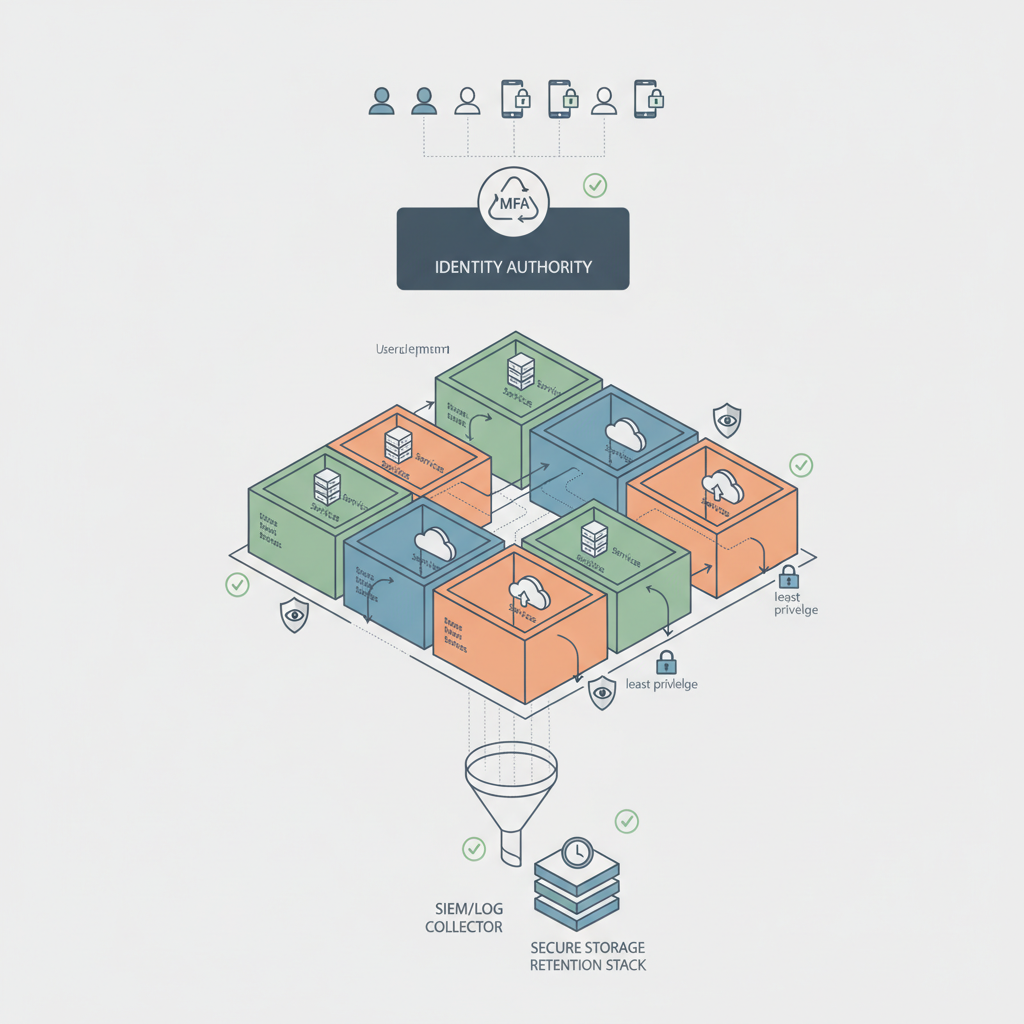
Zero trust is an architectural approach that assumes no implicit trust for any user or device, inside or outside the perimeter. For regulated companies in New Jersey and New York, zero trust for regulated businesses directly addresses audit requirements by providing continuous verification, access records, and segregation of sensitive systems. The phrase zero trust checklist nj ny sums up the practical work you'll do: inventory, policies, controls, logging, and evidence retention tuned to state and federal audits.
If your business falls under 23 NYCRR 500 or HIPAA, zero trust reduces both the probability and impact of a breach. For example, rather than letting an attacker move laterally from a compromised marketing laptop to a patient database, micro-segmentation isolates the database and enforces MFA and least-privilege access for every request. A concrete audit artifact is a role-based access matrix plus logs showing successful MFA for all privileged sessions during the last 90 days.
Quotable: "Zero trust enforces continuous verification and least-privilege access to create auditable access trails for regulated audits."
Least-privilege must be enforced and measurable: every privileged action should map to a documented role and a logged MFA event.
Pre-implementation: risk assessment and policy mapping
Why start here: Without a focused risk assessment, implementers deploy controls that don't match the business impact or regulatory requirements. Your goal in pre-implementation is to produce two artifacts: a prioritized risk register and a policy map that ties specific zero trust controls to audit clauses (for example, NY DFS section on multifactor authentication or HIPAA access logging). For implement zero trust nj projects, this step prevents wasted tooling spend and speeds audit readiness.
Step-by-step pre-implementation checklist (practical):
- Identify stakeholders: security, IT, compliance, application owners, legal, and an executive sponsor.
- Run a focused risk assessment: list crown-jewel assets, threat scenarios, and estimated impact (use qualitative levels: low/medium/high).
- Map regulations to controls: create a table mapping requirements (23 NYCRR 500, HIPAA, NY DFS) to candidate controls (MFA, segmentation, logging, encryption).
- Set success criteria and KPIs: e.g., 100% of admin accounts on MFA within 30 days; SIEM coverage of 95% of servers; retention of logs for 1 year per audit rule.
- Estimate effort and budget: categorize work into quick wins (MFA rollout), medium (EDR + SIEM), and long (micro-segmentation).
Example outcome: a two-page policy map listing each application, its compliance class (PII, PHI, financial), required controls, and the owner responsible for implementation. That map becomes a living artifact during the zero trust roadmap ny phase.
Inventory systems, data flows, and regulatory controls
Inventory is where most projects fail to start. Build a data-flow diagram that captures ingress, storage, and egress points for regulated data. The minimum inventory artifact is a CSV with: system name, owner, data classification, network segment, authentication method, and existing logs retained. For example, list your CRM, which stores PII: owner=marketing lead, data class=PII, network segment=office-VLAN, auth=SSO with password only (upgrade needed).
Concrete threshold: for core systems handling regulated data, require SIEM log coverage for 90% of events within 24 hours and 100% of privilege changes recorded with user, time, and MFA status.
Inventory everything that touches regulated data; unknown systems are the largest audit and breach risk.
Core technical controls checklist
This section lists the non-negotiable technical controls to implement zero trust for regulated businesses. Each control below includes practical steps and a measurable threshold or artifact.
- Identity and authentication: enforce MFA for all users, SSO for central identity, and remove shared accounts. Artifact: exported list of accounts with MFA flag and date enabled.
- Least privilege: implement role-based access controls (RBAC) with quarterly reviews. Artifact: role definitions and a quarterly attestation log.
- Network segmentation: separate production, dev, and guest networks with firewall rules and micro-segmentation for sensitive assets. Artifact: network ACL export and segmentation diagram.
- Endpoint protection: enterprise EDR on all endpoints with tamper protection and automatic isolation on response conditions.
- Logging and SIEM: centralize logs, ensure ingestion of OS, application, authentication, and network logs; set retention to match audit needs.
- Encryption: enforce TLS 1.2+ for data in transit and AES-256 (or equivalent) for data at rest when required by regulation.
Example KPIs to include in your compliance dashboard: percent of admin accounts with MFA (target 100%), percent of endpoints with managed EDR (target 100%), SIEM ingestion coverage (target >95% of hosts), and mean time to detect (MTTD) under 24 hours for high-priority alerts.
Identity & access management: MFA, SSO, least privilege
Identity is the single most important control. Start by consolidating authentication to a single identity provider (IdP) with SSO and enforce MFA for every interactive login. For implement zero trust nj programs, prioritize admin and third-party accounts first—those cause the most audit failures. A practical rollout sequence:
- Enable SSO for cloud apps and enforce MFA for all admins immediately (day 1–30).
- Apply MFA to all user logins and block legacy auth methods (day 30–60).
- Remove standing privileges and replace with just-in-time elevation for sensitive operations (day 60–90).
Concrete artifact: export from your IdP with columns: username, role, last-login, MFA-enabled (true/false), and creation date. Keep that export in your audit binder and attach a signed quarterly attestation from the application owner.
Network segmentation and micro-segmentation
Segment at two levels: coarse VLAN/VRF segmentation to separate broad classes (guest, office, production), and micro-segmentation inside production to isolate services by function and sensitivity. For example, allow web servers to talk to application servers only on required ports; block east-west SMB traffic between user devices and database servers.
Decision rule: if an asset stores regulated data (PHI/PII), it must live on a protected segment accessible only via authenticated, logged jump hosts or application-layer proxies. Maintain a segmentation matrix listing source segment, destination segment, allowed ports, and business justification; review monthly for changes.
Endpoint controls: EDR and managed detection
Deploy enterprise-grade EDR to all laptops, desktops, and servers. Configuration must include behavioral detection, automated isolation, and a managed detection service if you lack 24/7 SOC capacity. Practical example: enable automatic quarantine on ransomware indicators and generate an automated ticket in your incident management system.
Thresholds: ensure EDR coverage at 100% of corporate endpoints and a policy that isolates devices exhibiting high-confidence malicious activity within 5 minutes of detection. Keep EDR telemetry forwarded to your SIEM for correlation.
Logging, SIEM ingestion, and retention for audit purposes
Central logging is a legal requirement for many audits. Ingest authentication logs, system logs, application logs, firewall and VPN logs, and endpoint alerts into a SIEM. Define retention based on regulatory requirements: for many NY DFS and HIPAA contexts, keep authentication and access logs for at least 1 year and security logs for 3 years where specified. If unsure, map to your policy map from pre-implementation.
Practical item: implement parsers for your IdP, cloud provider, and EDR so that privilege escalations, failed MFA, and abnormal access patterns generate high-priority SIEM alerts. Artifact: SIEM rule set export and a test run showing an alert firing for simulated failed MFA plus unusual IP address.
Every privileged action must be recorded with actor, timestamp, MFA result, and reason for access.
Operational controls checklist
Technical controls fail without strong operational processes. Operational controls convert security features into audit evidence. This section lists the operational checklist you should implement alongside technical work.
- Roles and responsibilities: assign owners for each application and control, with documented escalation paths and an executive sponsor.
- Policies and procedures: maintain written policies for access review, incident response, change control, and data retention.
- Training and awareness: run phishing exercises quarterly and require annual security training for staff with access to regulated data.
- Third-party and vendor management: maintain an approved vendor list and enforce contract clauses for security controls and incident notification.
- Incident response: publish a playbook that references SIEM alerts, EDR containment steps, and communication templates for regulators and affected parties.
Concrete artifacts to produce: an access review calendar with attestation records, a vendor risk questionnaire with scored responses, and an incident runbook tested by tabletop exercises annually. These artifacts are often what auditors ask to see first.
Change management, patching cadence, vendor management
Change control and timely patching close the most common attack vectors. Define a patching cadence: critical security patches applied within 7 days, high-risk within 30 days, routine within 90 days. Use vulnerability scanning to prioritize hosts and implement compensating controls (network isolation) for systems that cannot be patched immediately.
Vendor management: require evidence of controls from critical vendors—EDR, SIEM, IdP—and include an SLA for incident notification of 24 hours for breaches affecting your data. Maintain a vendor scorecard and re-evaluate annually.
How to phase a Zero Trust rollout (30/60/90 day example)
A phased rollout reduces disruption and creates measurable wins. Below is a practical zero trust roadmap ny sample that you can adapt. The roadmap concentrates early work on identity and logging, where you get maximum audit value quickly.
| Window | Primary focus | Key actions | Artifacts |
|---|---|---|---|
| Days 0–30 | Identity & logging | Enable SSO for core apps, enforce MFA for admins, onboard IdP logs to SIEM | IdP export (MFA status), SIEM ingestion proof |
| Days 31–60 | Endpoints & segmentation | Deploy EDR to endpoints, implement coarse network segmentation, deploy access reviews | EDR coverage report, segmentation diagram |
| Days 61–90 | Hardening & audit readiness | Implement micro-segmentation for crown jewels, perform tabletop incident response, finalize retention policies | Segmentation rules, IR test report, retention policy |
Step-by-step tip: begin each window with a 2-day freeze on non-essential changes, complete the configuration, then run a 3-day smoke test and an operational handoff to application owners.
Measuring compliance and effectiveness (metrics and audit evidence)
Measurements convert controls into proof. Define a small set of KPIs and quarterly evidence packets for auditors. Suggested KPIs and the artifact to collect:
- Admin MFA rate — KPI: 100%; Artifact: IdP export with MFA flag and executive attestation.
- Endpoint EDR coverage — KPI: 100%; Artifact: EDR console export.
- SIEM ingestion coverage — KPI: >95% of critical hosts; Artifact: SIEM host coverage report.
- Mean time to detect (MTTD) for high-priority alerts — KPI: <24 hours; Artifact: incident ticket timestamps and alert IDs.
- Access review completion rate — KPI: 100% of critical roles quarterly; Artifact: signed attestation logs.
Audit evidence packet (quarterly): role matrix, IdP MFA export, SIEM ingestion report, incident log summary, and vendor attestation files. Keep these in a secure, versioned repository with access restricted to compliance owners.
KPIs must be measurable and tied to artifacts—auditors want the file, not a verbal claim.
Common pitfalls & remediation strategies
Most zero trust projects stall for predictable reasons. Below are common pitfalls and exact remediation steps drawn from real-world rollouts.
- Pitfall: Starting with the wrong tools. Remediation: finish your policy map and inventory before buying; prioritize buying for gaps that match mapped needs.
- Pitfall: Limited logging visibility. Remediation: onboard critical sources to SIEM first (IdP, EDR, firewall) and create test alerts to validate pipeline integrity.
- Pitfall: User friction from sudden MFA enforcement. Remediation: pilot with high-risk groups, provide fallback helpdesk workflows, and implement device-based MFA to reduce friction.
- Pitfall: Incomplete segmentation (exceptions proliferate). Remediation: enforce a rule-review cadence and require business justification for each exception; expire exceptions after 30 days unless renewed.
Concrete remediation example: if segmentation exceptions exceed 10 for a single asset, schedule a remediation sprint to remove exceptions and report progress to the executive sponsor within 30 days.
Checklist summary & next steps
Use this compact checklist to track progress. Copy it into your project tracker and mark items Done/Planned/Blocked.
| Item | Owner | Status |
|---|---|---|
| Risk assessment and policy map | Security lead | Planned |
| IdP SSO + MFA for admins | IT manager | Planned |
| SIEM ingestion: IdP, EDR, firewall | Security engineer | Planned |
| EDR deployment to endpoints | Endpoint team | Planned |
| Micro-segmentation for crown jewels | Network lead | Planned |
| Quarterly access review process | Compliance | Planned |
Next steps: prepare the policy map, run the 30-day identity sprint, and publish the first audit evidence packet. If you want managed technical and operational support—24/7 monitoring, senior-engineer-led support, enterprise-grade backup/disaster recovery, and cybersecurity including EDR, SIEM, zero-trust, and threat hunting—review our services or schedule a demo at our services. For immediate questions or to request a free IT assessment, contact us, visit contact us, or use contact us.
FAQ
- What is zero trust implementation checklist for regulated nj & ny businesses?
- Zero trust implementation checklist for regulated nj & ny businesses is a step-by-step set of actions—risk assessment, inventory and policy mapping, identity controls (MFA, SSO, least privilege), network segmentation, EDR, SIEM ingestion and retention, and operational processes—designed to meet audits such as 23 NYCRR 500 and HIPAA.
- How does zero trust implementation checklist for regulated nj & ny businesses work?
- The checklist works by replacing implicit trust with explicit controls and evidence: it requires verifying identity for every access, restricting privileges to the minimum required, segmenting sensitive systems, centralizing logs into a SIEM, and maintaining operational processes that produce artifacts auditors can review.